
For small and medium-sized enterprises (SMEs) in Ireland, growth is not just about attracting more customers or increasing sales. It is also about managing rising workloads, controlling operating costs and delivering consistent service without placing additional pressure on limited resources. As businesses navigate these challenges, business process automation is emerging as a practical way to improve efficiency and build a stronger foundation for long-term growth.
From processing invoices and responding to customer enquiries to managing inventory and tracking sales, everyday administrative tasks can consume hours that employees could otherwise spend on more valuable work. When these activities rely on manual data entry, repeated emails and disconnected software, delays and errors can affect both productivity and profitability.
Business Process Automation (BPA) uses digital tools to simplify repetitive tasks, connect workflows and reduce unnecessary manual intervention. For Irish SMEs, its real value lies in making existing operations work better, helping businesses handle more work without increasing costs at the same pace.
The Business Case for Automation in Ireland
Smaller businesses often operate with lean teams, where employees manage several responsibilities simultaneously. As a company expands, these arrangements can become difficult to sustain. More orders, invoices and customer requests can increase administrative pressure, leaving less time for business development and customer relationships.
Automation can help address this challenge by assigning routine tasks to digital workflows. For example, an incoming invoice can be routed for approval automatically, a new customer enquiry can be directed to the appropriate employee, and a sales representative can receive reminders to follow up with potential customers.
These improvements can reduce delays, create more consistent processes and give business owners a clearer picture of outstanding work. They may also allow a company to manage higher transaction volumes without immediately recruiting additional administrative staff.
However, automation does not automatically translate into higher profits. The outcome depends on the quality of implementation, the cost of the technology and whether the chosen process genuinely needs improvement.
For SMEs, the priority should be to solve specific operational problems rather than invest in technology simply because it is becoming popular.
Finance and Accounting: Improving Cash-Flow Management
Financial administration is one of the most useful starting points for business process automation. Invoice processing, expense management, payment reminders and bank reconciliation often involve repetitive tasks that can be streamlined through accounting software.
Automated systems can extract information from invoices, organise approval requests and import compatible transaction data into accounting platforms. This reduces repeated data entry and allows employees to concentrate on reviewing discrepancies instead of processing every document manually.
Better visibility into unpaid invoices and upcoming expenses can also support cash-flow planning. For small businesses, delayed customer payments can create difficulties in meeting supplier obligations, paying employees and covering routine operating expenses. Faster processing and timely reminders can help business owners identify overdue accounts earlier.
Financial automation must nevertheless include safeguards. High-value payments, changes to supplier bank details and unusual transactions should receive appropriate human review. Access restrictions, approval limits and reliable audit records are essential to reducing the risk of fraud and costly mistakes.
The objective is to make financial administration more efficient without weakening financial control.
Customer Service: Faster Responses and Better Experiences
Customer expectations are changing, with many people seeking quick responses, convenient bookings and timely updates about products or services. For SMEs with small customer-service teams, responding individually to every routine enquiry can become difficult during busy periods.
Automation can acknowledge incoming messages, create support tickets, schedule appointments and send reminders. AI-powered assistants can also help answer frequently asked questions using approved business information, while complicated enquiries can be transferred to employees.
These tools can be particularly useful for retailers, hospitality businesses, professional service providers and maintenance companies that experience fluctuations in customer demand.
The commercial benefits extend beyond saving time. Faster responses can reduce missed enquiries, improve customer satisfaction and help businesses maintain relationships with existing clients.
Nevertheless, technology should not eliminate the human element of customer service. Complaints, sensitive matters and unusual requests often require judgement, empathy and personal attention. Businesses should make it straightforward for customers to speak with a real person when automated assistance is insufficient.
Sales and Marketing: Turning Enquiries into Revenue
For growing businesses, a missed follow-up can mean a lost sale. When customer information is scattered across emails, spreadsheets and individual employees’ records, it becomes harder to track opportunities and maintain consistent communication.
Customer relationship management systems can bring this information together and automate selected sales activities. Incoming enquiries can be assigned to employees, follow-up reminders can be scheduled, and sales teams can track the progress of potential customers.
Marketing automation can also support customer segmentation, scheduled email campaigns and routine communications. Used carefully, these tools help businesses maintain contact with customers without requiring employees to manage every activity manually.
For Irish SMEs operating with limited marketing budgets, a more organised sales process can improve the use of existing resources. Businesses can identify which enquiries convert into sales, which campaigns generate meaningful responses and where potential customers are dropping out of the buying process.
However, automated marketing must remain relevant and respectful of customers’ preferences. Accurate records, appropriate consent and compliance with applicable data-protection and electronic-marketing requirements are essential for maintaining trust.
Connecting Digital Systems to Reduce Repeated Work
Many small businesses use separate applications for accounting, inventory, online orders, sales and internal communication. When these systems cannot exchange information effectively, employees may need to enter the same details several times.
This duplication wastes time and increases the risk of inconsistent records. It can also make it difficult for managers to obtain a reliable view of sales, stock levels and outstanding payments.
System integration can address this problem by allowing compatible applications to share information. An online order, for example, may update inventory records and trigger an invoice workflow. Customer details entered into a sales system may also become available to the accounting or service team without repeated manual entry.
A connected digital environment can improve reporting, reduce administrative delays and help employees make decisions using more consistent information.
For SMEs, replacing every existing software system is rarely necessary. Connecting a few essential applications may deliver meaningful benefits at a lower cost. Before proceeding, businesses should assess compatibility, data quality, cybersecurity requirements and ongoing maintenance expenses.
Artificial Intelligence Is Expanding the Scope of Automation
Artificial intelligence is creating new opportunities for businesses to automate activities that previously required more manual effort. Depending on the tool and level of supervision, AI can help classify emails, extract information from documents, summarise customer conversations and prepare routine written communications.
Low-code and no-code platforms are also making it easier to build basic workflows without extensive programming knowledge. This can help smaller companies experiment with automation while limiting their dependence on specialised technical resources.
However, more advanced technology is not always the best solution. A business struggling with delayed invoice approvals may benefit more from improving its existing accounting workflow than from adopting a complex AI platform.
SMEs must also consider the risks of inaccurate AI-generated information, unauthorised access and exposure of confidential business or customer data. Sensitive information should only be processed through tools that meet the organisation’s security and compliance requirements.
Human oversight remains essential when automated outputs could affect financial decisions, customer relationships, employees or regulatory obligations.
Skills, Training and Business Support Matter
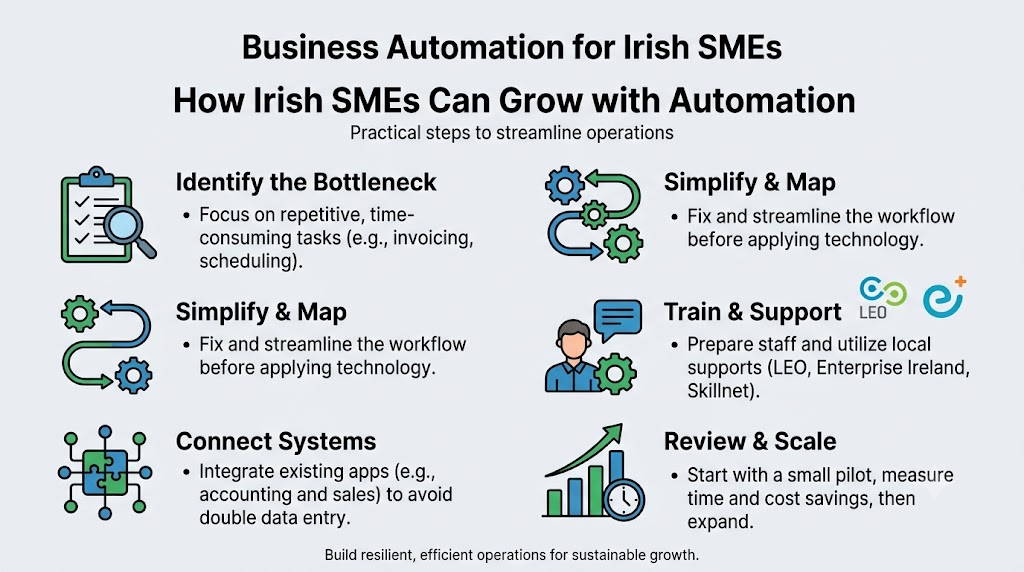
The cost of implementation and limited technical expertise can prevent smaller businesses from adopting automation. Ireland has several business-support and training channels that may help eligible companies strengthen their digital capabilities.
Enterprise Ireland supports qualifying businesses through relevant development and innovation programmes, while Local Enterprise Offices provide advice, training and selected supports for eligible small enterprises. Skillnet Ireland also works with businesses and sector networks to support workforce development.
Available programmes, funding conditions and eligibility criteria can change, so businesses should verify current requirements directly with the relevant organisations before making investment decisions.
Training is equally important. Employees need to understand how automated workflows operate, how to identify errors and when to escalate an issue for human intervention. Involving staff during planning and testing can also reveal practical problems that may otherwise emerge only after implementation.
Automation works best when technology complements employees’ skills rather than being treated as a substitute for effective management and training.
How Irish SMEs Can Introduce Automation Without Overspending
A gradual approach can help businesses control costs and assess whether automation delivers measurable value.
The first step is to identify a recurring problem. Invoice processing, appointment scheduling, stock updates and routine customer enquiries may be suitable starting points if they consume significant time or regularly create delays.
Next, businesses should measure how the existing process performs. Recording the time required, frequency of errors and associated administrative costs creates a baseline against which improvements can be evaluated.
The workflow should then be reviewed before technology is introduced. Automating unnecessary steps can make an inefficient process more complicated rather than more productive.
A limited pilot can help establish whether the selected tool works reliably with existing systems. Employees should receive appropriate training, and clear procedures should be established for handling exceptions, technical failures and sensitive decisions.
Finally, businesses should compare the results with the original baseline. Processing times, error rates, customer response times, subscription charges and staff training costs all provide useful indicators of performance.
Expanding automation to other departments should follow only when the initial implementation demonstrates clear and sustainable benefits.
Measuring the Financial Return on Automation
For business owners, the important question is not how many digital tools they have adopted, but whether those tools improve business performance.
The financial assessment should include implementation expenses, software subscriptions, maintenance, staff training and the time required to manage the new system. These costs should be weighed against reduced administrative effort, fewer errors, faster processing and any improvements in customer retention or revenue.
Time saved is valuable, but its economic benefit depends on how that time is used. If employees can devote more attention to sales, customer support or production, automation may create opportunities for additional growth. If the new system introduces unnecessary complexity or requires extensive manual corrections, the expected gains may not materialise.
Regular reviews can help businesses identify problems early, adjust workflows and determine whether the investment continues to justify its cost.
Conclusion: Automation as a Practical Growth Strategy
Business Process Automation is becoming an important consideration for Irish SMEs seeking to control costs, improve productivity and respond to changing customer expectations. From finance and customer service to sales management and system integration, carefully selected digital workflows can reduce repetitive work and make daily operations more reliable.
The strongest results are likely to come from a practical approach built around clearly defined business needs, employee involvement and measurable outcomes. SMEs do not need to automate everything at once or invest in the most advanced technology available. They need to identify where time and money are being lost and choose solutions that address those problems effectively.
As competition and customer expectations continue to evolve, the ability to operate efficiently may become an increasingly important advantage for smaller businesses. When implemented thoughtfully, business process automation can help Irish SMEs build more resilient operations, make better use of their workforce and create a stronger platform for sustainable growth.
