
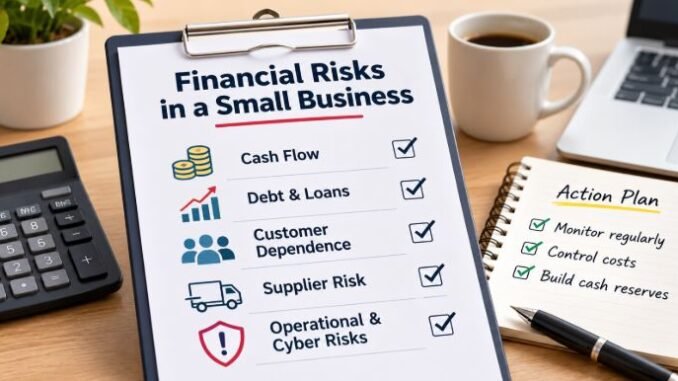
Running a small business involves more than finding customers, increasing sales and making a profit. Business owners also need to make sure there is enough money available to pay employees, suppliers, lenders and other expenses. A company may appear financially healthy on paper but still face serious problems if payments are delayed, costs rise unexpectedly or debt becomes difficult to manage.
This is why identifying financial risks early is essential. For small businesses, even a relatively minor financial setback can create pressure on daily operations. A major customer delaying payment, a sudden increase in raw material prices or an unexpected loan repayment can affect the entire business.
The good news is that financial risks do not always require complicated systems to identify. By keeping a close watch on cash flow, costs, debt, customers and suppliers, business owners can recognise warning signs and take action before problems become difficult to control.
Look Beyond Profit and Pay Attention to Cash Flow
One of the most common mistakes in business is assuming that profitability automatically means financial stability. In reality, profit and cash flow are two different things.
Consider a small company that supplies products to a large customer. The company may complete an order and record the sale, but if the customer takes 90 days to pay while suppliers expect payment within 30 days, the business has to cover a significant cash gap.
This can make it difficult to pay salaries, purchase new stock or meet other operating expenses, even when sales are growing.
Business owners should regularly review how quickly customers pay their invoices, how much money is overdue and when major expenses are due. A rolling cash flow forecast can also help estimate whether the business will have enough money available over the coming weeks and months.
The important point is to identify a cash shortage before it affects everyday operations.
Keep an Eye on Debt, Costs and Financial Ratios
Financial ratios can help business owners understand whether their company is becoming more vulnerable. They do not need to calculate dozens of indicators. A few basic measures can provide useful insight.
The current ratio and quick ratio help assess whether a business can meet its short-term obligations. If these figures fall over time, it may indicate that the company is becoming less capable of paying its immediate bills.
Debt also deserves close attention. A business that relies heavily on borrowing may find it difficult to manage repayments when sales slow down or interest rates increase. Monitoring the debt-to-equity ratio and interest coverage can help reveal whether borrowing is becoming excessive.
Profit margins are equally important. Rising electricity bills, transport expenses, wages or raw material prices can gradually reduce the money a company earns from each sale. If these increases are not reflected in selling prices or offset through better efficiency, profitability can weaken.
Regularly comparing actual expenses with budgets can help identify unexpected cost increases before they become a bigger problem.
Avoid Depending Too Much on One Customer or Supplier
A business may have strong sales but still be financially exposed if most of its revenue comes from just one or two customers.
For example, imagine a small manufacturer that earns 40 per cent of its revenue from a single client. If that client reduces orders, delays payments or moves to another supplier, the manufacturer could face an immediate cash flow problem.
The same concern applies to suppliers. Depending on one supplier for an essential material or component can leave a business vulnerable to price increases, delivery delays or sudden supply disruptions.
Business owners should understand where their revenue comes from and identify suppliers that are difficult to replace. Building relationships with additional customers and alternative suppliers can reduce this dependence.
External factors also matter. Businesses that import goods may face higher costs when exchange rates move unfavourably. Changes in taxes, regulations and commodity prices can also affect operating expenses.
Understanding these exposures gives owners more time to prepare.
Do Not Ignore Operational and Cyber Risks
Not every financial risk begins in the accounts department. Problems inside daily operations can also lead to significant losses.
Weak internal controls may allow payment errors, fraud or misuse of company funds to go unnoticed. Poor inventory management can tie up money in unsold stock, while equipment breakdowns can interrupt production and delay customer orders.
Cybersecurity is another growing concern. A data breach, ransomware incident or fraudulent payment request can cause financial damage and disrupt business operations. Small businesses may be particularly vulnerable if they lack dedicated IT and security teams.
Basic precautions can make a difference. These include restricting access to financial accounts, checking payment requests before transferring money, backing up important data and reviewing inventory and accounting records regularly.
Create a Simple Financial Risk Register
Identifying every possible risk is not enough. Business owners also need a practical way to decide which problems require attention first.
A financial risk register can help. It is simply a record of the main risks facing the business, their possible financial impact and the actions needed to manage them.
Each risk can be rated on two measures: how likely it is to happen and how serious its financial consequences could be. A simple scale of one to five can be used for both.
For example, a delayed payment from a major customer may receive a high score if the business depends heavily on that customer. A small increase in office expenses may receive a lower score because it is unlikely to threaten operations.
This approach helps owners focus limited time and resources on the issues that matter most.
Turn Risk Identification Into Practical Action
Once a business understands its main financial risks, the next step is deciding how to respond.
Some risks can be reduced by setting customer credit limits, following up on overdue invoices and maintaining an emergency cash reserve. Others may require insurance, stronger internal controls or alternative suppliers.
Businesses exposed to currency movements may consider appropriate hedging arrangements, while companies with heavy debt should review repayment schedules and borrowing costs with their financial advisers.
Responsibility also needs to be clear. Someone should be accountable for monitoring cash flow, following up on payments, checking expenses and reporting unusual financial changes.
A simple monthly review can help keep these tasks on track. For businesses facing tighter cash conditions or rapid growth, more frequent monitoring may be necessary.
Technology Can Help, but Financial Discipline Still Matters
Accounting software and digital financial tools have made it easier for small businesses to track payments, monitor expenses and prepare cash flow forecasts.
Some platforms also use artificial intelligence to identify unusual spending patterns, estimate future cash requirements and support credit analysis. These tools can save time and help owners spot trends that may otherwise go unnoticed.
However, technology cannot replace sound business judgement. Forecasts depend on the quality of the information entered, and unexpected changes in customer behaviour or market conditions may not be captured accurately.
Business owners should use digital tools to support decisions, not make financial decisions without reviewing the underlying information.
Building a More Financially Resilient Business
Financial risk management does not have to be a complicated exercise reserved for large companies. For a small business, it can begin with a few straightforward habits: checking cash flow, reviewing debt, monitoring costs, following up on unpaid invoices and avoiding excessive dependence on individual customers or suppliers.
The aim is not to eliminate every risk. That would be unrealistic, and avoiding all risk could also prevent a business from growing. The real objective is to understand which risks the company can afford to take and which could threaten its financial stability.
Small businesses often operate with limited cash reserves and fewer resources to absorb unexpected losses. That makes early warning signs especially important.
Ultimately, a financially resilient business is not simply one that makes money during good times. It is one that understands its vulnerabilities, prepares for uncertainty and makes informed decisions before a financial problem turns into a crisis.
