
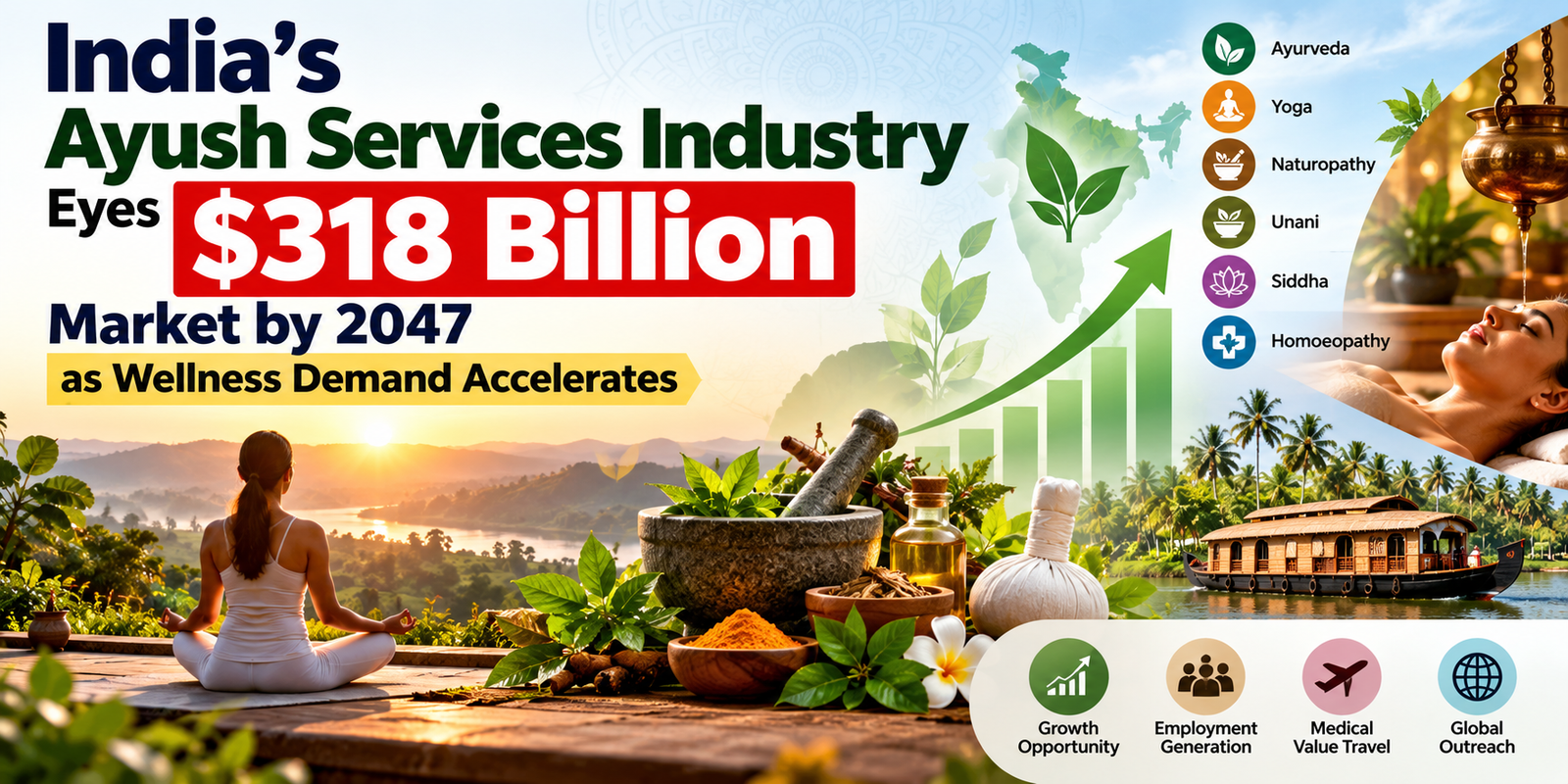
New Delhi: India’s traditional healthcare and wellness sector is emerging as a significant growth opportunity, with its services economy projected to reach between US$216 billion and US$318 billion by 2047, according to a study by the Research and Information System for Developing Countries (RIS). The projection underscores the expanding economic relevance of Ayurveda, Yoga, Naturopathy, Unani, Siddha and Homoeopathy, driven by rising interest in preventive healthcare, holistic wellness and traditional treatment systems.
The study estimates that India’s Ayush services economy was valued at US$36.92 billion in FY2024-25, equivalent to approximately ₹3.19 lakh crore. The sector has recorded a compound annual growth rate of 16.91% since FY2022-23, reflecting the increasing scale of healthcare establishments, wellness centres and related service businesses.
The findings are based on a nationwide survey covering 15,914 establishments across the six recognised Ayush systems. The report examines the sector’s economic contribution, employment potential, business landscape and opportunities for international expansion. It was released during the 11th Ayurveda Day celebrations in Nagpur on September 23, 2026.
Ayurveda remains the largest contributor to the industry’s revenue, accounting for US$17.73 billion in FY2024-25, or approximately 48% of the total Ayush services market. Its contribution reflects the established presence of Ayurvedic clinics, treatment centres and specialised wellness facilities across the country, alongside growing interest in traditional healthcare services.
Clinics and day-care facilities continue to form the backbone of the sector’s revenue generation. Standalone clinics contributed approximately US$16.21 billion, while day-care centres generated US$10.13 billion. Together, these segments accounted for more than 71% of the industry’s total revenue, highlighting the importance of accessible healthcare delivery and specialised treatment services.
Wellness-oriented businesses are also gaining momentum. The Ayush wellness segment, which includes yoga centres, spas and resorts offering traditional therapies, registered a compound annual growth rate of 21.29%. Yoga centres recorded revenue growth of around 75% over two years, indicating increasing commercial interest in lifestyle management, stress reduction and preventive health services.
The industry’s employment contribution is equally significant, with approximately 1.76 million people directly engaged across its various segments. Standalone and local clinics account for more than one million jobs, making them an important source of healthcare employment and livelihood generation. The sector’s workforce profile also reflects substantial participation by women.
Women constitute approximately 43% of the overall Ayush workforce, with their representation exceeding 50% in several organised service categories. Their participation stands at more than 60% in wellness spas and resorts, 58% in educational institutions, 57% in day-care centres and 53% in hospitals. These figures highlight the sector’s potential to support wider employment opportunities, particularly in healthcare, education and wellness services.
International demand is opening another avenue for growth through Medical Value Travel (MVT). India’s Ayush services industry generated an estimated US$1.77 billion from this segment in FY2024-25. Although international patients account for approximately 5% of total patient volumes, they contribute an estimated 15–25% of hospital-segment revenues, indicating the economic significance of overseas healthcare seekers.
Traditional therapies and residential wellness programmes are also contributing to India’s appeal as a destination for holistic healthcare. Ayush-based treatment programmes, including Panchakarma and residential Yoga, are associated with patient stays ranging from five to 11 days. Longer treatment durations can create business opportunities for healthcare institutions, wellness resorts, accommodation providers and allied service industries.
The RIS study also identifies digital infrastructure and quality accreditation as important factors in attracting international patients. Establishments with functional websites demonstrated 3.6 times higher odds of receiving international patients, while recognised certifications such as NABH or ISO were associated with twice the odds. The findings point towards the need for stronger digital outreach, professional standards, modern facilities and greater international visibility.
To unlock the sector’s long-term potential, the study outlines priorities covering the Ayush knowledge value chain, enterprise development, global competitiveness, Medical Value Travel and innovation through digital technologies and artificial intelligence. Strengthening professional skills, institutional capabilities, quality assurance and market access will be essential to expanding the industry’s reach. The projected market size of US$216 billion to US$318 billion by 2047 represents a substantial opportunity, although achieving it will depend on sustained investment and coordinated development.
The findings position Ayush as an emerging contributor to India’s healthcare, wellness and services-led growth ambitions under the Viksit Bharat @2047 vision. With traditional treatment systems increasingly intersecting with organised healthcare, tourism, technology and entrepreneurship, the sector could create new avenues for investment, employment and international business. Its future expansion will depend on combining traditional knowledge with measurable service quality, professional expertise and globally accessible healthcare delivery.
