
Artificial intelligence in the fashion business is rapidly moving beyond image generation. Demand analysis, product development, pricing, collection testing and production management are becoming part of a single digital value chain. For smaller brands, this means an opportunity to test business hypotheses faster and more accurately identify which products are ready to scale.
This transformation was one of the key business themes at the BRICS+ Fashion Summit in Moscow. The forum combines technology and entrepreneurship with insights from different national fashion industries, creating a valuable platform for professional exchange among growing markets. Over the course of its editions, the Summit has brought together experts from more than 100 countries.
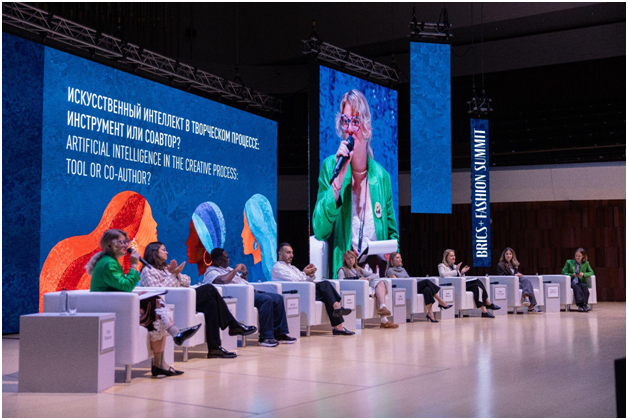
The Summit explored AI from multiple perspectives, with valuable insights from Indian designers and entrepreneurs. Kanika Goyal, Founder and Creative Director of Kanika Goyal Label, who is featured on the Forbes 30 Under 30 list, participated in a discussion on the role of artificial intelligence in the creative process. The conversation focused on questions facing contemporary fashion brands: where the use of AI as a tool ends and the delegation of creative decision-making begins, how generative technologies are changing the role of the designer, and who owns the rights to designs created with their help. Participants also discussed the risk of stylistic homogenization and the ability of algorithms to work with culturally significant imagery.
Kanika Goyal drew on her experience as a brand founder to explain how technology and a designer’s vision intersect in collection development. KGL makes extensive use of hand embroidery, and she believes craftsmanship is becoming increasingly valuable: “AI and technology can accelerate many things, but the human touch, irregularity and skill behind something made by hand are actually becoming more valuable because they cannot be completely replicated.”
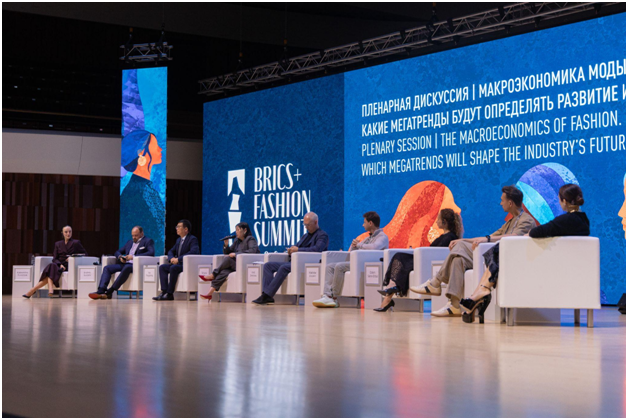
During the plenary discussion “The Macroeconomics of Fashion. Which Megatrends Will Shape the Industry’s Future?”, technology was examined in the context of consumer demand, supply chains, investment and new business models. Tatyana Kim, Head of RWB and Founder of Wildberries, emphasized the need to move beyond discussions of international cooperation and focus on building practical partnerships. Citing Wildberries’ collaboration with AliExpress, she highlighted the potential for closer cooperation between Russian and Chinese digital platforms. According to Kim, sharing resources, technologies and customer bases can create new opportunities for emerging designers and local brands to scale their businesses. Wildberries was the General Partner of Moscow Fashion Week.
Vladislav Kreinin, Senior Vice President and Director of Marketing and Communications at Sber, spoke about the development of AI tools for the fashion industry. According to Kreinin, Sber currently serves around 19,000 companies operating in fashion and selling through online marketplaces. He identified the shift towards end-to-end AI agent integration across business processes as one of the key changes, covering everything from market research and pricing to product development, manufacturing and logistics. Kreinin also highlighted virtual product testing as another area of development. The forum’s partnership program also reflected its focus on technology: Sber was the strategic partner of the BRICS+ Fashion Summit, while GigaChat, Sber’s neural network, served as the technological partner.
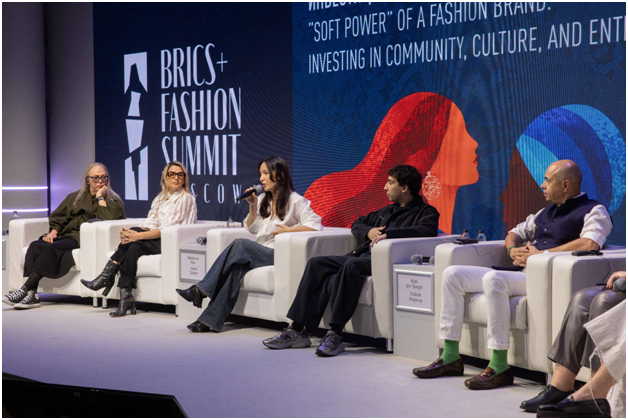
Scaling also depends on the quality of the business ecosystem surrounding a brand. Ajai Vir Singh, Founder and Managing Director of Colombo Fashion Week (Sri Lanka), links the competitiveness of brands from emerging markets to the development of ecosystems that connect supply chains, retail and brand storytelling. Following the Summit, Colombo Fashion Week continued to build professional connections, including with Beijing Fashion Week, helping extend the industry dialogue through cooperation between markets.
Ultimately, AI accelerates processes involving products and data, digital commerce infrastructure shortens the path to the customer, and international professional connections expand the geographic reach of businesses. The BRICS+ Fashion Summit brings these issues together in an industry-wide dialogue on how a creative idea can become a sustainable fashion business with strong growth potential.
