
Solar power is emerging as a major force in India’s electricity market, offering a cost-effective alternative to conventional energy sources while creating new business opportunities across manufacturing, infrastructure and power generation. Falling technology costs, rising electricity consumption and growing investments in renewable energy are accelerating the country’s transition towards cleaner power.
Solar energy is no longer driven solely by environmental concerns. Its growing commercial viability, potential to reduce dependence on imported fuels and ability to support long-term energy security are making it an increasingly important part of India’s economic and industrial development.
As the country expands its renewable energy capacity, the changing economics of electricity generation are influencing investment decisions, industrial power procurement and the future of the energy sector.
Falling Solar Costs Are Changing the Economics of Electricity
One of the biggest factors driving solar adoption is the significant reduction in electricity generation costs.
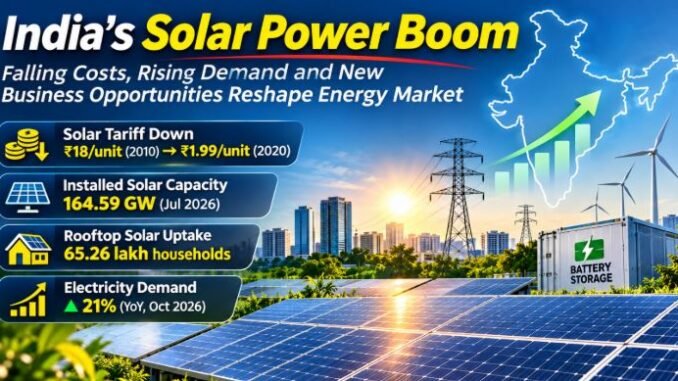
In India, competitive bidding and reverse auctions have played an important role in making solar power more affordable. Solar tariffs declined from around Rs 18 per unit in 2010 to a record low of Rs 1.99 per unit in 2020.
The global trend is equally significant. More than 90 per cent of new renewable energy projects are now cheaper than fossil-fuel alternatives, while solar power is estimated to be around 41 per cent cheaper.
For businesses, this cost advantage is becoming increasingly important. Industries with high electricity consumption are exploring renewable power procurement to manage operating expenses and reduce exposure to fluctuations in conventional fuel prices.
India’s Solar Capacity Crosses 160 GW
India’s solar industry has recorded substantial growth over the past decade.
The country’s installed solar capacity reached approximately 164.59 GW as of July 2026, compared with just 2.8 GW in 2014. India added a record 44.61 GW of solar capacity during FY2025-26, almost double the 23.83 GW added in the previous financial year.
This expansion is creating opportunities for solar developers, equipment suppliers, engineering companies and infrastructure providers.
The growth of solar installations is also increasing demand for photovoltaic modules, inverters, transmission infrastructure and energy management technologies.
Rooftop Solar Creates New Opportunities for Households and Businesses
The expansion of rooftop solar is adding another important dimension to India’s renewable energy market.
The PM Surya Ghar: Muft Bijli Yojana is encouraging households to install rooftop solar systems and generate their own electricity. The government has allocated Rs 75,021 crore for the programme, which aims to support installations in one crore households.
By November 2026, approximately 65.26 lakh households had benefited from rooftop solar installations under the scheme, with around 19.1 GW of rooftop solar capacity commissioned.
The programme is also creating opportunities for installation companies, equipment manufacturers and renewable energy service providers.
Beyond residential consumers, factories, offices, shopping centres and warehouses are increasingly exploring rooftop solar to reduce electricity expenses and improve energy efficiency.
Rising Electricity Demand Strengthens the Solar Industry Outlook
India’s growing electricity consumption is creating additional opportunities for renewable energy companies and power infrastructure developers.
According to a Jefferies report, India’s overall electricity consumption increased by approximately 21 per cent year-on-year in October 2026.
Rising demand from households, industries, commercial establishments and infrastructure development is increasing the need for additional electricity generation capacity.
Solar energy is positioned to benefit from this trend as businesses and consumers look for cost-effective and sustainable power solutions.
The expansion of utility-scale solar projects, rooftop installations and battery storage is creating opportunities in equipment manufacturing, project development, power distribution and energy management.
For companies operating across the energy value chain, rising electricity demand represents an expanding market for both power generation and supporting infrastructure.
Domestic Solar Manufacturing Gains Momentum
India’s solar expansion is also creating opportunities for domestic manufacturers.
Solar module manufacturing capacity increased from approximately 2.3 GW in 2014 to around 192 GW by June 2026, reflecting the rapid expansion of the country’s renewable energy manufacturing ecosystem.
The government’s Production Linked Incentive scheme, with an allocation of Rs 24,000 crore for high-efficiency solar photovoltaic modules, is supporting domestic manufacturing and encouraging investment in the supply chain.
The expansion is creating opportunities across solar modules, cells, wafers and related components.
However, manufacturers continue to face challenges involving raw material prices, imported components, competitive pricing and project delays.
Maintaining healthy profit margins while expanding production capacity will remain an important business priority.
Energy Security Becomes a Major Business Advantage
Another important advantage of solar energy is its ability to reduce dependence on conventional fuel supplies.
Coal- and gas-based power generation requires continuous fuel procurement, making operating costs vulnerable to international commodity prices and supply disruptions.
Solar projects, by contrast, do not require regular fuel purchases once installed. Although initial investment, financing and maintenance remain important costs, solar generation offers greater protection against fuel price fluctuations.
In Indonesia, utility-scale solar power is estimated to cost between 5.6 and 8.4 US cents per kilowatt-hour, compared with 10 to 15 cents for coal-based electricity and 14 to 21 cents for gas-based power.
These cost differences highlight why solar energy is becoming an increasingly important consideration in long-term electricity planning.
For energy-intensive industries, renewable power can offer greater cost visibility and help reduce exposure to unpredictable fuel expenses.
Battery Storage Could Be the Next Big Opportunity
While solar panels generate electricity during daylight hours, power demand continues throughout the day and night. This creates a growing need for technologies that can store surplus electricity and make it available when required.
Battery energy storage systems are emerging as an important part of this transition.
By combining solar installations with battery storage, power producers and industrial consumers can store excess daytime electricity and use it during evening peak-demand periods.
India’s increasing focus on energy storage is opening opportunities for battery manufacturers, storage developers, grid technology providers and infrastructure companies.
However, the wider adoption of battery storage will depend on technology costs, financing, installation economics and grid integration.
Investment Opportunities Across India’s Solar Industry
The expansion of solar power is creating business opportunities across several segments of India’s energy ecosystem.
- Solar manufacturing: Growing demand is supporting opportunities in photovoltaic modules, cells, inverters and related equipment.
- Project development: Utility-scale installations require investment in land, engineering, construction and project management.
- Rooftop solar: Residential and commercial installations are creating demand for solar installation companies and energy service providers.
- Battery storage: Energy storage solutions are becoming increasingly important for managing renewable electricity.
- Power infrastructure: Transmission networks, grid modernisation and energy management technologies are gaining importance as renewable capacity expands.
For investors, these segments offer exposure to different parts of the renewable energy value chain. However, evaluating individual companies requires attention to order books, debt levels, production costs, execution capabilities and operating margins.
A growing solar market does not automatically translate into higher profitability for every company.
The Road Ahead for India’s Solar Energy Market
India’s solar industry is entering an important phase of development as rising electricity consumption, competitive generation costs and energy security considerations reshape the country’s power market.
The country is working towards its broader target of achieving 500 GW of non-fossil fuel-based electricity capacity by 2030, making renewable energy an important part of its long-term infrastructure strategy.
However, challenges remain. Grid infrastructure, energy storage costs, financing requirements, supply-chain dependence and manufacturing competitiveness will influence how effectively new renewable capacity is integrated into the electricity system.
For businesses, the opportunity extends beyond electricity generation. Manufacturing, storage, infrastructure development and energy management are expected to play important roles in the next phase of the renewable energy industry.
Solar power is increasingly becoming a major part of India’s economic and industrial growth story. As electricity demand rises and renewable generation becomes more competitive, the sector is opening new avenues for investment, manufacturing and infrastructure development while reshaping the country’s electricity market.
