
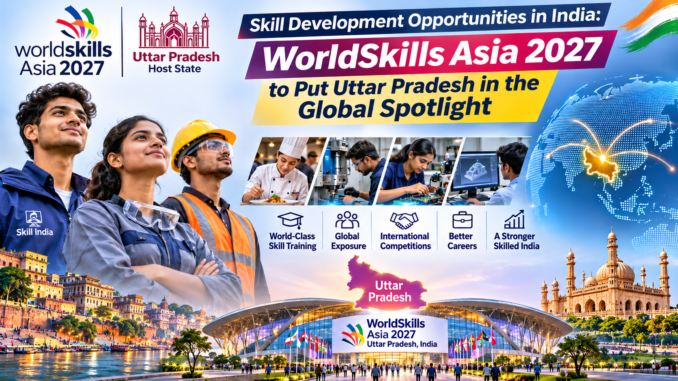
Nov 25: India’s growing focus on skill development will receive international attention in 2027 as Uttar Pradesh prepares to host WorldSkills Asia in Greater Noida. The announcement, made during the fifth Kaushal Deekshant Samaroh in Lucknow on November 21, 2026, puts India’s vocational education and workforce development ambitions in the spotlight.
The competition is expected to bring skilled young participants from across Asia to India, creating an opportunity to showcase technical expertise, vocational training and emerging professional capabilities.
However, the significance of hosting an international skills competition goes beyond the event itself. As businesses adopt artificial intelligence, automation and advanced manufacturing technologies, the demand for specialised skills is changing. India’s ability to prepare young people for these requirements will play an important role in its future economic growth.
For Uttar Pradesh, WorldSkills Asia 2027 offers an opportunity to showcase its growing industrial ecosystem. For India, it is a chance to strengthen its position as a source of skilled professionals for domestic industries and international markets.
WorldSkills Asia 2027: Why Greater Noida Is in Focus
Greater Noida’s selection as the host city for WorldSkills Asia 2027 brings attention to India’s expanding vocational training ecosystem and Uttar Pradesh’s industrial development.
WorldSkills competitions provide an international platform for young professionals to demonstrate their abilities across different technical and vocational disciplines. They also encourage countries to exchange knowledge, compare training standards and understand changing industry requirements.
For India, hosting the competition creates an opportunity to demonstrate the capabilities of its vocational education institutions and skilled workforce.
Greater Noida’s manufacturing presence, educational institutions and connectivity make it a relevant location for an international event of this nature. The competition could also create opportunities for interaction between training institutions, employers and international skill development organisations.
More importantly, it can help change how young people and families view vocational education. Technical qualifications and practical expertise can offer meaningful career opportunities across several industries.
India’s Skill Development Mission: What NITI Aayog’s Report Reveals
India’s skill development priorities are closely connected to its ambition of becoming a developed economy by 2047. An important contribution to this discussion comes from NITI Aayog’s August 2026 report, Reimagining Skilling for Viksit Bharat@2047.
The report calls for a more integrated approach to education, vocational training, employment and entrepreneurship. It argues that skill development should not be treated as a one-time activity but as a continuous process that allows individuals to upgrade their capabilities throughout their careers.
One of its key recommendations is stronger industry participation in vocational education. Employers should have a greater role in identifying skill requirements, developing training programmes, providing apprenticeships and supporting practical learning.
The report also highlights the importance of flexible learning pathways, digital lifelong learning accounts, skills-based recruitment and better recognition of professional experience.
These recommendations are particularly relevant as businesses adopt new technologies and change the way they organise their workforce.
For India, the challenge is not simply to train more people. It is to ensure that training programmes prepare individuals for real employment opportunities and allow them to adapt as industries evolve.
Five Skill Development Areas That Could Create New Opportunities in India
As businesses modernise their operations, the demand for specialised technical capabilities is changing. Several sectors are likely to remain important for India’s future workforce.
1. Artificial Intelligence and Digital Technology
Artificial intelligence is changing how businesses manage operations, communicate with customers and analyse information. This is creating demand for professionals with knowledge of AI tools, data analytics, software development and cybersecurity.
The opportunities are not limited to technology companies. Banking, healthcare, retail, education and manufacturing businesses are also incorporating digital systems into their operations.
Young professionals who combine digital knowledge with practical industry experience could find opportunities across a wider range of sectors.
2. Semiconductor Manufacturing and Electronics
India’s ambitions to expand domestic electronics and semiconductor manufacturing are increasing the importance of specialised technical skills.
The industry requires trained professionals in electronics engineering, equipment maintenance, production management, quality testing and semiconductor-related processes.
Uttar Pradesh’s emerging semiconductor and electronics manufacturing ecosystem could create demand for technical workers as industrial projects develop.
3. Electric Vehicles and Advanced Manufacturing
The transition towards electric mobility is changing the automotive industry. Businesses need professionals who understand battery systems, electrical components, vehicle diagnostics and modern production techniques.
Robotics and industrial automation are also transforming factory operations. Workers who can operate, maintain and troubleshoot advanced machinery will become increasingly important to manufacturers.
4. Renewable Energy and Green Technology
The expansion of solar power, wind energy and other clean energy technologies is creating new requirements for trained technical professionals.
Installation, maintenance, energy management and electrical safety are among the areas where specialised training can support employment opportunities.
As businesses focus on energy efficiency and sustainability, green technology skills could become increasingly valuable.
5. Healthcare and Technical Services
Healthcare is another sector where trained professionals are essential. Opportunities extend beyond doctors and nurses to include laboratory technicians, medical equipment specialists, diagnostic support professionals and healthcare administrators.
As healthcare infrastructure expands, vocational and technical training can help prepare workers for specialised roles.
Uttar Pradesh’s Industrial Growth Could Strengthen Demand for Skilled Workers
Hosting WorldSkills Asia 2027 could give Uttar Pradesh an opportunity to connect its industrial ambitions with workforce development.
The state has been investing in infrastructure, expressways, airports and industrial projects. It has also attracted attention for its mobile manufacturing ecosystem and emerging semiconductor-related developments.
During the Lucknow event, the government highlighted the state’s industrial infrastructure, including mobile manufacturing facilities, an upcoming semiconductor factory and BrahMos missile manufacturing.
These developments are relevant to skill development because industrial expansion requires people who can operate equipment, manage production systems, maintain technology and meet quality requirements.
The international competition could increase the visibility of Uttar Pradesh’s technical training institutions and encourage greater interaction with international vocational education systems.
Potential benefits include stronger industry-academia partnerships, greater awareness of international training standards and increased interest among young people in technical careers.
However, the long-term impact will depend on whether the visibility generated by the event translates into sustained investment in training, apprenticeships and employment opportunities.
ITI Modernisation and PM-SETU: Connecting Training with Industry Requirements
Industrial Training Institutes continue to play an important role in preparing India’s workforce for technical occupations. Their emphasis on practical instruction makes them relevant to industries that require trained technicians, operators and maintenance professionals.
During the Kaushal Deekshant Samaroh, the government highlighted the introduction of more than 30 new-age trades in ITIs. These include artificial intelligence, cybersecurity, drone technology, green hydrogen, industrial robotics, electric vehicles and semiconductor technology.
The focus on modernising vocational education is also reflected in the Pradhan Mantri Skilling and Employability Transformation through Upgraded ITIs (PM-SETU) scheme, which has an investment outlay of ₹60,000 crore.
The initiative aims to modernise ITI infrastructure, upgrade machinery, improve instructor training and strengthen industry linkages.
For businesses, this approach is important because training institutions need to keep pace with changing workplace requirements.
For example, an automotive technician today may need knowledge of electric vehicle systems in addition to conventional mechanical skills. Similarly, manufacturing workers may increasingly need to understand automated equipment and digital monitoring systems.
Closer cooperation between employers and training institutions can help bridge this gap and make vocational qualifications more relevant to actual jobs.
India’s Employment Challenge: Why Skills Must Match Industry Demand
India’s young population offers considerable potential for economic growth. However, providing education and training is only one part of the employment challenge. The skills people acquire must also match the requirements of the labour market.
The India Employment Report 2024, published by the International Labour Organization in collaboration with the Institute for Human Development, examines the relationship between youth employment, education and skills.
The report highlights concerns around the mismatch between educational qualifications, job aspirations and available employment opportunities. It also discusses how technological change and digitalisation are influencing the demand for skills.
This makes industry-linked training particularly important.
Young people need access to practical learning, apprenticeships and career guidance. Employers, meanwhile, need to communicate the capabilities they require and participate more actively in workforce development.
For India, improving the connection between vocational education and employment could help make training more meaningful and improve career prospects.
WorldSkills Asia 2027 provides an opportunity to bring greater attention to the importance of practical competencies and internationally recognised vocational standards.
Artificial Intelligence and the Future of Skilled Employment
Artificial intelligence is changing the nature of work, but it is also creating new requirements for human expertise.
Businesses adopting AI systems need people who can manage digital tools, interpret information, supervise automated processes and solve problems when technology does not deliver the expected results.
The growing use of AI also makes continuous learning important. Skills acquired at the beginning of a career may need to be updated as technology and business requirements change.
For young professionals, this means combining technical knowledge with problem-solving, communication and adaptability.
Educational institutions will need to introduce emerging technologies into their training programmes, while employers will have to invest in upskilling their existing workforce.
The objective should not simply be to train people for today’s jobs, but to prepare them for roles that may evolve considerably over the next few years.
Can WorldSkills Asia 2027 Strengthen India’s Global Position?
India’s ambition to become a global centre for skilled talent will depend on the quality and relevance of its workforce.
International competitions such as WorldSkills Asia provide an opportunity to demonstrate technical capabilities, exchange knowledge and understand how vocational training standards differ across countries.
For Indian participants, exposure to international competition can provide valuable learning experiences. For educational institutions, it can offer insights into training methods and professional expectations. For businesses, it can encourage greater engagement with technical education.
The opportunity also extends to India’s position in the global labour market. Countries and businesses looking for trained professionals increasingly need workers who can meet technical requirements and adapt to new workplace technologies.
However, the real measure of success will extend beyond the event itself. Better training infrastructure, stronger industry partnerships, wider apprenticeship opportunities and improved employment outcomes will determine its long-term impact.
Conclusion: Building a Skilled Workforce for India’s Future
WorldSkills Asia 2027 in Greater Noida places Uttar Pradesh at the centre of an important international conversation about vocational education and workforce development.
India has an opportunity to strengthen its skill development ecosystem by connecting training programmes with the changing needs of businesses. NITI Aayog’s 2026 report reinforces the importance of lifelong learning, industry participation and employment-oriented training, while the ILO’s findings highlight the need to address the gap between education and labour market demand.
Opportunities in artificial intelligence, semiconductor manufacturing, electric vehicles, renewable energy and healthcare show why technical education needs to evolve alongside business requirements.
For young Indians, this is an opportunity to look beyond conventional career choices and recognise the value of specialised skills. For businesses, it is a reminder that investment in people is just as important as investment in technology and infrastructure.
As Uttar Pradesh prepares to welcome participants from across Asia in 2027, the larger opportunity for India will be to turn international recognition into a stronger, more adaptable and employment-ready workforce.
