
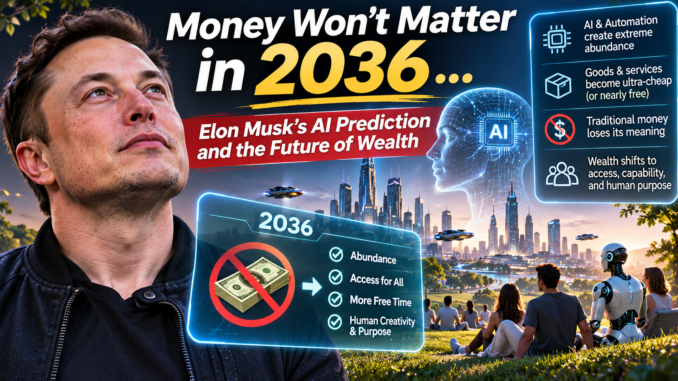
Nov 16: What if earning money is no longer the biggest concern in people’s lives? What if artificial intelligence and robots become capable of producing almost everything people need, making traditional employment less important? It may sound like a distant possibility, but technology entrepreneur Elon Musk believes the world could be moving towards such a future.
During a July 23, 2026 interview with The Economist, Musk made a striking prediction: “Money won’t matter in 2036.”
He suggested that rapid advances in artificial intelligence (AI) and robotics could eventually create an age of extraordinary abundance, where machines produce more goods and services than people could possibly consume.
The prediction raises an important question: Is money really heading towards becoming irrelevant, or are we witnessing the beginning of a major transformation in how wealth is created and distributed?
While the disappearance of money remains highly speculative, developments in AI, robotics, digital finance and automated production are already changing the global economy. Over the next decade, these technologies could reshape employment, business ownership, consumer spending and the meaning of financial security.
Elon Musk’s 2036 Prediction: Why Does He Think Money Won’t Matter?
Musk’s prediction is based on a simple economic argument. People need money to purchase goods and services, including food, housing, transportation and entertainment. But what happens if advanced AI systems and robots can produce these resources in abundance?
During his interview with The Economist, Musk questioned the importance of money in a future where automated systems could supply more goods and services than humans could consume.
He also suggested that work could become optional, with people choosing occupations because they enjoy them rather than because they need an income to survive.
This idea is closely connected to the concept of a post-scarcity economy, where technological progress makes many goods and services increasingly accessible.
However, this vision depends on several conditions. Production must become significantly more efficient, energy must remain affordable, and the benefits of automation must reach beyond the companies and individuals who own the technology.
Musk’s prediction is therefore not a guarantee that money will disappear by 2036. It is a thought-provoking possibility about how the global economy could evolve if AI and robotics advance at an extraordinary pace.
AI Could Change How People Earn a Living
Artificial intelligence is already changing the way businesses operate. Companies are using AI to analyse information, develop software, manage customer interactions, automate administrative work and support business decisions.
As these systems improve, organisations may be able to produce more with fewer human resources.
The World Economic Forum’s Future of Jobs Report 2025 estimates that 170 million new jobs could be created globally by 2030, while 92 million existing jobs could be displaced. This represents a projected net increase of 78 million jobs.
The report also identifies AI, information processing, robotics and automation as important drivers of employment transformation.
The International Monetary Fund has highlighted the scale of this transition as well. In February 2026, the IMF noted that approximately 40% of jobs globally could be affected by AI, either through transformation, upgrading or displacement.
These findings suggest that the future of employment will not simply be about machines replacing people. Many occupations will change, new roles will emerge, and workers will need to develop skills that complement increasingly capable technologies.
By 2036, the traditional relationship between working hours and income could look very different. People may spend less time on repetitive tasks and more time on creativity, decision-making, specialised expertise and activities requiring human interaction.
Could Robots Make Everyday Products More Affordable?
One of the strongest arguments behind Musk’s prediction is the possibility of reducing the cost of producing goods and delivering services.
Imagine a manufacturing facility where robots operate around the clock, AI systems monitor product quality and automated logistics manage inventory and transportation.
Such operations could improve productivity while reducing certain labour and operational expenses.
Similar developments could influence several industries.
In agriculture, precision farming and automated machinery could improve productivity. In healthcare, AI-assisted diagnostics and automated administrative systems could help healthcare providers manage their workloads. In education, personalised AI tutors could make learning more accessible.
Construction could also change through robotics, prefabricated building components and advanced manufacturing techniques.
If these technologies reduce the cost of producing essential goods and services, households could potentially spend less on certain everyday requirements.
However, cheaper production does not automatically mean cheaper consumer prices. Land, energy, raw materials, infrastructure, ownership and distribution will continue to influence the final cost.
The real test will be whether technological efficiency translates into meaningful savings for ordinary consumers.
The Future of Money Could Become Digital and Almost Invisible
Even if money does not disappear, the way people interact with it could change considerably by 2036.
Digital payments, mobile banking and instant transaction systems have already reduced the need to carry physical cash. The next stage could involve AI-powered financial assistants that manage everyday transactions.
Imagine an AI assistant that reviews household expenses, compares insurance policies, manages subscriptions and pays utility bills after receiving the necessary permissions.
Instead of manually completing every transaction, people could increasingly rely on automated financial systems.
Tokenisation could also influence the future of financial services. It involves representing financial or physical assets digitally on programmable platforms, potentially making certain transactions and ownership transfers more efficient.
The Bank for International Settlements, in its Annual Economic Report 2026, examines how tokenisation could contribute to the development of a next-generation monetary and financial system.
The BIS highlights the potential for programmable payments and more efficient financial infrastructure, while emphasising that trust, regulation and financial stability must remain central.
This suggests that the future may not involve abandoning money. Instead, financial transactions could become faster, more automated and less visible to consumers.
Could Universal Basic Income Become More Important?
If automation significantly changes employment patterns, governments may need to reconsider how people earn and receive income.
One proposal that frequently appears in discussions about an automated economy is Universal Basic Income (UBI).
Under this model, eligible individuals receive regular financial support, generally without having to demonstrate employment status.
The concept could become more relevant if AI and robotics reduce the demand for certain categories of human labour.
Governments may also explore expanded social security programmes, publicly funded healthcare, affordable education and employment transition initiatives.
However, Universal Basic Income is not an inevitable consequence of AI development. Its implementation would depend on government finances, taxation, productivity, inflation and political decisions.
The larger challenge will be determining how the wealth generated by increasingly automated businesses can be distributed more widely.
Without appropriate economic policies, technological progress could increase the concentration of wealth rather than make financial security accessible to everyone.
How AI and Automation Could Transform Businesses by 2036
The possibility of a less money-dependent economy could have major implications for businesses.
Companies may increasingly compete on productivity, innovation and the ability to use technology effectively.
Manufacturing: Automated production facilities could reduce certain operating costs, improve quality control and enable customised manufacturing.
Healthcare: AI-assisted services could help medical professionals analyse information, manage patient records and improve operational efficiency.
Financial services: Intelligent systems could automate routine financial processes, detect unusual transactions and support personalised financial services.
Retail and e-commerce: AI could improve inventory management, customer recommendations, pricing strategies and supply chain operations.
Education: Personalised learning platforms could make specialised knowledge more accessible and change how educational services are delivered.
For startups, these developments could create opportunities to build businesses with smaller teams and more automated operations.
At the same time, competition may intensify as access to advanced AI tools makes it easier for new businesses to enter certain markets.
Companies that combine technological capabilities with customer trust, creativity and specialised expertise could have an advantage.
The Biggest Risk: Could AI Increase Wealth Inequality?
There is another side to Musk’s prediction that deserves attention.
Even if robots and AI make production more efficient, the benefits may not be distributed equally.
Companies that own advanced AI systems, robotics infrastructure, computing facilities, data and intellectual property could gain considerable economic advantages.
Meanwhile, workers whose livelihoods depend on easily automated activities may face financial uncertainty.
The IMF has warned that AI could widen economic inequalities if the benefits of productivity improvements are concentrated among certain businesses, workers and economies.
Access to affordable technology, digital education and reliable infrastructure will therefore influence who benefits from the next phase of economic development.
For developing economies, including India, the challenge will be to adopt AI while ensuring that workers and smaller businesses are not left behind.
The future of wealth may depend as much on technology ownership and access as it does on traditional income.
Will Money Really Become Irrelevant by 2036?
Despite the possibilities, predicting that money will become irrelevant within ten years would be an exaggeration.
Money performs several essential functions. It helps people exchange goods and services, measure economic value, save wealth and establish financial relationships.
Even in a highly automated economy, resources such as land, energy, computing capacity and desirable locations may remain limited.
Someone will still need to determine who owns these resources and how they are distributed.
The more realistic possibility is that technology could reduce the importance of money in certain aspects of everyday life.
If healthcare, education, transportation and other essential services become more affordable and accessible, people may become less dependent on conventional salaries to maintain their quality of life.
But achieving that outcome will require more than technological innovation. Economic policies, competition, infrastructure and fair access will play equally important roles.
Conclusion: By 2036, Could Access Matter More Than Income?
Elon Musk’s prediction that money won’t matter in 2036 is ambitious, but it highlights a transformation that businesses, governments and individuals cannot afford to ignore.
Artificial intelligence, robotics, automated production and digital finance are changing the foundations of the global economy. These developments could influence how people work, how businesses generate revenue and how wealth is distributed.
The future may not be about eliminating money altogether. Instead, it could be about reducing the human effort required to produce goods and services and making resources more accessible.
Whether this creates a more equal society or concentrates economic power in the hands of a few will depend on how governments, businesses and communities respond.
Perhaps the biggest change by 2036 will not be that money disappears, but that people begin to measure wealth differently — through access to resources, time, opportunities, creativity and quality of life.
The question is no longer simply how much money people will earn in the future. It is whether technological progress will allow them to live better without having to earn as much.
