
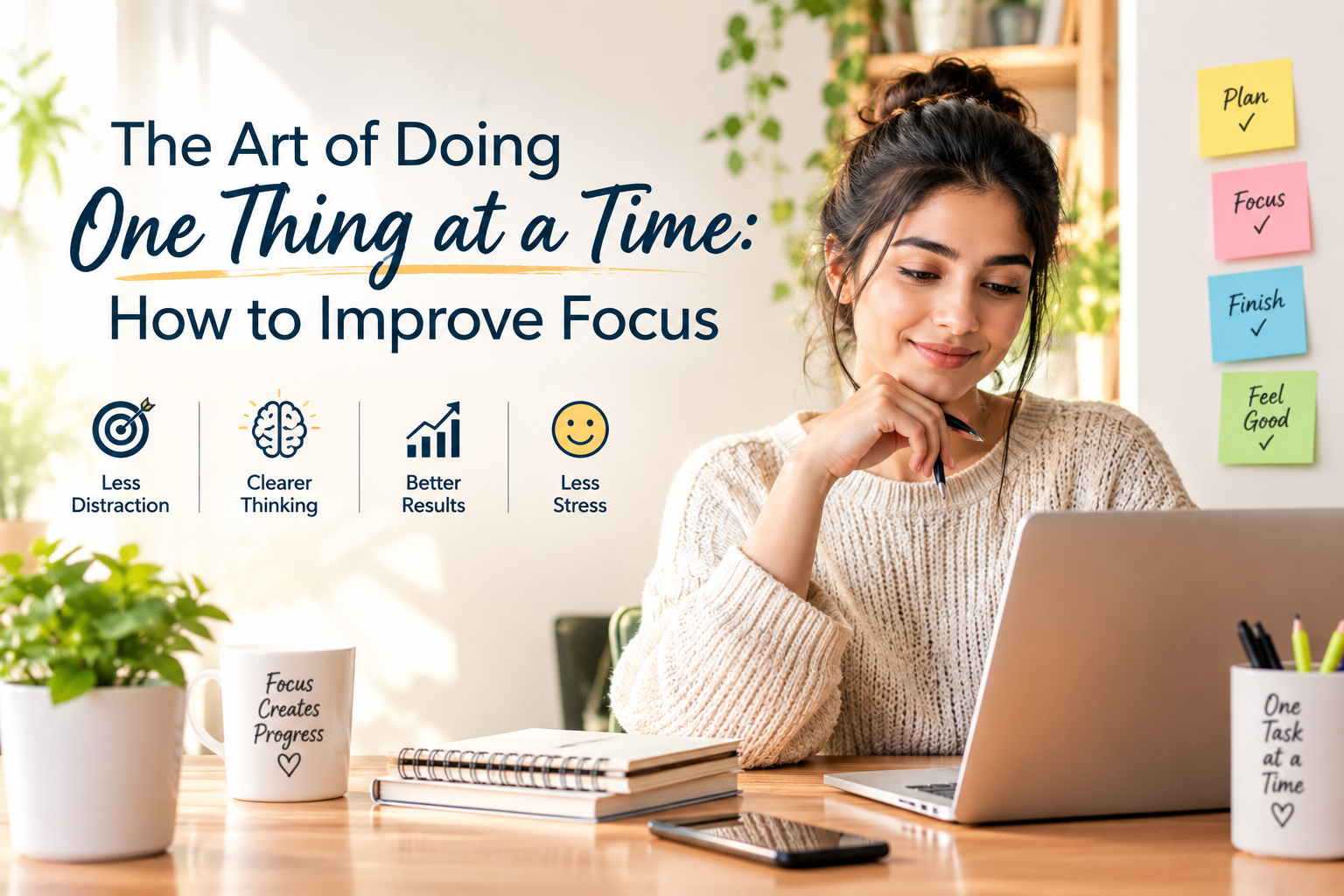
You sit down to finish an important piece of work. A WhatsApp message arrives, so you reply. An email catches your eye, and you open it. Then you remember a call you need to make and something you forgot to buy. By the time you return to your original task, half an hour has disappeared. You have been busy, but the work you sat down to do is barely started.
This has become familiar to many of us. We answer messages while eating, think about office deadlines while spending time with family, and reach for our phones whenever there is a spare moment. Even rest can feel crowded when our minds are occupied with everything we have not yet done.
Perhaps the problem is not simply that we have too much to do. It is that we rarely give one thing our complete attention. The art of doing one thing at a time is about rediscovering the value of being fully involved in what we are doing, whether that means finishing an assignment, listening to a friend or enjoying an ordinary moment without feeling the need to move on.
The Busy Trap: Why Multitasking Doesn’t Always Work
We often admire people who seem capable of managing everything simultaneously. At work, the colleague who answers emails during meetings may appear efficient. At home, a parent who prepares dinner while helping a child with homework seems impressively organised. When the day is demanding, doing several things at once can feel like the only way to keep up.
But the brain does not always handle competing tasks as smoothly as we imagine. When activities require concentration, we generally switch our attention between them. Each switch can interrupt our train of thought, and returning to a complicated task may take longer than expected. Research on attention has repeatedly highlighted the costs that demanding task-switching can impose on performance.
This explains why a day filled with activity can still leave us feeling unproductive. We may respond to dozens of messages but make little progress on an important report. We may start several jobs and finish none. The effects of multitasking on productivity are not always obvious in the moment, but they can appear in the form of wasted time, avoidable mistakes and mental fatigue. Sometimes, finishing one task before moving to another is the more effective choice.
When Your Mind Is Still at the Previous Task
Have you ever finished a meeting but found yourself thinking about it long after you have moved on to something else? Perhaps a comment from a colleague keeps replaying in your mind while you try to prepare a presentation. Your laptop is open, the work is in front of you, but part of your attention remains elsewhere.
Psychologists use the term attention residue to describe how thoughts about a previous task can linger when we move to a new one. Switching activities does not always mean that our minds switch completely with them. Unfinished work, an uncomfortable conversation or an unanswered question can continue occupying mental space.
This is one reason constant interruptions can be tiring. We are not merely doing more things; we may also be carrying fragments of several tasks in our minds. Before moving on, it can help to note what remains unfinished and identify the next step. That small action gives you a clearer place to return to later, rather than repeatedly revisiting the same concern.
How to Improve Concentration Without Changing Your Entire Life
Improving concentration does not require an elaborate routine or a complete digital detox. Start with one task you have been postponing. Put your phone out of reach, close unnecessary tabs and give yourself 20 minutes to work without avoidable interruptions. If another responsibility comes to mind, write it down and return to it later.
The same habit can make a difference outside work. Eat one meal without watching a video. Listen to a family member without checking your screen halfway through the conversation. If you are travelling by bus or metro, spend a few minutes watching the world outside instead of automatically opening social media. These small choices help you practise directing your attention rather than following every distraction.
Of course, not every interruption can be avoided. Teachers may have several students asking for help, parents need to respond to their children, and some professional roles demand immediate decisions. The aim is not to achieve perfect concentration throughout the day. It is to recognise the moments when uninterrupted attention is possible and use them well.
How to Avoid Distractions at Work Without Becoming Unavailable
Many of us feel an unspoken pressure to respond immediately. A message arrives, and we feel we should answer it. An email appears, and we want to know what it says. Even when nothing is particularly urgent, the possibility that something important might be waiting can pull us away from the task in front of us.
Yet constant availability is not the same as effectiveness. A carefully prepared presentation may be more valuable than ten hurried replies. A thoughtful conversation with a colleague may prevent a misunderstanding that would otherwise take hours to resolve. The challenge is to distinguish what genuinely needs immediate attention from what can reasonably wait.
Where your work permits, group similar tasks together. Check emails at planned intervals, keep a short list of priorities and protect some time for work that requires deeper thought. If your role involves customer service or urgent communication, adapt the approach to your responsibilities. Focus does not mean ignoring people; it means being deliberate about when and how you give them your attention.
Being Present Is a Skill Worth Relearning
We often imagine productive people as those who are always moving, planning and achieving. But some of our best work happens when we have enough quiet to think clearly. Some of our most meaningful memories come from conversations, family outings and simple experiences in which we are so involved that we forget to check the time.
Learning to do one thing at a time will not make every day peaceful. Deadlines will still overlap, unexpected calls will arrive, and some days will feel far more demanding than others. The difference lies in recognising that we do not have to respond to every interruption automatically. Even a small amount of deliberately protected attention can make work feel more manageable.
The next time you sit down to do something important, resist the urge to open another tab or check one more message. Give the task a little time. Finish your tea before reaching for your phone. Listen when someone is speaking to you. These choices may seem ordinary, but they are reminders that life is not simply a list of things to get through. Sometimes, doing one thing at a time helps us not only work better, but also experience more of the life happening around us.
