
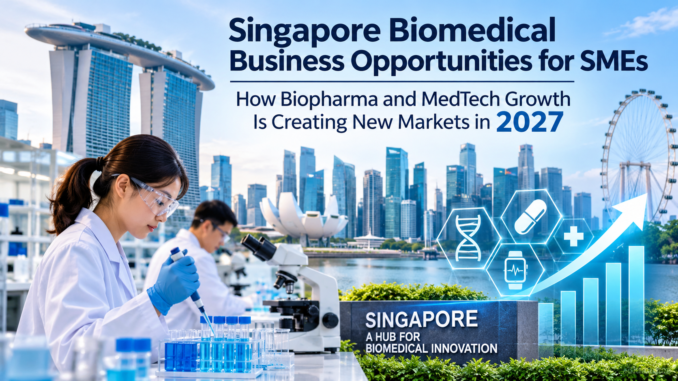
Nov 23: Singapore’s biomedical industry is opening up new business possibilities for small and medium-sized enterprises (SMEs). With pharmaceutical manufacturers expanding their production capabilities and medical technology companies developing more advanced healthcare solutions, the opportunities are no longer limited to large multinational corporations.
Businesses that supply specialised components, laboratory equipment, automation technology and technical services are also finding potential opportunities within this growing ecosystem.
As Singapore strengthens its position as a biomedical manufacturing and research hub, 2027 could be an important year for SMEs looking to enter the healthcare supply chain. For smaller businesses, the opportunity may not necessarily lie in developing medicines or manufacturing complete medical devices. Instead, supplying the products, technology and services that support these industries could offer a more practical route into the market.
Why Singapore’s Biomedical Industry Deserves Attention
Singapore has spent years developing its biomedical manufacturing capabilities, attracting international pharmaceutical companies and encouraging investment in medical technology.
According to Singapore’s Ministry of Trade and Industry, the country has more than 60 biomedical sciences manufacturing plants, including facilities operated by eight of the world’s top 10 biopharmaceutical companies.
The investment outlook is equally encouraging. In 2025, Singapore’s Economic Development Board secured S$4.4 billion in biomedical sciences investment commitments, with these projects expected to generate 1,775 jobs over the following five years.
The medical technology industry has also established a considerable presence. Singapore’s MedTech manufacturing output reached S$20.3 billion in 2024, with more than 400 global and local MedTech enterprises employing over 17,000 people.
For SMEs, these developments point towards a wider business ecosystem that needs engineering partners, equipment suppliers, software developers and specialised service providers.
The challenge is identifying the right opportunity and understanding what established biomedical companies need from their business partners.
1. Precision Engineering: An Opportunity in Medical Device Manufacturing
Medical devices depend on components that meet precise technical specifications. From diagnostic equipment and surgical instruments to patient monitoring systems, manufacturers require specialised parts that can deliver consistent performance.
This creates opportunities for SMEs with experience in precision engineering, electronics and component manufacturing.
Singapore already has a well-developed precision engineering and electronics manufacturing services ecosystem, with more than 2,700 providers identified by the Economic Development Board.
Smaller engineering businesses can explore opportunities in precision machining, plastic moulding, specialised metal components, electronics assembly and product prototyping.
There is also potential in manufacturing equipment housings, mechanical subassemblies and customised components for medical technology companies.
For an SME, specialising in one particular manufacturing requirement may be more realistic than attempting to supply an entire medical device. Building a reputation for accuracy, quality and reliable delivery can help businesses establish relationships with larger manufacturers.
2. Pharmaceutical Manufacturing Creates Demand for Technical Services
Running a pharmaceutical manufacturing facility involves considerably more than producing medicines. Companies need reliable equipment, regular maintenance, monitoring systems and specialised engineering support to keep production operations running smoothly.
This is where smaller service providers can find opportunities.
Businesses offering equipment maintenance, calibration, industrial automation, facility management and process monitoring can explore partnerships with pharmaceutical manufacturers.
Technical documentation and engineering support are other areas worth considering, particularly for companies familiar with controlled manufacturing environments.
However, pharmaceutical production operates under strict quality requirements. Service providers must understand the relevant procedures and be prepared to demonstrate their technical capabilities.
For SMEs, developing expertise in pharmaceutical manufacturing support could provide an opportunity to build long-term relationships without having to invest in their own drug manufacturing facilities.
3. Laboratory Equipment and Research Supplies
Singapore’s biotechnology and pharmaceutical industries depend on laboratories for research, product development and testing. These facilities require specialised instruments, scientific supplies and regular equipment maintenance.
This creates a market for SMEs involved in laboratory equipment distribution and technical support.
Businesses can explore opportunities in scientific instruments, laboratory consumables, calibration services, equipment installation and maintenance.
There is also room for technology companies offering laboratory inventory management and research data management solutions.
Rather than trying to serve every type of research facility, smaller businesses could focus on a particular customer group, such as biotechnology startups, diagnostic laboratories or pharmaceutical research centres.
A specialised product range and dependable after-sales support can help SMEs differentiate themselves in a competitive market.
4. AI and Automation Could Open New Doors for Technology SMEs
As biomedical manufacturing becomes more sophisticated, companies are looking for ways to improve production efficiency and reduce operational interruptions.
Artificial intelligence (AI), robotics and industrial automation are becoming increasingly relevant to these requirements.
For technology-focused SMEs, this creates opportunities to develop practical solutions for biomedical manufacturers.
Some potential areas include automated quality inspection, machine vision, predictive maintenance, production monitoring and manufacturing data analytics.
For example, an AI-based monitoring system could help a manufacturer identify unusual equipment performance before it leads to production downtime. Automated inspection technology could also help identify product defects during manufacturing.
Software companies can explore another opportunity by connecting older manufacturing equipment with modern digital platforms.
The important consideration is to solve a specific operational problem. SMEs do not necessarily need to develop large automation systems to become useful technology partners. A focused solution that saves time, improves monitoring or supports quality control may be more commercially attractive.
5. Quality Management and Regulatory Documentation
Quality management is an essential part of the pharmaceutical and medical technology industries. Companies need organised documentation, traceability systems and established procedures to maintain product quality and meet applicable regulatory requirements.
This creates opportunities for SMEs with expertise in software development, documentation and professional support services.
Businesses can explore quality management software, digital document control, technical writing, audit preparation and employee training.
There is also potential for developing software that helps manufacturers manage document revisions, maintain audit trails and organise quality-related records.
However, the requirements differ between pharmaceutical products, medical devices and other healthcare technologies. Businesses offering regulatory support need the relevant technical knowledge and should avoid making unrealistic promises about approvals or compliance outcomes.
6. Medical Device Packaging and Supply Chain Management
Packaging and logistics may not receive as much attention as drug development or medical device innovation, but they remain essential to biomedical manufacturing.
Pharmaceutical companies and medical technology manufacturers need dependable packaging, labelling, storage and distribution arrangements.
This provides opportunities for SMEs in specialised packaging, product identification, inventory management and logistics technology.
Businesses could explore manufacturing packaging components, developing tracking solutions or providing procurement and distribution support.
Temperature monitoring is another relevant area, particularly for products that require controlled storage and transportation conditions.
The requirements can vary significantly depending on the product. Packaging for sterile medical devices, temperature-sensitive medicines and ordinary laboratory supplies involves different considerations.
SMEs should understand these requirements before investing in specialised infrastructure or approaching prospective customers.
7. Contract Manufacturing and Product Development
Developing a medical device or healthcare product does not always mean setting up an entire manufacturing facility.
Some medical technology companies work with external partners for product design, prototyping, component production and selected manufacturing activities.
This creates opportunities for SMEs that already have specialised technical capabilities.
Engineering businesses can explore mechanical design, electronics assembly, component fabrication and small-batch production. Technology companies may also find opportunities in product development and systems integration.
Working with established manufacturers or product developers can provide a practical entry point into the biomedical supply chain.
However, companies looking for manufacturing partners usually assess production capacity, quality procedures, technical experience and delivery reliability before entering into commercial agreements.
For SMEs, a clearly defined area of expertise can be a stronger selling point than attempting to offer a broad range of unrelated services.
How SMEs Can Prepare to Enter Singapore’s Biomedical Market
Entering the biomedical sector requires more preparation than simply identifying a growing industry and approaching potential customers.
Businesses need to understand the technical requirements of their chosen segment and demonstrate that they can meet customer expectations.
A few practical steps can help SMEs prepare.
Start with an achievable niche: Identify whether the business is better suited to precision engineering, laboratory supplies, automation, packaging or manufacturing support. A focused offering makes it easier to communicate the company’s capabilities.
Understand potential customers: Research pharmaceutical manufacturers, biotechnology companies, medical technology businesses and research facilities that may require the products or services being offered.
Prepare for quality assessments: Understand the certifications, technical standards, supplier audits and documentation requirements relevant to the business activity.
Build a strong business profile: Present information about equipment, production capacity, technical expertise, quality procedures and previous projects. Biomedical companies generally need confidence in a supplier’s ability to deliver consistently.
Look for partnership opportunities: Working with established suppliers or manufacturers may be a more realistic way to enter the market than immediately pursuing large contracts.
Invest in digital visibility: A professional website with clear product information, technical capabilities and relevant case studies can help international buyers understand what an SME offers.
Plan finances carefully: Equipment, testing, certification, staff training and working capital can increase the cost of entering this sector. Businesses should also account for potentially lengthy customer evaluation and procurement processes.
Challenges SMEs Should Not Overlook
Despite its growth potential, Singapore’s biomedical industry is not an easy market to enter.
Established manufacturers often have strict supplier selection procedures. New suppliers may need to undergo technical evaluations, quality assessments and audits before receiving approval.
Competition is another consideration. Larger suppliers may already have established relationships with pharmaceutical and medical technology companies, making it difficult for new businesses to secure contracts immediately.
The cost of specialised equipment, certifications and employee training can also place pressure on smaller businesses.
For this reason, SMEs should avoid investing heavily based only on industry growth projections. Understanding actual customer requirements and identifying a commercially viable niche should come first.
A smaller business with specialised expertise and dependable delivery capabilities may have a better chance of building sustainable relationships than one attempting to compete across multiple segments.
What Could Drive Singapore’s Biomedical Business Opportunities in 2027?
Looking towards 2027, the opportunities within Singapore’s biomedical ecosystem are likely to extend across manufacturing, technology and specialised business services.
The continued development of biopharmaceutical production and medical technology creates potential demand for precision-engineered components, laboratory infrastructure and manufacturing support.
At the same time, AI and automation could create new opportunities for technology companies developing solutions for production monitoring, quality inspection and equipment management.
Supply chain reliability, specialised packaging and digital quality management are other areas that SMEs can explore.
For international businesses considering Singapore, the country’s established manufacturing ecosystem offers a starting point for identifying potential customers and supplier partnerships. However, success will depend on matching actual market requirements with the company’s technical capabilities and available resources.
Conclusion
Singapore’s biopharma and MedTech industries are creating business opportunities that extend well beyond pharmaceutical research and medical device manufacturing. As the sector develops, SMEs can explore opportunities in precision engineering, laboratory equipment, industrial automation, packaging, quality management and technical support.
For businesses planning their next phase of expansion, 2027 could offer an opportunity to enter a specialised part of Singapore’s biomedical supply chain.
Rather than competing directly with established healthcare companies, smaller businesses should focus on the products and services that help these organisations operate more efficiently.
With the right technical expertise, quality standards and business partnerships, Singapore’s growing biomedical ecosystem could provide a promising market for SMEs looking to expand their presence in the healthcare and manufacturing industries.
