
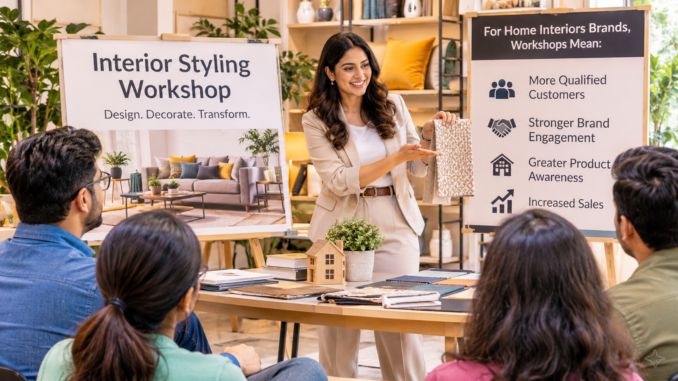
Nov 23: Interior design is becoming an increasingly engaging part of the home-buying and renovation journey. Homeowners are looking beyond individual furniture pieces and decorative products to understand how different elements can work together to create functional, attractive living spaces. This shift is opening new opportunities for home interiors brands to connect with potential customers through interactive experiences.
Interior styling workshops are emerging as a practical marketing approach for furniture retailers, décor brands, paint companies, interior designers and home styling businesses. Instead of relying entirely on traditional advertising, brands can invite customers to participate in demonstrations, learn styling techniques and explore products in real-life settings.
For businesses, these workshops offer more than brand visibility. They create opportunities to understand customer preferences, build relationships and generate enquiries that can lead to consultations and purchases.
Why Interior Styling Workshops Are Becoming a Marketing Opportunity
Consumers often find it difficult to visualise how furniture, lighting, wall colours, fabrics and accessories will look together in their homes. Product photographs and online catalogues provide inspiration, but interactive demonstrations allow customers to experience design ideas more directly.
Interior styling workshops address this gap by bringing products and practical design advice together. Participants can learn how to coordinate colours, arrange furniture, select lighting and make better use of available space.
For home interiors brands, this creates an opportunity to demonstrate expertise while introducing products in a useful and engaging environment.
The broader appeal of experiential marketing is reflected in the March 2026 EY-Parthenon and BookMyShow study, Beyond Attention. Into Immersion. The study reported that 78% of surveyed Indian consumers preferred spending on experiences over products. It also found that 55% of live-event attendees reported higher purchase intent after interacting with brands. These findings indicate the potential value of meaningful brand experiences, although they do not specifically measure sales generated by interior styling workshops.
How Workshops Help Home Interiors Brands Generate Qualified Leads
One of the strongest business benefits of interior styling workshops is the opportunity to attract people who already have an interest in improving their homes.
A person attending a session on living-room design, compact-home organisation or bedroom styling may be planning a renovation or considering new furniture and décor purchases. This makes workshop participation a useful starting point for identifying potential customers.
Brands can collect registrations, understand participants’ design interests and invite them to request personalised consultations. For example, a workshop on designing small apartments may attract homeowners looking for space-saving furniture, modular storage or multifunctional interiors.
The key is to make the experience relevant to the customer’s needs rather than turning the session into a direct sales presentation.
Businesses should also track the results after each event. Useful indicators include registrations, actual attendance, consultation requests, product enquiries, quotations shared and purchases completed within a defined follow-up period. These measurements help brands understand whether workshops are generating commercially valuable leads.
Product Demonstrations Make Furniture and Décor More Relevant
Furniture and home décor purchases often involve decisions about size, material, colour, comfort and compatibility with existing interiors. Workshops provide an opportunity for brands to demonstrate these features in practical settings.
A furniture retailer, for instance, can organise a session on arranging furniture in compact living spaces. Participants can explore different layouts and understand how sofas, tables, storage units and lighting work together.
Similarly, a home décor brand can demonstrate how cushions, rugs, curtains, wall art and accessories can change the appearance of a room without requiring a complete renovation.
These demonstrations allow customers to interact with products and ask questions. They also help businesses communicate the practical value of their offerings beyond price and appearance.
Paint, Wall Décor and Lighting Brands Can Build Customer Engagement
Interior styling workshops can also help specialised home interiors brands reach customers who may not otherwise visit their showrooms.
Paint companies can conduct colour-selection sessions, demonstrating how lighting and room dimensions influence colour choices. Wallpaper and wall décor businesses can introduce different textures, finishes and design combinations.
Lighting brands can organise demonstrations explaining how ambient, task and accent lighting influence the atmosphere and functionality of different spaces.
Such activities give customers a clearer understanding of product applications. They also create opportunities for brands to introduce new collections and connect participants with product specialists.
Interior Designers Can Use Workshops to Generate Consultation Opportunities
Independent interior designers and design studios can use workshops to demonstrate their expertise and build relationships with prospective clients.
Sessions covering topics such as kitchen planning, sustainable interiors, rental-home styling, storage solutions and budget-friendly renovations can attract homeowners at different stages of their decision-making process.
A participant who initially attends to learn about colour coordination may later require professional assistance with a complete room makeover. Workshops therefore provide designers with an opportunity to establish trust before discussing paid projects.
Design businesses can offer optional consultations after the session, allowing interested participants to discuss their requirements, budgets and timelines.
Brand Collaborations Can Expand Customer Reach
Interior styling workshops also create opportunities for collaboration between businesses operating in related categories.
A furniture retailer can partner with a paint brand, lighting company, home textile business or interior design studio to conduct a joint event. Each participating brand contributes expertise, products or resources while gaining access to a shared audience.
Such partnerships can make workshops more informative and reduce the promotional burden on individual businesses.
For smaller home interiors brands, collaborations can also provide access to established customer communities and physical venues without requiring substantial investment in independent events.
Social Media Can Extend the Value of Every Workshop
The marketing value of an interior styling workshop does not end when the event is over. Brands can use photographs, short videos, styling demonstrations and expert discussions to create content for their digital platforms.
A demonstration on choosing colours for a small living room, for example, can be converted into short-form videos, educational posts and practical design tips. With participants’ permission, brands can also share event highlights and customer experiences.
This content can help businesses maintain engagement with attendees while reaching people who could not participate in person.
However, brands should ensure that the content provides genuine design information rather than functioning only as product promotion. Practical advice is more likely to encourage continued engagement and build credibility.
Can Paid Workshops Become an Additional Revenue Stream?
Some home interiors brands and design professionals may also consider offering paid workshops. These sessions can cover specialised subjects such as advanced styling, seasonal home décor, sustainable materials, space planning and personalised design guidance.
Paid participation can help businesses recover event costs and attract people with a stronger interest in the subject.
However, the commercial approach should depend on the target audience and workshop format. Introductory sessions may work better as free events that encourage showroom visits and consultations, while specialised training can justify a participation fee.
Businesses should evaluate the cost of organising each event against registrations, attendance, customer enquiries and subsequent revenue before expanding the format.
What Home Renovation Trends Mean for Interior Styling Businesses
The opportunity for interior styling workshops is also connected to broader consumer interest in renovating and decorating living spaces.
The 2026 U.S. Houzz & Home Study, published in April 2026, surveyed 20,358 Houzz users, including 10,176 homeowners who had undertaken renovation activity. It reported that 54% of surveyed homeowners had renovated in 2025, while 52% had undertaken decorating projects. The study also found that 50% planned renovations and 41% planned decorating projects in 2026.
These figures provide an indication of activity in the U.S. home renovation and decorating market. They should not be interpreted as direct measurements of demand in India. Nevertheless, they illustrate how renovation and decorating decisions can create opportunities for businesses offering products, services and practical design guidance.
For home interiors brands, workshops can help bridge the gap between consumer inspiration and purchasing decisions by allowing people to explore ideas before committing to a project.
Turning Workshop Attendance into Business Results
Organising an event is only the first step. Businesses need a clear follow-up strategy to convert customer interest into enquiries and sales.
Brands can begin by identifying the main objective of each workshop, whether it is to introduce a product range, generate interior design consultations, promote a showroom or attract renovation enquiries.
Registration forms can capture relevant information, such as the participant’s area of interest and whether they are planning a home improvement project. During the event, businesses can offer product demonstrations and practical recommendations.
After the workshop, interested participants can receive relevant product information, consultation invitations or details of suitable services. Follow-ups should be based on the participant’s expressed interests rather than generic promotional messages.
Brands should monitor the complete customer journey, from registration to consultation and eventual purchase. This helps them identify which workshop themes attract the most relevant audiences and which activities contribute to business growth.
A More Interactive Approach to Home Interiors Marketing
As competition increases across furniture, décor, lighting, paint and interior design services, home interiors brands need effective ways to differentiate themselves. Interior styling workshops offer a format that combines education, product discovery and direct customer interaction.
For smaller businesses, these events can provide a relatively focused way to demonstrate expertise and build relationships without depending entirely on large advertising campaigns. For established brands, workshops can support product launches, showroom engagement and customer retention.
Their long-term value will depend on the quality of the experience, the relevance of the subject and the effectiveness of post-event engagement. Businesses that connect useful design guidance with carefully planned customer follow-ups can turn workshops into a meaningful part of their marketing strategy.
