
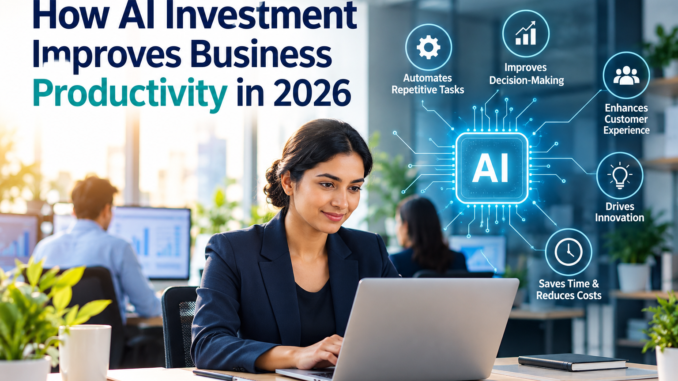
Oct 23: Artificial intelligence (AI) is changing how businesses manage daily operations, serve customers and make decisions. From automating repetitive tasks to analysing business data, AI-powered tools are helping organisations explore new ways to save time, control costs and improve productivity.
In 2026, AI investment is no longer just a technology decision. Businesses are increasingly evaluating how artificial intelligence can solve operational problems, support employees and contribute to measurable growth. However, purchasing AI tools alone does not guarantee better results. The real value comes from choosing the right applications and integrating them into everyday business processes.
AI Investment Trends in 2026: What the Latest Reports Reveal
The growing importance of artificial intelligence is reflected in recent industry research. Stanford University’s Institute for Human-Centered Artificial Intelligence reported in its 2026 AI Index Report that global corporate AI investment reached $581.69 billion in 2025, more than doubling from the previous year. The report also found that 88% of surveyed organisations were using AI in 2025.
These findings illustrate the speed at which AI is becoming part of business strategy. Companies are exploring applications ranging from customer service and marketing to operational planning and product development.
However, rising investment does not necessarily mean that every organisation is achieving stronger financial results.
McKinsey & Company’s 2026 report, The State of AI: On the Road to ROI, found that 80% of respondents reported improvements in individual productivity from AI, while 37% reported a positive impact on their organisations’ earnings before interest and taxes (EBIT).
The distinction matters. AI may help an employee complete a task faster, but the overall business benefit depends on how the saved time is used, whether output quality improves and whether the change contributes to lower costs or higher revenue.
For business leaders, the priority should therefore be to connect AI investment with specific goals rather than adopt new technology simply because it is becoming popular.
How AI Investment Improves Business Productivity
AI can support productivity across several business functions. The most useful applications often involve tasks that are repetitive, time-consuming or dependent on processing large amounts of information.
1. Business Automation Reduces Repetitive Work
Administrative tasks can take up a significant part of the working day. Preparing reports, sorting documents, entering information and responding to routine enquiries can leave employees with less time for planning and customer engagement.
AI-powered automation can simplify parts of these processes by organising information, classifying requests, summarising documents and supporting workflows across business applications.
For example, a service company could use an AI-enabled system to categorise incoming customer enquiries and direct them to the appropriate team. Employees would spend less time sorting requests manually and more time resolving customer issues.
Businesses should begin by identifying tasks that create recurring delays or unnecessary manual effort. Automating a well-defined process is often more useful than introducing technology without a clear business objective.
2. AI Tools Improve Marketing and Content Efficiency
Marketing teams can use AI productivity tools for keyword research, content planning, campaign analysis, audience segmentation and the preparation of initial drafts. These capabilities can help teams manage workloads more efficiently and explore new ideas.
AI can also assist with identifying customer interests, reviewing campaign performance and organising content around relevant search queries.
For businesses focused on digital visibility, these tools can support search engine optimisation (SEO) by helping teams research topics and improve content planning. However, AI-generated material still requires editorial review, factual verification and original insights.
Publishing large volumes of repetitive content is not a substitute for useful information. Businesses should focus on producing accurate, relevant content that addresses what their audiences actually want to know.
3. AI Enhances Customer Service and Sales
Customers expect timely responses and convenient access to information. AI-powered chatbots and virtual assistants can help businesses answer common questions, explain basic services and route complex enquiries to the right employees.
Sales teams can also use AI to summarise customer interactions, organise leads and prepare relevant follow-up communication.
These applications can reduce routine workloads and help employees concentrate on building relationships. However, businesses should ensure that customers can reach a human representative when an issue requires judgement, empathy or individual attention.
4. AI Supports Data-Driven Business Decisions
Businesses generate information through sales transactions, customer feedback, website activity and internal operations. Reviewing all this information manually can be difficult and time-consuming.
AI-powered analytics can help identify patterns, summarise data and highlight areas that deserve further investigation.
For example, a retailer could analyse purchasing trends to improve inventory planning, while a service provider could review enquiry volumes to allocate staff more effectively.
AI-generated insights should always be evaluated against reliable data and business experience. The technology can support decision-making, but it should not replace human judgement in important commercial matters.
How to Calculate the ROI of AI Investment
Return on investment (ROI) is one of the most important considerations when evaluating AI for business productivity. A tool may appear affordable initially, but its actual value depends on implementation costs and the improvements it delivers.
Businesses should consider software subscriptions, employee training, integration, maintenance, data security and the time required for human review. These costs can then be compared with measurable benefits, including time savings, fewer errors, improved customer service and additional revenue.
A simple ROI calculation is:
ROI = (Financial benefits − Total investment cost) ÷ Total investment cost × 100
Consider a hypothetical business that invests ₹1,00,000 in an AI-enabled workflow over a defined evaluation period. If the business achieves ₹1,50,000 in measurable financial benefits during that same period, its net benefit is ₹50,000 and its ROI is 50%.
This example assumes that the benefits and costs have been measured consistently. Businesses should avoid counting the same saving twice or treating estimated time savings as cash savings unless those savings translate into measurable financial value.
Useful performance indicators include:
- Time required to complete a task
- Cost per transaction or customer enquiry
- Error rates and rework
- Customer response times and satisfaction
- Number of qualified leads generated
- Revenue or cost savings attributable to the new workflow
Establishing a baseline before implementing AI makes it easier to determine whether the investment is delivering genuine improvements.
AI Investment for Small Businesses: Where to Start
Small businesses do not need to invest in expensive systems or automate every department at once. A focused AI adoption strategy can help them test the technology while keeping costs under control.
Identify a specific problem. Look for tasks that consume considerable employee time, create recurring delays or require repetitive data processing.
Choose a suitable AI tool. Compare features, subscription costs, security safeguards and compatibility with existing software before making a decision.
Start with a small pilot. Test the tool with one team or workflow before expanding its use across the organisation.
Train employees. Explain how the tool should be used, what information it can access and when its output requires verification.
Measure the results. Compare productivity, quality and total costs with the original baseline. Expand the investment only when the results justify it.
For example, a small marketing agency could use AI to assist with initial research, content outlines and campaign reporting. Employees could then devote more time to client strategy, creative development and performance analysis.
The objective is not to replace every manual activity. It is to help employees spend more time on work that requires expertise and delivers greater business value.
Challenges Businesses Should Consider Before Adopting AI
Despite its potential, AI adoption comes with risks that should be addressed as part of any investment decision.
Implementation and maintenance costs: Integration, training and ongoing software expenses can reduce the expected return if they are not included in the budget.
Data privacy and cybersecurity: Businesses should understand how AI providers handle customer information, confidential documents and other sensitive business data. Access controls and appropriate security measures are essential.
Accuracy and reliability: AI systems can generate incorrect information or misleading recommendations. Important outputs need human verification, particularly when they affect financial decisions or customer commitments.
Employee training and adoption: Teams need the skills and confidence to use new tools effectively. Involving employees in the process can help identify practical use cases and reduce resistance.
Uncertain financial returns: Faster task completion does not automatically lead to higher profits. Businesses need to assess whether productivity gains translate into measurable improvements in service, costs or revenue.
Addressing these challenges early can help organisations make better technology decisions and avoid investing in tools that do not solve their actual problems.
The Future of AI Investment and Business Productivity
AI is moving beyond tools that assist with individual tasks. Businesses are increasingly exploring connected workflows in which different applications support research, analysis, communication and routine decision-making.
AI agents may also help coordinate multi-step activities, depending on their capabilities, integrations and permissions. However, complex workflows still require clear instructions, appropriate safeguards and human supervision.
As adoption expands, businesses will need to consider how AI fits into their wider operating models. Reliable data, employee expertise, strong governance and measurable performance targets will remain important.
Organisations that treat AI as a business improvement initiative rather than simply a technology purchase may be better positioned to achieve lasting benefits. Their success will depend on selecting useful applications, improving existing processes and reviewing outcomes regularly.
Conclusion
AI investment is creating new opportunities to improve business productivity through automation, more efficient marketing, better customer service and data-driven decisions. Research from Stanford and McKinsey highlights both the rapid expansion of AI adoption and the challenge of converting individual productivity improvements into measurable financial returns.
For businesses in 2026, the priority should be to identify practical use cases, assess costs carefully and measure results against clear objectives. Starting small, training employees and expanding successful applications can help organisations manage risks while discovering where AI delivers the greatest value.
Ultimately, successful AI investment is not about adopting the largest number of tools. It is about using artificial intelligence to solve real business problems, make better use of resources and support sustainable growth.
