
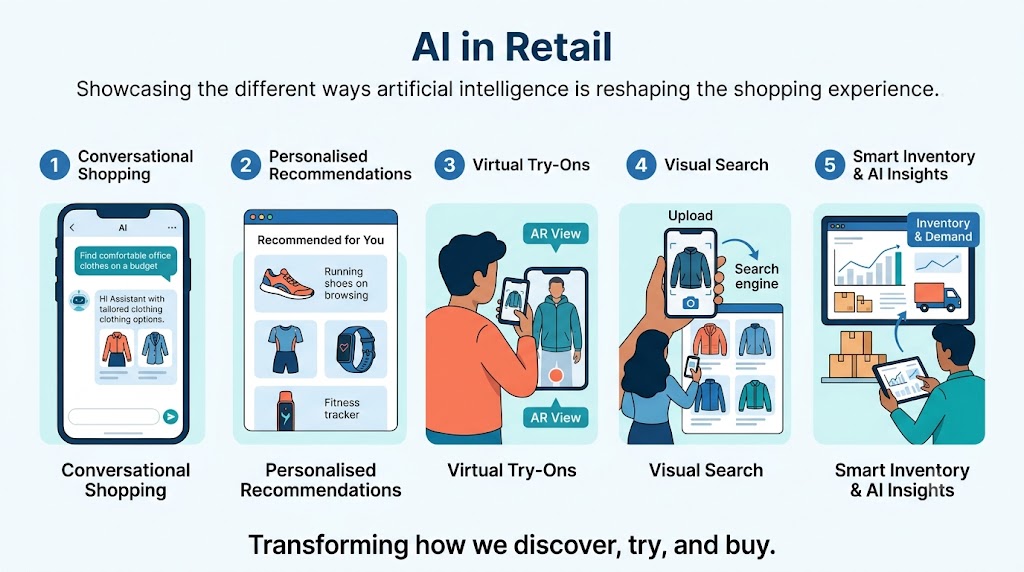
Artificial intelligence is reshaping the American retail industry, changing how consumers discover products, compare prices and make purchasing decisions. From personalised product recommendations to virtual try-ons and conversational shopping assistants, retailers are increasingly using AI to create shopping experiences that feel faster, simpler and more relevant to individual customers.
Personalisation has become a major technology priority for retailers as competition intensifies across online marketplaces, physical stores and mobile shopping platforms. Instead of presenting every customer with the same products and promotions, businesses are using data and AI-powered tools to understand individual preferences and anticipate what shoppers may need next.
The shift is also changing how retailers attract customers, manage marketing expenses and build long-term relationships in an increasingly digital marketplace.
AI Is Making Online Shopping More Conversational
One of the biggest changes is the emergence of conversational shopping. Consumers are gradually moving beyond traditional keyword searches and browsing through endless product listings. AI assistants allow them to describe what they want in everyday language and receive recommendations tailored to their needs.
For example, a shopper might ask for comfortable office clothes within a specific budget or request furniture suitable for a small apartment. AI-powered systems can interpret these requirements, narrow down the options and help customers compare suitable products.
Retailers are also exploring integrations that allow customers to discover products and move towards purchasing through AI chat interfaces. Such developments could reduce the number of steps between identifying a need and completing a transaction.
For businesses, conversational shopping offers an opportunity to improve product discovery and reduce the chances of customers abandoning their searches because they cannot find what they want.
Personalised Recommendations Are Driving Customer Engagement
AI recommendation engines have become an important part of digital retail. These systems analyse signals such as browsing activity, previous purchases, product searches and stated preferences to suggest relevant items.
A customer shopping for running shoes, for instance, may receive recommendations for sportswear, fitness accessories or products suited to their preferred activities. Similarly, an online grocery shopper may see suggestions based on frequently purchased household essentials.
When used effectively, these recommendations can make shopping more convenient while helping retailers increase product discovery, repeat purchases and average order values.
However, personalisation must be useful rather than intrusive. Customers are more likely to respond positively when recommendations reflect their interests without making them feel that their private behaviour is being excessively monitored.
Virtual Try-Ons Are Reducing Buying Uncertainty
Buying products online can be difficult when customers cannot physically examine them. Artificial intelligence, combined with augmented reality, is helping address this challenge through virtual try-ons and visualisation tools.
Fashion and beauty retailers are experimenting with digital experiences that allow shoppers to preview clothing styles, makeup shades and accessories. Furniture retailers can offer tools that help customers visualise how a sofa, table or decorative item might look in their homes.
These technologies can make online shopping more interactive and help consumers make informed choices before placing an order.
For retailers, the potential business benefits include stronger purchase confidence, improved customer engagement and fewer returns caused by mismatched expectations. The actual results, however, depend on the accuracy of the technology and how easily customers can use it.
Visual Search Is Changing How Customers Find Products
Not every shopper knows the right words to describe a product. Visual search allows customers to upload a photograph, screenshot or reference image and find similar items in a retailer’s catalogue.
This feature is particularly useful for fashion, home furnishings, accessories and lifestyle products, where colour, shape and design often influence buying decisions.
A consumer who spots an attractive jacket in a photograph, for example, can use an image to search for similar styles without knowing the product’s name or brand.
Visual search also creates new opportunities for retailers to connect customer inspiration with actual purchases. Businesses with well-organised product catalogues and accurate image data are better positioned to benefit from these tools.
AI Is Changing Retail Marketing and Product Discovery
Artificial intelligence is also influencing how brands reach customers and compete for visibility online. Retailers can use automated systems to tailor emails, mobile notifications and promotional messages according to customer interests and shopping activity.
A shopper who has viewed a product may receive a reminder about a price reduction, while someone who regularly purchases household essentials could receive relevant offers when supplies are likely to run low.
These automated campaigns can help marketing teams use their budgets more efficiently by prioritising relevant communication over generic promotions.
At the same time, consumers are increasingly exploring products through AI assistants and conversational search tools. This is encouraging retailers to improve product descriptions, maintain accurate pricing and availability information, and publish useful content that AI-powered search systems can interpret.
As a result, visibility may depend not only on traditional search rankings but also on whether a retailer’s products are clearly represented in the information used by AI tools.
The Business Benefits Extend Beyond Sales
The growing use of AI in retail is about more than creating a personalised shopping experience. It can also influence how businesses manage inventory, forecast demand and allocate resources.
By analysing purchasing patterns and seasonal trends, AI systems can help retailers anticipate which products may sell faster and where additional stock could be needed. Better forecasting can reduce the risk of overstocking, limit missed sales caused by shortages and improve working capital management.
AI can also support customer service by answering routine questions, tracking orders and helping resolve common issues. This may allow employees to devote more time to complex customer needs and other operational responsibilities.
For small and medium-sized retailers, these capabilities could offer a way to compete with larger businesses. However, implementation costs, integration with existing systems, employee training and access to reliable data remain important barriers.
Retailers will need to assess whether the expected gains justify the investment rather than adopting AI simply because competitors are doing so.
Data Privacy and Trust Remain Major Challenges
Personalised shopping depends on customer information, making privacy and responsible data use central to the future of AI-driven retail.
Consumers may welcome relevant recommendations but become uncomfortable when businesses collect excessive information or make personalisation difficult to control. AI-generated recommendations can also be inaccurate, while automated pricing and marketing systems may raise concerns about fairness and transparency.
Retailers must therefore establish clear data practices, protect customer information and provide meaningful choices about how personal data is used. They should also monitor AI systems to identify errors, misleading recommendations and unintended bias.
Trust will be especially important as shopping assistants become more capable of guiding consumers from product discovery to purchase.
The Future of Retail Will Depend on Useful AI
Artificial intelligence is moving retail towards a more responsive and personalised model in which product discovery, marketing, customer service and inventory management are increasingly connected.
For American retailers, the opportunity lies in using these tools to solve genuine customer problems: finding suitable products faster, making confident purchasing decisions and receiving relevant information at the right time.
Yet technology alone will not guarantee success. Retailers must balance convenience with privacy, automation with human support, and personalisation with transparency.
Businesses that achieve this balance could strengthen customer loyalty, improve operational efficiency and develop a competitive advantage in a crowded marketplace. Ultimately, the future of AI-powered retail will be shaped not by how much technology a company adopts, but by how effectively it makes shopping more useful for consumers and more sustainable for the business.
