
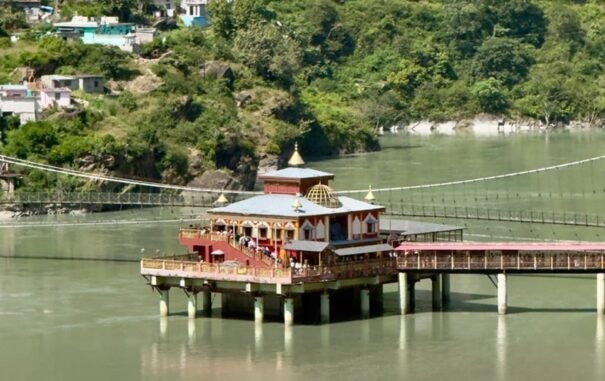
Sept 23: Perched above the Alaknanda in Uttarakhand, Dhari Devi Temple is one of the most distinctive shrines in the Garhwal Himalayas. Located near Kalyasaur between Srinagar and Rudraprayag, the temple is dedicated to Dhari Devi, regarded as a form of Goddess Kali.
Its striking location is only part of its story. The temple has witnessed a major infrastructure project, the temporary relocation of its idol, the devastating Uttarakhand floods of 2013 and, nearly a decade later, the return of the deity to an elevated shrine at the same sacred site.
Today, it is also attracting an increasingly large number of pilgrims.
A Shrine With an Ancient Local Story
According to local tradition, the history of Dhari Devi is closely associated with a devastating flood that occurred generations ago.
The story goes that the waters swept away an earlier temple and carried the idol of the goddess downstream. The idol eventually became lodged against a rock near Dharo village. Villagers are said to have heard a divine voice instructing them to establish the deity at that location.
A shrine was subsequently built there, and Dhari Devi became an important local deity.
Over time, the temple developed into a significant pilgrimage stop in the Garhwal region.
The Decision to Raise the Temple
The temple’s location became complicated with the development of the Srinagar hydropower project.
As the project affected the surrounding area and water levels, plans were made to protect the shrine by constructing it at a higher elevation. The idol was therefore temporarily moved from its traditional position in June 2013.
What happened next would forever change the way the episode is remembered.
The 2013 Uttarakhand Floods
In June 2013, Uttarakhand was hit by catastrophic floods and landslides that caused widespread destruction and loss of life.
The removal of Dhari Devi’s idol shortly before the disaster quickly became part of local and popular discussion. Many devotees came to believe that disturbing the goddess from her traditional seat had angered her and was connected to the disaster.
This remains a religious belief rather than a scientifically established explanation for the floods. Nevertheless, the timing created a powerful association that continues to be part of the temple’s modern history.
For devotees, the episode became about more than the physical movement of an idol. It was seen as a disruption of a centuries-old relationship between the goddess and her traditional seat.
The Temple Was Not Permanently Relocated
The story is sometimes simplified as the “relocation of Dhari Devi Temple,” but that description misses an important detail.
The idol was temporarily moved, while the sacred site itself was retained.
A new elevated temple was constructed at essentially the same location, allowing the shrine to remain connected to its traditional setting while being positioned higher than the earlier structure.
The result is the temple visitors see today: an elevated shrine reached by a walkway, with the surrounding Himalayan landscape opening out around it.
Nearly a Decade Later, the Goddess Returned
The temporary relocation lasted for several years as the new shrine was developed.
For devotees, the process was not complete until Dhari Devi returned to her traditional place.
In January 2023, the idol was ceremonially reinstalled in the elevated temple after years away from the original shrine.
The return was an important moment for devotees who had regarded the temporary relocation as an incomplete chapter in the temple’s history.
It also marked the end of a remarkable period during which the shrine had undergone one of the most significant changes in its modern history.
A Shrine That Continues to Face the Elements
The temple’s elevated position remains particularly important during periods of heavy rainfall.
In 2025, the Alaknanda rose significantly following heavy rain and reached the temple platform. The incident attracted attention because of memories of the 2013 disaster, although no damage to the temple was reported.
The episode also served as a reminder of why the shrine was raised in the first place.
Visitor Numbers Are Rising
Dhari Devi is not only an important religious site; it is also becoming increasingly popular with travellers visiting Uttarakhand.
According to Uttarakhand Tourism Department figures reported in 2026, 5,42,626 pilgrims visited Dhari Devi between January and June 2026, compared with 2,83,275 during the same period in 2025.
That represents an increase of approximately 92% in the first six months of the year.
Dhari Devi Pilgrim Footfall
| Period | Visitors |
|---|---|
| January–June 2025 | 2,83,275 |
| January–June 2026 | 5,42,626 |
| Increase | Approximately 92% |
Reports from the 2026 pilgrimage season also indicated exceptionally high visitor numbers, with more than six lakh devotees reported during the first month of the season and daily footfall reaching approximately 20,000–25,000 visitors on busy days.
The figures should not be confused: the 5.42 lakh figure covers January to June 2026, while the six-lakh figure relates specifically to the reported pilgrimage-season period.
Why Dhari Devi Is Becoming a Popular Stop
Dhari Devi is not one of Uttarakhand’s four Char Dham shrines, but its location along important pilgrimage routes has made it a popular stop for people travelling towards destinations such as Kedarnath and Badrinath.
Its appeal also comes from the combination of history and setting.
Visitors encounter a temple with a centuries-old local tradition, a dramatic modern history and a striking elevated structure that reflects the changes the shrine has undergone.
For many travellers, it offers a quieter opportunity to experience the religious landscape of Garhwal beyond the better-known Char Dham destinations.
A Story of Continuity
Dhari Devi’s recent history is ultimately a story of preservation.
The idol was moved in 2013. The temple was rebuilt at a higher level. The devastating floods that followed became permanently associated with the shrine in local memory. And in 2023, the deity was returned to the elevated temple at the traditional sacred site.
The temple has therefore changed without losing its identity.
With more than 5.4 lakh pilgrims recorded in just the first six months of 2026, Dhari Devi is also becoming an increasingly prominent destination for visitors to Uttarakhand.
For those travelling through the Garhwal Himalayas, the temple offers something that few pilgrimage sites can: a powerful combination of faith, history, dramatic landscape and a remarkable story of survival and return.
