
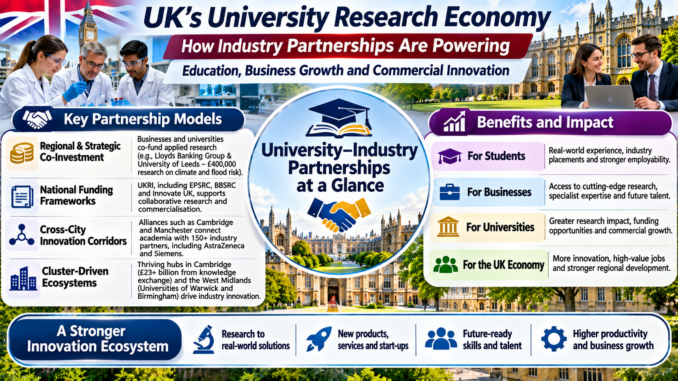
From university classrooms and research laboratories to global businesses and emerging industries, the UK is creating a powerful connection between education and enterprise. Strategic partnerships are helping universities turn knowledge into commercial opportunities, prepare future-ready graduates and strengthen the country’s innovation economy.
The future of education is increasingly being shaped by what happens beyond the classroom. Across the United Kingdom, universities are building stronger relationships with businesses, financial institutions, technology companies and public organisations, creating an environment where academic knowledge can translate into real economic value.
This growing collaboration is changing the way higher education contributes to society and the economy. University research is helping businesses develop new products, improve services, address industry challenges and explore emerging markets. At the same time, companies are becoming more involved in education by supporting research projects, offering industry placements, sharing expertise and helping universities understand the skills employers will need in the years ahead.
For students, this creates a more connected learning experience. For universities, it opens new avenues for research funding, partnerships and commercial development. For businesses, it provides access to specialist knowledge, fresh ideas and talented graduates who can contribute to innovation.
The UK’s university research economy is therefore developing into an important meeting point for education, investment and enterprise, where academic excellence and commercial ambition work together to create opportunities for the next generation.
Universities Are Becoming Engines of Business Innovation
Universities have long been centres of knowledge creation, but their economic contribution is becoming more visible through industry collaboration and research commercialisation.
Businesses increasingly recognise that universities offer more than academic qualifications. They provide access to specialist researchers, advanced laboratories, emerging technologies and intellectual expertise that can help companies respond to complex commercial challenges.
Through collaborative research, businesses can work with academics to develop new technologies, improve manufacturing processes, explore artificial intelligence applications and create solutions for sectors such as healthcare, financial services, clean energy and advanced engineering.
This relationship also benefits universities. Industry partnerships allow researchers to understand real-world challenges, access additional research opportunities and demonstrate how their work can deliver practical benefits.
For higher education institutions, commercial collaboration is becoming an important way to strengthen their position as contributors to national productivity, regional development and global competitiveness.
Lloyds Banking Group and the University of Leeds Demonstrate the Value of Strategic Collaboration
A recent example of this approach is the partnership between Lloyds Banking Group and the University of Leeds, announced on 17 November 2026.
The collaboration is designed to connect university research with businesses, investors and regional organisations, supporting innovation and economic development across Yorkshire.
Its first initiative includes a £400,000 research agreement and a Knowledge Transfer Partnership focused on climate, flood and risk modelling. The research aims to strengthen the ability to predict and manage climate-related risks, demonstrating how academic expertise can support practical business and societal needs.
The wider partnership also focuses on graduate opportunities, internships, industry placements, curriculum development and financial education.
What makes this collaboration particularly valuable is its broader vision. It brings together research, business expertise and talent development within one strategic framework. Businesses gain access to academic knowledge, while students benefit from closer connections with employers and opportunities to understand how research translates into professional practice.
It is a strong example of how universities and major employers can work together to create value that extends beyond campus boundaries.
UKRI Funding Is Helping Turn Research into Commercial Opportunities
Research funding remains an important foundation of the UK’s university-industry ecosystem.
UK Research and Innovation (UKRI) supports collaboration between academic institutions, businesses and research organisations through a range of funding and knowledge-exchange programmes.
Its wider network includes the Engineering and Physical Sciences Research Council (EPSRC), the Biotechnology and Biological Sciences Research Council (BBSRC) and Innovate UK.
These organisations help support research across areas such as engineering, biotechnology, manufacturing, digital technologies, healthcare and environmental innovation.
One particularly important mechanism is the Knowledge Transfer Partnership (KTP), which connects a business with a university or research organisation to address a strategic business challenge.
Under this model, a qualified graduate, known as a KTP Associate, works with the company while receiving academic support from the university. The arrangement allows businesses to bring specialist knowledge into their operations while giving graduates the opportunity to lead meaningful innovation projects.
For companies, this can support the development of new products, services and processes. For universities, it creates a direct connection between academic expertise and commercial application. For graduates, it provides valuable professional experience and an opportunity to apply their education to real business challenges.
The Knowledge Transfer Partnership programme illustrates how investment in education and research can generate benefits across the wider economy.
Regional University Partnerships Are Strengthening Local Economies
The impact of university-industry collaboration is not limited to individual research projects. Across the UK, regional innovation ecosystems are bringing universities, businesses, investors and public institutions closer together.
Cambridge is one of the country’s best-known examples. Its university-led research environment has helped support a strong network of technology, biotechnology and scientific businesses. The presence of research institutions, specialist facilities and innovative companies has created an environment where academic discoveries can develop into commercial ventures.
The West Midlands also demonstrates the importance of regional academic and industrial relationships. Institutions such as the University of Warwick and the University of Birmingham contribute to research and innovation across advanced manufacturing, engineering, healthcare and technology.
These regional partnerships create opportunities for businesses to access research expertise while helping universities respond to local economic priorities.
They also provide students with greater exposure to employers through placements, collaborative projects, research opportunities and professional networks. This strengthens the relationship between universities and the communities they serve.
Industry Partnerships Are Making Education More Career-Oriented
One of the most valuable outcomes of university-industry collaboration is the opportunity to connect academic learning with professional experience.
Students today are preparing for careers in industries that are changing rapidly. Employers increasingly value graduates who combine subject knowledge with practical skills, digital confidence, communication abilities and problem-solving experience.
Industry-linked education can help students develop these capabilities before entering the workforce.
Internships, work placements, live business projects, research collaborations and employer-led learning opportunities allow students to understand workplace expectations while applying their academic knowledge in practical situations.
These experiences can also help graduates develop professional confidence, build industry networks and gain a clearer understanding of their chosen careers.
For universities, working closely with employers provides valuable insight into changing skills requirements. This can support curriculum development and encourage courses to reflect developments in areas such as artificial intelligence, financial technology, clean energy, advanced manufacturing and data science.
The result is an educational experience that combines academic depth with practical relevance.
Commercial Research Is Creating New Business Opportunities
Research commercialisation is another important part of the UK’s university economy.
Academic discoveries can lead to new products, specialist technologies, improved industrial processes and entirely new businesses. Universities support this journey through technology transfer offices, business incubators, intellectual property support, licensing arrangements and spin-out companies.
These structures help researchers move from an initial discovery towards a commercial application. They can also connect entrepreneurs with investors, industry partners and experienced business advisers.
For businesses, university research offers opportunities to access ideas and technologies that can strengthen competitiveness. For students and graduates, the growing start-up ecosystem creates opportunities to participate in entrepreneurship, research-led companies and innovation-driven careers.
This is particularly significant in high-growth sectors such as biotechnology, healthcare, artificial intelligence, robotics, clean energy and advanced materials.
As research moves closer to commercial markets, universities are becoming increasingly important contributors to the UK’s business creation and innovation landscape.
Building a Future-Ready Workforce Through Education and Enterprise
The value of university-industry partnerships extends beyond immediate commercial results. They also help develop the skills and knowledge required by future industries.
As businesses adopt new technologies and operating models, demand is growing for graduates with expertise in digital systems, engineering, data analysis, sustainability, research and innovation management.
Universities that maintain strong employer relationships are better positioned to understand these changing requirements and respond through relevant courses, professional training and applied research.
Partnerships can also support lifelong learning, executive education and professional development, helping existing employees update their skills as industries evolve.
For employers, this creates a stronger talent pipeline. For students, it provides a clearer connection between education and career opportunities. For the wider economy, it supports the development of a skilled workforce capable of driving productivity and innovation.
The Growing Business Value of University Research
The UK’s university research economy is creating value across several interconnected areas.
- Business innovation: Companies gain access to specialist research, technology and expertise that can support new products and services.
- Research investment: Collaborative funding creates opportunities for universities and businesses to develop ambitious projects.
- Graduate employability: Placements, internships and Knowledge Transfer Partnerships provide practical experience and stronger links with employers.
- Entrepreneurship: Research commercialisation and university spin-outs help transform academic discoveries into new businesses.
- Regional development: University partnerships support local employers, investment networks and skilled employment.
- Industry competitiveness: Access to research and emerging talent helps businesses respond to technological and market changes.
These benefits demonstrate why university-industry collaboration is becoming an important part of the UK’s economic and educational strategy.
A Positive Outlook for UK Higher Education and Business
The UK’s university research economy is entering an exciting period of opportunity. Universities are strengthening their role as centres of education, research and enterprise, while businesses are increasingly recognising the value of academic collaboration.
The development of strategic partnerships, research funding programmes, regional innovation networks and industry-linked learning is creating a more connected environment for students, researchers and employers.
For universities, these relationships provide opportunities to expand research impact and strengthen their contribution to society. For businesses, they offer access to knowledge, talent and innovation. For students, they bring academic learning closer to professional opportunities and future career pathways.
As collaboration continues to grow, the relationship between education and industry will become an even more important part of the UK’s economic development.
The greatest achievement of this partnership-driven approach is the opportunity it creates for everyone involved. A research discovery can become a business solution, a university project can open the door to a graduate’s first professional opportunity, and an industry challenge can inspire the next generation of innovation. By bringing education and enterprise closer together, the UK is building an environment where knowledge creates opportunity, talent drives growth and research helps shape a more innovative future.
