
Introduction: Earning Money Is One Thing. Managing It Is Another
Nov 19: A young professional receives a salary at the end of the month. Rent is paid, food is ordered, subscriptions are renewed, shopping notifications arrive and a weekend plan is booked. Within a few days, a significant part of the salary has already been allocated.
By the middle of the month, the bank balance may begin to look uncomfortable.
For many young adults, this is becoming a familiar financial experience. Generation Z is entering the workforce in an economy where digital payments, online shopping, instant credit and easy access to investment platforms have changed how money is earned, spent and managed.
Young Indians have access to more financial information than previous generations. They can compare investment products, open accounts and make digital transactions from their phones. Yet access to financial tools does not automatically translate into sound money management.
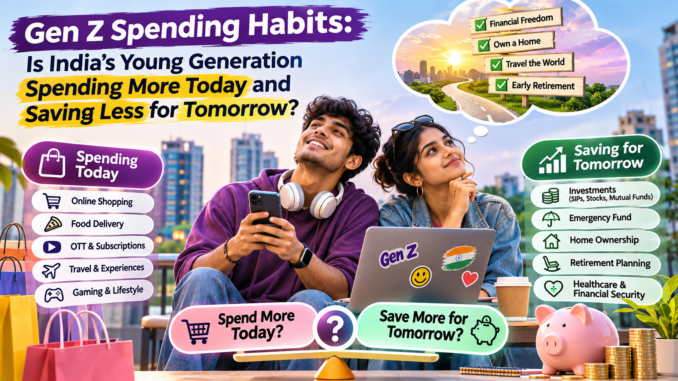
The bigger question is whether today’s young earners are balancing their desire to enjoy the present with the need to prepare for the future.
One simple financial principle offers a useful starting point:
Income – Investment = Expenses
Instead of spending first and investing whatever remains, this approach encourages individuals to allocate money towards savings and investments at the beginning of the month. The remaining income becomes the amount available for everyday expenses and lifestyle choices.
It is a simple shift in behaviour, but it can influence long-term financial stability.
1. Gen Z and Money: A Different Relationship with Spending
Previous generations often associated financial success with owning a home, maintaining a stable job, saving regularly and preparing for retirement. For Gen Z, financial priorities are more varied.
Young adults want career growth, financial independence, travel, personal experiences and flexibility. They are also more comfortable using digital platforms to manage everyday transactions and explore financial products.
However, the idea that Gen Z only spends and rarely saves does not tell the whole story.
The 2025 India Gen Z Study by EY and the Reserve Bank Innovation Hub, based on a survey of 1,046 young respondents, found that 81% demonstrated some level of financial planning or spending management. Yet, only 33% said they actively budgeted and consistently stuck to it.
This distinction matters. Gen Z is not a generation without financial goals. It is a generation learning to balance aspirations, digital convenience and long-term responsibilities.
2. The Financial Formula: Income – Investment = Expenses
The principle behind this formula is straightforward: decide how much to save and invest before allocating money to discretionary spending.
Consider a young professional in India earning ₹40,000 per month.
Under a simple budgeting approach, the individual could allocate the income as follows:
| Category | Monthly allocation |
|---|---|
| Income | ₹40,000 |
| Savings and investments | ₹8,000 |
| Essential expenses | ₹20,000 |
| Lifestyle and personal spending | ₹12,000 |
| Total allocated | ₹40,000 |
This is an illustrative 50-30-20 allocation: 50% for essential expenses, 30% for lifestyle choices and 20% for savings and investments.
The percentages are not fixed rules. Someone living in a high-rent city, supporting family members or repaying education loans may need a different allocation.
The important point is to make saving a planned activity rather than relying on whatever remains at the end of the month.
Emergency savings should also be included in the financial plan. Someone without a safety net may choose to direct part of the savings allocation towards building an emergency fund before increasing market-linked investments.
3. The 50-30-20 Rule: A Practical Starting Point for Young Earners
One of the simplest ways to organise monthly income is the 50-30-20 budgeting method.
-
50% for needs: Rent, groceries, electricity, transport, essential bills and necessary repayments.
-
30% for wants: Shopping, entertainment, dining, subscriptions, holidays and personal interests.
-
20% for savings and investments: Emergency savings, recurring deposits, mutual funds and other investments suited to individual goals and risk tolerance.
For a person earning ₹40,000, this means ₹20,000 for needs, ₹12,000 for wants and ₹8,000 for savings and investments.
The advantage of this method is that it creates a visible limit for lifestyle spending without requiring people to eliminate enjoyable activities.
It can also be adjusted as income changes. A person receiving a salary increase could direct part of the additional income towards savings rather than immediately increasing monthly expenses.
4. Why Digital Convenience Can Make Spending Harder to Track
India’s digital payment ecosystem has made everyday transactions faster and more convenient. UPI processed approximately 24,162 crore transactions worth ₹314 lakh crore during FY2025–26, accounting for around 85% of India’s digital payment transactions during the year.
For consumers, this means payments can be completed almost instantly, whether they are buying groceries, ordering food, booking transport or shopping online.
The convenience is valuable, but it can also make frequent spending less visible. Paying ₹150 several times a day may not feel significant, but small transactions can accumulate into a substantial monthly amount.
Some common spending patterns deserve attention.
Online shopping and lifestyle purchases
Fashion, gadgets, skincare and lifestyle products are constantly promoted through digital platforms. Discounts, limited-time offers and personalised advertisements can create pressure to buy something immediately.
A lower price does not necessarily make a purchase worthwhile. Buying something that is not needed simply because it is discounted can still affect the monthly budget.
Food delivery and convenience spending
Ordering food can save time, particularly for people with demanding work schedules. However, frequent delivery charges, platform fees and premium pricing can increase monthly expenses.
Planning meals, setting a weekly food budget and balancing home-cooked meals with occasional orders can help manage this category.
Subscriptions that quietly drain money
Streaming services, music platforms, gaming applications, cloud storage and premium software often operate through recurring payments.
The cost of one subscription may appear small, but several unused or overlapping subscriptions can become an unnecessary monthly expense.
Reviewing recurring payments every few months can help identify services that are no longer useful.
Travel and experiences
Travel, concerts, events and social activities are meaningful parts of life for many young adults. They do not need to disappear from a financial plan.
The better approach is to create a separate experience or travel fund and save towards it in advance rather than relying on credit to finance every plan.
5. Social Media, FOMO and the Psychology of Spending
Social media has changed how people discover products and perceive lifestyles. Young consumers are constantly exposed to images of expensive holidays, branded clothing, new smartphones, premium restaurants and aspirational experiences.
This can create a subtle pressure to keep up.
A young professional may begin wondering whether they are earning enough, whether they should upgrade their phone or why their lifestyle does not look like those of people they follow online.
The problem is that social media rarely shows the complete financial picture. A holiday photograph does not reveal whether the trip was paid for through savings, a loan, family support or a credit card.
The fear of missing out, commonly known as FOMO, can encourage purchases that are driven by comparison rather than genuine need.
Before making a non-essential purchase, it helps to ask:
Would I still want this if nobody else could see me using it?
A short waiting period before buying expensive items can also reduce impulse spending. The objective is not to avoid spending altogether, but to make purchases that genuinely add value.
6. Are Young Indians Saving and Investing Enough?
The available research challenges the assumption that Gen Z is uninterested in saving.
The EY and Reserve Bank Innovation Hub India Gen Z Study 2025 found that 93% of respondents set aside some portion of their money for savings, although only 37% said they did so consistently. Savings accounts were the most commonly reported savings vehicle, selected by 63% of respondents.
The same study found that 62% identified savings or investments among their major monthly spending categories. Household expenses, rent and transport were identified by 59%, while shopping was reported by 57%. These were multiple-choice responses, not percentages of total income spent.
This suggests that many young Indians recognise the importance of financial security. The challenge is translating that intention into a consistent habit.
At the national level, net household financial savings in India increased to 7% of gross national disposable income in 2024–25, compared with 5.8% in 2023–24. This is a measure of household savings across India, not a Gen Z-specific figure, but it provides useful context on the country’s broader savings environment.
For young earners, the next step is to understand the difference between keeping money in a savings account and investing towards longer-term financial goals.
7. Investment Habits: Opportunities and Risks for Gen Z
Young Indians have access to a growing range of financial products, including fixed deposits, recurring deposits, mutual funds, systematic investment plans (SIPs), stocks and government-backed savings options.
The EY study found that around one in three respondents actively participated in market-linked investments. Among the investment options reported, 40% selected the stock market, 34% selected SIPs or mutual funds and 30% reported futures and options. The findings also identified gaps in investment knowledge and a lack of sufficient funds as barriers for some respondents.
The figures highlight both growing interest and the need for financial education. In particular, futures and options involve substantial risk and are not appropriate for every investor.
Young investors should consider a few basic principles:
-
Understand the difference between saving and investing.
-
Build an emergency fund before taking significant market risks.
-
Clear or manage expensive debt before committing large amounts to investments.
-
Learn how mutual funds, index funds, deposits and equities work.
-
Understand risk, liquidity and investment time horizons.
-
Avoid investment decisions based solely on social media recommendations.
-
Be cautious of schemes promising guaranteed or unusually high returns.
Investing should be connected to a financial goal, such as higher education, buying a home, starting a business or building retirement savings. It should not become a competition to identify the next trending stock or make quick profits.
8. Common Financial Mistakes Young Investors Should Avoid
Access to investment platforms has made participation easier, but it has also increased the importance of understanding financial risks.
Investing without an emergency fund
Unexpected medical expenses, job changes, family responsibilities or urgent repairs can create financial pressure. Without accessible savings, individuals may be forced to sell investments at an unsuitable time or borrow money.
Following unverified financial influencers
Online creators can make financial topics easier to understand, but their recommendations should not automatically be treated as professional advice. Investment decisions require independent research and an understanding of risk.
Treating trading as a shortcut to wealth
Frequent trading, leveraged positions and derivatives can expose inexperienced investors to significant losses. A long-term investment strategy should not be confused with speculative activity.
Ignoring high-interest debt
Credit card balances and expensive personal loans can reduce the money available for future savings. Repaying high-interest debt can be a more useful financial priority than taking additional investment risks.
Expecting immediate returns
Wealth creation generally requires time, consistency and realistic expectations. Market returns fluctuate, and no investment can guarantee profits.
9. Credit Cards and Buy Now, Pay Later: Convenience or Financial Pressure?
Credit cards and Buy Now, Pay Later (BNPL) services can make purchases more convenient, but they can also create the impression that an expense is more affordable than it really is.
A product priced at ₹20,000 may appear manageable when divided into smaller instalments. However, several such commitments can accumulate and reduce the amount of income available for rent, savings and other essential expenses.
Credit cards can be useful when payments are managed responsibly and the full outstanding balance is paid on time. Carrying balances, missing payment dates or withdrawing cash through credit cards can lead to substantial costs.
Before taking on a new credit commitment, young consumers should consider:
-
Whether the purchase is necessary.
-
Whether the instalment fits comfortably within the monthly budget.
-
The interest rate, processing charges and late-payment fees.
-
Existing EMIs and credit card obligations.
-
Whether the purchase can be postponed and funded through savings.
Financial freedom is not simply about having access to credit. It is about having enough control over income to meet obligations without constant financial pressure.
10. The Future Financial Concerns Gen Z Cannot Ignore
Today’s financial decisions will influence tomorrow’s opportunities. Several challenges deserve attention as young Indians plan their careers and personal finances.
Rising living costs
Rent, education, healthcare, transport and food can account for a significant share of monthly income. Inflation can also reduce purchasing power over time.
A budget should therefore be reviewed periodically rather than treated as a fixed plan.
AI and employment uncertainty
Artificial intelligence is changing business operations and the skills employers seek. Some roles are evolving, while new opportunities are emerging in technology, analytics, automation and digital services.
Deloitte’s 2025 Gen Z and Millennial Survey findings for India reported that 54% of Gen Z respondents had delayed major life decisions because of financial constraints. The survey also found that 37% of Indian Gen Z respondents said they could not afford a home.
For young professionals, developing new skills and maintaining career flexibility can be important parts of financial planning. Investing in education and professional development may improve future earning potential.
The dream of owning a home
Buying a home remains an important goal for many young Indians. However, property prices, down payments, loan interest and long repayment periods can make ownership difficult.
Building savings early, managing existing debt and maintaining a healthy credit profile can improve future financial options.
Retirement may seem distant, but it matters
For someone in their early twenties, retirement can feel like a concern for another generation. However, starting early gives long-term investments more time to potentially benefit from compounding.
The amount invested, the time horizon and the level of risk all matter. Returns are not guaranteed, but consistent contributions can help build a foundation for the future.
11. A Practical Monthly Financial Plan for Gen Z
Financial planning does not need to begin with complex spreadsheets or professional software. A simple monthly routine can help young earners understand where their money goes.
Step 1: Calculate take-home income.
Start with the amount actually credited to the bank account after deductions. Do not build a spending plan around a salary figure that includes amounts not received as take-home pay.
Step 2: List fixed expenses.
Record rent, loan repayments, utility bills, insurance premiums, transport and other recurring commitments.
Step 3: Set a savings target.
Choose a realistic amount to transfer into savings or investments immediately after receiving income. If income is limited, start with a smaller amount and increase it gradually.
Step 4: Build an emergency fund.
Work towards keeping enough accessible savings to cover several months of essential expenses. The appropriate amount depends on job stability, dependants and personal responsibilities.
Step 5: Set limits for lifestyle spending.
Create separate budgets for shopping, dining, travel and entertainment. This allows room for enjoyment without making every purchase an unplanned expense.
Step 6: Review the budget at the end of each month.
Check whether actual expenses matched the plan. Identify recurring overspending, unused subscriptions and opportunities to redirect money towards financial goals.
A monthly review can turn budgeting into a habit rather than a temporary exercise.
12. Financial Freedom Is About Balance, Not Restriction
The objective of financial planning should not be to stop young people from travelling, shopping, dining out or enjoying their income.
A sustainable financial life needs room for both present experiences and future security.
Gen Z can enjoy the flexibility of digital payments and modern financial services while remaining conscious of spending. It can explore investments without treating the stock market as a shortcut to wealth. It can use credit responsibly without allowing instalments to control future income.
The key is to make financial decisions deliberately.
A salary increase does not have to result in an immediate lifestyle upgrade. A discount does not always justify a purchase. A trending investment does not automatically make it a good choice.
Small decisions repeated over time can have a meaningful effect on financial stability.
Conclusion: Is Gen Z Spending Too Much or Learning to Manage Money Differently?
The question of whether Gen Z is spending too much and saving too little does not have a simple answer. Research suggests that young Indians are interested in saving, investing and financial independence, but many still face challenges in maintaining consistent budgeting habits.
Digital convenience, lifestyle expectations, rising living costs and easy access to credit can make money management more complicated. At the same time, young earners have access to financial education, investment tools and digital services that can support better planning.
The principle of income minus investment equals expenses offers a practical starting point. By prioritising savings, building emergency funds, managing debt and investing according to their goals, young people can create a healthier relationship with money.
Financial freedom is not about earning more and spending less at every opportunity. It is about knowing where money goes, making informed choices and ensuring that today’s lifestyle does not come at the cost of tomorrow’s security.
