
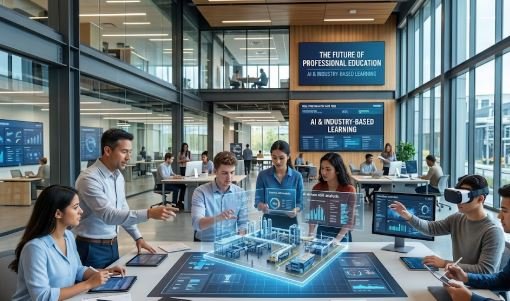
The way people learn, develop professional skills and prepare for employment is undergoing a significant transformation. Artificial intelligence (AI) is changing the nature of work, and the impact is becoming increasingly visible in classrooms, universities, professional training institutions and corporate learning programmes.
For decades, professional education largely followed a familiar approach: students completed academic programmes, earned degrees or diplomas and entered the workforce with the expectation that their qualifications would support their careers for years.
That model is now facing new challenges.
As businesses introduce AI-powered systems, automate routine tasks and adopt new technologies, employers are looking for professionals who can do more than simply understand theoretical concepts. They increasingly need people who can apply knowledge, solve real business problems, work with technology and make informed decisions.
This is encouraging educational institutions to rethink how courses are designed and how students are prepared for the workplace.
The emerging approach places greater importance on practical learning, AI literacy, industry exposure and continuous professional development.
AI Is Changing What Students Need to Learn
Artificial intelligence is becoming part of everyday professional activities, from financial analysis and healthcare research to marketing, engineering and customer service.
Tasks that previously required considerable manual effort can now be supported by AI tools. Research assistance, data processing, report preparation and basic content development are among the activities increasingly influenced by automation.
However, this does not mean that professional knowledge is becoming less important. In many cases, it is becoming more valuable.
As AI handles more routine work, professionals need the ability to understand problems, evaluate information, identify errors and make decisions based on their industry knowledge.
For example, a finance professional may use AI to analyse financial statements, but understanding business risks and interpreting the results still requires professional judgement.
Similarly, healthcare professionals may use AI-assisted diagnostic tools, but patient assessment and clinical decision-making continue to require human expertise.
This changing relationship between technology and professional knowledge is pushing educational institutions to teach students not only how to use AI but also how to question, verify and responsibly apply its outputs.
Universities Are Moving Beyond Traditional Classroom Learning
One of the biggest changes taking place in professional education is the growing importance of practical experience.
Traditional classroom teaching remains important for developing foundational knowledge. However, employers increasingly expect graduates to understand how that knowledge is applied in real working environments.
As a result, universities and professional institutions are placing greater emphasis on internships, live projects, industry collaborations, case studies, simulations and practical assignments.
For example, management students may work on real business problems, engineering students may participate in industry-based projects, and technology students may develop AI-powered applications as part of their academic training.
This approach helps students understand workplace expectations before entering full-time employment.
It also allows employers to identify candidates who can demonstrate practical capabilities rather than relying entirely on academic qualifications.
The growing focus on experiential learning suggests that the value of professional education will increasingly depend on what students can actually do with the knowledge they acquire.
Continuous Learning Is Becoming Essential for Career Growth
Another major change is the declining relevance of one-time education.
In the past, completing a degree or professional qualification was often considered sufficient preparation for a long career. Today, rapid technological developments are making continuous learning increasingly necessary.
AI tools, software platforms, industry regulations and business practices are evolving quickly. Skills that are valuable today may require updating within a few years.
This is encouraging companies to invest more in employee training, reskilling and professional development.
Employees are also taking greater responsibility for their own learning through online courses, professional certifications, specialised workshops and industry training programmes.
For educational institutions, this creates an opportunity to expand beyond traditional degree programmes and offer shorter, flexible learning pathways for working professionals.
The future of education is therefore likely to involve a combination of formal qualifications, practical experience and regular skill development throughout a person’s career.
Industry-Based Learning Can Help Close the Employability Gap
One of the persistent challenges in education is the gap between what students learn and what employers expect.
Many graduates enter the job market with academic qualifications but limited exposure to actual workplace processes.
Industry-based learning can help address this problem by bringing educational institutions and businesses closer together.
Companies can contribute to curriculum development, provide access to practical projects, offer internships and help students understand emerging industry requirements.
Universities, in turn, can develop programmes that combine academic fundamentals with current professional practices.
For instance, a business analytics programme could include training in AI-assisted data analysis, industry software and practical decision-making. An engineering programme could integrate automation, robotics and digital manufacturing.
Such partnerships can help students develop skills that are more directly relevant to employment.
The approach can also benefit employers by reducing the time and resources required to train new recruits.
Human Skills Will Become More Important in an AI-Driven Workplace
While technical knowledge and AI proficiency are becoming increasingly important, employers will also continue to value skills that technology cannot easily replace.
Critical thinking, communication, leadership, creativity, adaptability and ethical judgement are likely to remain essential across professional fields.
AI can generate information and identify patterns, but people must determine whether the information is relevant, reliable and appropriate for a particular situation.
This distinction is particularly important in fields such as law, medicine, finance, education and public administration, where decisions can have significant consequences.
Educational institutions therefore need to balance technical training with the development of human capabilities.
Students should learn how to collaborate, communicate effectively, manage uncertainty and take responsibility for their decisions.
The objective should not be to prepare graduates who simply know how to operate AI tools, but professionals who can use technology intelligently while retaining independent judgement.
The Risks of Overdependence on AI in Education
The growing use of AI in education also raises important concerns.
Students may become overly dependent on AI-generated answers for assignments, research and problem-solving. While these tools can improve productivity, excessive reliance may weaken independent thinking and reduce opportunities to develop analytical skills.
There are also concerns about inaccurate information, plagiarism, data privacy and academic integrity.
Educational institutions need clear policies that explain where AI assistance is acceptable and where independent student work is necessary.
Rather than completely restricting AI, universities should teach students how to use it responsibly.
Assignments can increasingly focus on practical problem-solving, oral presentations, project demonstrations and the explanation of individual reasoning.
This would help educators assess whether students genuinely understand a subject instead of simply evaluating the quality of AI-assisted submissions.
Why Collaboration Between Universities and Employers Matters
Preparing the workforce for an AI-driven economy cannot be the responsibility of educational institutions alone.
Universities, employers, technology companies and professional bodies need to work together to identify changing skill requirements and develop relevant learning programmes.
Technology companies can provide access to tools and training resources, while employers can communicate the practical capabilities needed in their industries.
Universities can use this information to update curricula and create opportunities for students to gain workplace experience.
Professional institutions can also support lifelong learning through specialised certifications and continuing professional development programmes.
Such collaboration will be especially important in emerging areas such as artificial intelligence, cybersecurity, cloud computing, semiconductor technology, advanced manufacturing and data analytics.
What Educational Institutions Need to Focus on Next
As professional education evolves, institutions will need to reconsider their priorities.
Some important areas include:
1. AI literacy across disciplines: Students should understand the opportunities, limitations and ethical implications of AI, regardless of their chosen profession.
2. Practical and project-based education: Learning programmes should include real-world assignments, simulations, internships and industry projects.
3. Flexible professional courses: Universities should expand short-term certifications and modular courses that allow working professionals to update their skills.
4. Critical thinking and problem-solving: Students should learn to assess information independently rather than relying entirely on automated systems.
5. Stronger industry partnerships: Employers should participate more actively in curriculum development, internships and professional training.
6. Faculty development: Teachers and trainers also need regular exposure to emerging technologies and modern teaching methods.
Conclusion:
Artificial intelligence is changing the relationship between education, employment and professional development. As businesses automate routine activities and adopt intelligent technologies, the expectations placed on the workforce are also changing.
The traditional model of completing education and relying on the same skills throughout an entire career is becoming increasingly difficult to sustain.
Universities and professional institutions must therefore focus on creating learning environments that combine academic knowledge, practical experience, technological understanding and human judgement.
Industry participation will be equally important in ensuring that education remains relevant to actual workplace requirements.
Ultimately, the future of professional education will not be determined by how many students earn degrees or complete training programmes. It will depend on whether they can apply their knowledge, adapt to new technologies and contribute meaningfully to a changing economy.
AI may transform the way people work, but the quality of education and the ability to keep learning will determine how successfully people adapt to that transformation.
