
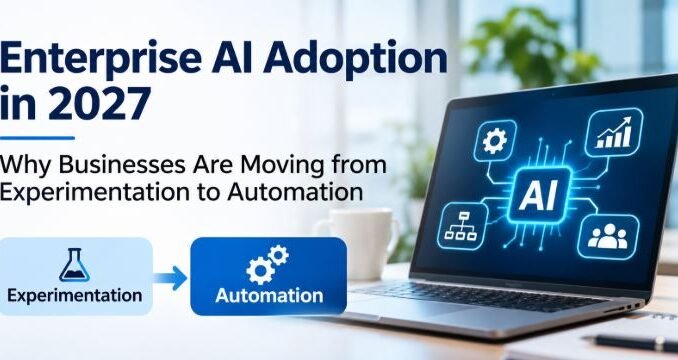
Artificial intelligence is entering a defining phase in the corporate world. What began as a wave of experimentation with chatbots, generative AI tools and productivity assistants is gradually turning into something much bigger: the automation of everyday business operations.
In 2027, the central question for enterprises is no longer simply how to use AI, but how to make it deliver measurable business value.
Across industries, companies are reassessing their AI strategies. Instead of launching multiple experimental projects, business leaders are increasingly looking at systems that can manage repetitive tasks, support operational decisions, process information and coordinate complex workflows with limited human intervention.
This shift reflects a growing realisation that experimenting with AI is not the same as transforming a business.
From AI Experiments to Real Business Results
Over the past few years, organisations have invested heavily in generative AI technologies. Employees have adopted AI assistants for writing, research, customer communication and data analysis. However, many businesses have struggled to translate these early experiments into meaningful financial returns.
The challenge is straightforward: an AI tool may improve an employee’s productivity, but its wider business impact remains limited if it is not connected to the organisation’s actual operations.
That is now beginning to change.
Companies are increasingly integrating AI into customer service, finance, supply-chain management, human resources and enterprise software. Rather than simply generating recommendations, newer AI systems are being designed to perform specific actions, update business records, process requests and manage routine workflows.
The objective is to move from AI that assists employees to AI that becomes part of the operational structure of a business.
Why Businesses Are Becoming More Serious About AI Automation
One of the biggest reasons behind this transition is the growing pressure to demonstrate a return on investment.
Enterprise leaders are becoming more cautious about spending money on AI initiatives that produce impressive demonstrations but fail to improve revenue, reduce costs or increase operational efficiency.
According to the broader direction of enterprise technology forecasts from Gartner, organisations face an increasingly complex challenge in scaling AI responsibly, including managing infrastructure, governance and operational costs.
This is encouraging businesses to prioritise practical applications over experimentation.
For example, a financial services company may use AI to process routine documentation and identify unusual transactions. A retailer may automate inventory monitoring and demand forecasting. A manufacturing company may use AI to predict equipment failures and improve production planning.
These applications have a clearer connection to business performance than standalone AI demonstrations.
The Rise of AI Agents: Beyond Traditional Chatbots
Another major development is the growing interest in AI agents.
Traditional chatbots primarily respond to questions and generate information. AI agents, by comparison, are designed to complete sequences of tasks using approved tools, business data and defined instructions.
For enterprises, this creates new opportunities.
An AI-powered customer service system could identify a customer complaint, retrieve relevant account information, prepare a response and route the issue to the appropriate department.
Similarly, an AI-enabled finance workflow could extract information from invoices, check entries against company records and flag discrepancies for human approval.
However, greater autonomy also creates greater responsibility. Businesses must ensure that AI systems operate within clearly defined permissions and that sensitive decisions remain subject to appropriate human oversight.
The future of enterprise automation is therefore unlikely to be about removing people entirely. It will be about combining machine efficiency with human judgement.
Data Quality and Infrastructure Become Critical
While AI automation offers significant opportunities, companies cannot achieve reliable results without a strong data foundation.
Many organisations still operate with fragmented databases, outdated software and disconnected business applications. These problems can limit the accuracy and usefulness of AI systems.
Static information retrieval may also become unreliable when company policies, product information or regulatory requirements change.
As a result, businesses are increasingly focusing on data integration, real-time information access and modern cloud infrastructure.
The economics of AI are another important consideration. Running advanced AI systems can involve substantial computing and inference costs. Enterprises must therefore evaluate whether the productivity gains justify the infrastructure and maintenance expenses.
In the coming years, successful AI adoption will depend as much on infrastructure planning and cost management as on the underlying technology.
The Workforce Is Changing Alongside Automation
The movement towards AI automation is also changing how organisations approach their workforce.
Rather than simply introducing new software, companies need to reconsider how jobs and responsibilities are structured.
Employees may spend less time on repetitive administrative work and more time on customer relationships, problem-solving, supervision and strategic decisions.
This transition will require training and new skills. Employees will need to understand how AI systems operate, how to verify their outputs and when human intervention is necessary.
For business leaders, the challenge is to ensure that technology adoption improves productivity without creating unnecessary uncertainty among employees.
Companies that invest in workforce development alongside automation may be better positioned to achieve sustainable results.
The Biggest Challenges Facing Enterprise AI Adoption
Despite growing interest, moving AI into core business operations is not without risks.
1. Reliability and accuracy: AI systems can generate incorrect information or take inappropriate actions. Enterprises need testing, monitoring and approval mechanisms.
2. Data privacy and security: Connecting AI systems to internal databases increases the importance of access controls, cybersecurity and data protection.
3. Accountability: Organisations must establish who is responsible when an automated system makes a mistake or produces an unexpected outcome.
4. Rising technology costs: Infrastructure, computing resources, integration and ongoing maintenance can make large-scale deployment expensive.
5. Regulatory compliance: Businesses operating in regulated sectors must ensure that automated processes comply with applicable legal and industry requirements.
These challenges suggest that automation cannot succeed through technology investment alone. It requires a combination of governance, process redesign and organisational readiness.
What Enterprise AI Adoption Could Look Like in 2027
The next phase of enterprise AI is likely to be shaped by a more disciplined approach to deployment.
Businesses are expected to concentrate on a smaller number of high-impact applications rather than spreading resources across numerous disconnected experiments.
Three areas are likely to attract particular attention:
- Operational automation: AI systems handling repetitive business processes across departments.
- Decision intelligence: AI analysing business information to support faster and better-informed decisions.
- Agent-based workflows: AI agents coordinating tasks across approved business applications under human supervision.
The companies that succeed will not necessarily be those that deploy the largest number of AI tools. They will be those that integrate technology into business processes in a way that produces measurable and sustainable improvements.
Conclusion: The Real AI Competition Is About Execution
Enterprise AI is moving into a more demanding phase. The excitement surrounding generative AI is gradually giving way to questions about productivity, accountability, costs and measurable outcomes.
For businesses, 2027 could become an important year in determining which AI investments deliver lasting value and which remain expensive experiments.
The competitive advantage will increasingly belong to organisations that can combine reliable AI systems, high-quality data, effective governance and skilled employees.
Ultimately, the future of enterprise AI will not be measured by how many companies use artificial intelligence. It will be measured by how effectively they use it to transform the way business gets done.
The message for business leaders is clear: AI experimentation may have introduced the technology to the workplace, but automation will determine its real economic impact.
