
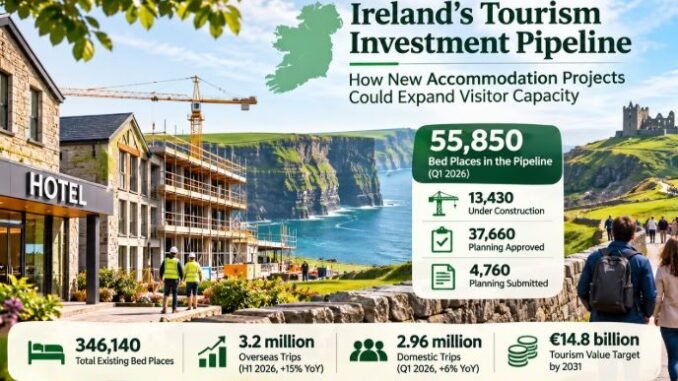
Ireland’s tourism sector is preparing for a new phase of growth, with thousands of accommodation bed places at different stages of development across the country. The expanding project pipeline is creating potential opportunities for hotel developers, hospitality operators and investors as Ireland looks to increase visitor capacity and strengthen the economic contribution of tourism.
Figures for the first quarter of 2026 show that 55,850 accommodation bed places are included in the development pipeline. Of these, 13,430 are under construction, 37,660 have received planning permission and another 4,760 are awaiting planning decisions. The scale of planned development highlights the potential for a significant expansion of Ireland’s tourism accommodation market.
Hotel Projects Lead the Development Pipeline
Hotels are at the centre of the current investment activity, accounting for 68% of accommodation bed places under construction. This indicates strong development activity in a segment that plays an important role in supporting international visitors, business travel and domestic tourism.
Dublin remains the leading development location, accounting for 64% of the bed places currently under construction. The capital already represents 26% of Ireland’s existing accommodation capacity, making it a major centre for hotel investment.
However, the development pipeline also points to opportunities beyond the capital. Expanding accommodation in other parts of Ireland could help meet visitor demand, support regional economies and encourage tourists to explore a wider range of destinations.
Rising Visitor Numbers Strengthen the Business Case
Growing travel demand is an important factor behind the potential for additional accommodation capacity. Ireland recorded 3.2 million overseas trips in the first half of 2026, an increase of 15% compared with the same period in 2025. Domestic travel also showed growth, with 2.96 million trips recorded in the first quarter, up 6% year on year.
These figures provide a positive demand backdrop for businesses considering investment in hotels, holiday accommodation and related tourism services.
Ireland has set a target of increasing the value of tourism to €14.8 billion by 2031. Reaching this ambition will require investment not only in accommodation but also in visitor experiences, hospitality services and supporting infrastructure.
Regional Tourism Could Unlock New Opportunities
While Dublin continues to attract a substantial share of development, regional destinations are also expected to play a greater role in Ireland’s tourism growth.
Ireland’s Hidden Heartlands, Ireland’s Ancient East and the northern part of the Wild Atlantic Way are targeting annual visitor growth of at least 7% through 2031.
This creates potential opportunities for investment in boutique hotels, guesthouses, rural retreats, serviced accommodation and tourism experiences. Businesses that connect accommodation with local heritage, food, outdoor activities and cultural attractions could benefit as more visitors explore destinations outside the main tourism centres.
A wider distribution of accommodation could also support local employment and create demand for businesses operating in transport, restaurants, leisure and other visitor services.
Regulation and Planning Will Shape Future Development
The expansion of Ireland’s accommodation sector will also depend on planning decisions, regulatory requirements and the ability of developers to deliver projects.
A national register for short-term letting is scheduled for December 2026, while a new Tourist Accommodation Strategy is expected to provide further direction for the industry. These developments will be important for operators and investors assessing opportunities in the short-term rental and wider accommodation markets.
Although the pipeline contains a substantial number of bed places, projects at different stages of development carry different levels of certainty. Planning permission does not guarantee construction, while projects awaiting approval remain subject to the planning process.
Investors will therefore need to assess project status, location, construction costs, infrastructure access and local visitor demand before committing capital.
Investment Outlook: Capacity Expansion Could Support Long-Term Growth
Ireland’s tourism accommodation pipeline signals considerable potential for the hospitality and property development sectors. With 55,850 bed places at various stages of development, the country has a sizeable base of proposed and ongoing projects that could expand its ability to welcome visitors.
The strongest opportunities may emerge in locations where accommodation development aligns with rising visitor demand and broader regional tourism ambitions. Hotels remain a major part of the pipeline, but alternative accommodation and experience-led tourism businesses could also contribute to the sector’s expansion.
As Ireland works towards its €14.8 billion tourism value target by 2031, the delivery of these projects will be an important factor in determining how much additional visitor capacity the country can create. For investors, the opportunity lies not simply in building more rooms, but in developing accommodation that responds to changing travel demand and supports sustainable growth across Ireland’s tourism economy.
