
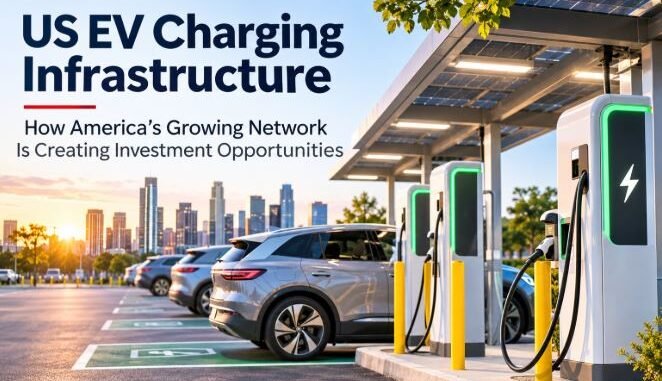
The electric vehicle revolution in the United States is creating a business opportunity that extends far beyond the vehicles themselves. As more drivers consider switching to electric mobility, attention is turning towards the infrastructure needed to support that transition. Charging stations, electricity networks, battery storage, smart energy systems and digital services are becoming important parts of a rapidly evolving market.
For businesses and investors, this shift represents the development of an entirely new infrastructure economy. What was once viewed mainly as a supporting service for electric vehicles is emerging as a commercial sector in its own right. From highway charging hubs and shopping-centre installations to fleet depots and residential charging facilities, opportunities are opening across multiple industries.
However, the real business opportunity is not simply in installing more chargers. It lies in building networks that are reliable, strategically located, commercially viable and capable of meeting changing consumer and business needs.
A rapidly expanding market with a significant investment requirement
The scale of America’s charging infrastructure requirement is substantial. As electric vehicle adoption increases, the country will need millions of additional charging points across residential properties, workplaces, public parking facilities and major transport routes.
Industry projections indicate that the United States could require between 11 million and 26 million privately accessible charging ports and between 600,000 and 2.4 million publicly accessible ports by 2030. The wide range reflects different assumptions about EV adoption, charging behaviour and infrastructure development. Nevertheless, the message is clear: significant investment will be required to support the next phase of electric mobility.
Research has also estimated that meeting future charging infrastructure requirements could involve investment of approximately $50 billion to $125 billion by 2030. This creates potential opportunities for infrastructure developers, equipment manufacturers, energy providers, technology businesses and property owners.
The market is also moving beyond its early development stage. Charging infrastructure is increasingly being viewed as a long-term asset that can generate revenue through electricity sales, commercial partnerships, fleet contracts, subscriptions and related services.
For investors, this creates an opportunity to participate in the wider electrification economy rather than relying solely on the performance of electric vehicle manufacturers.
Fast-charging networks are becoming a major business opportunity
One of the most important developments is the growing demand for public fast-charging infrastructure. While home charging remains convenient for many EV owners, it is not a practical solution for every driver. People living in apartments, travelling long distances or operating commercial vehicles often depend on public charging facilities.
DC fast-charging stations are therefore becoming essential to the development of a more accessible charging network. Their ability to deliver electricity more quickly makes them particularly valuable along highways, at transport centres, in urban locations and near commercial destinations.
The expansion of these facilities is creating opportunities for businesses that can secure suitable locations, manage electricity costs and attract consistent customer traffic.
A strategically positioned charging hub can also generate value beyond charging fees. Drivers may spend money at nearby restaurants, convenience stores, supermarkets and other retail businesses while their vehicles recharge. This creates a commercial relationship between charging infrastructure and the wider retail and hospitality sectors.
The business model is gradually evolving from simply selling electricity to developing integrated destinations where transport, retail and customer services come together.
The investment opportunity extends beyond charging stations
The growth of charging networks is generating demand across several connected industries. This wider ecosystem may prove just as important as the charging stations themselves.
Electrical equipment and grid infrastructure
Every new charging installation requires a dependable electricity connection. High-powered charging facilities can demand significant electrical capacity, creating a need for transformers, switchgear, cables, power-management systems and grid upgrades.
This creates business opportunities for electrical equipment manufacturers, engineering contractors, installation specialists and infrastructure service providers. As charging networks expand, demand for these supporting systems is likely to remain an important part of the investment landscape.
Battery storage and energy management
Electricity demand is not constant throughout the day. Charging activity can increase during peak travel periods, potentially raising energy costs and placing additional pressure on local electricity networks.
Battery energy storage systems can help address this challenge. By storing electricity and supplying it when demand increases, these systems can help charging operators manage peak loads and improve energy efficiency.
Combining battery storage with smart energy-management technology may also make charging locations more commercially attractive, particularly where grid capacity is limited or electricity prices fluctuate.
Commercial property and retail locations
Property owners are becoming important participants in the EV charging market. Shopping centres, hotels, office complexes, supermarkets and residential developments offer natural locations for charging infrastructure.
For commercial property operators, installing chargers can improve customer convenience, strengthen the appeal of a location and create additional revenue opportunities. In residential developments, access to charging facilities may increasingly influence property expectations as electric mobility becomes more common.
The opportunity is particularly interesting because property owners can integrate charging infrastructure into existing developments rather than building entirely new businesses around it.
Fleet and logistics charging
Commercial fleets represent another important growth segment. Delivery vehicles, taxis, ride-hailing services, public transport and logistics operations require dependable charging arrangements to maintain daily operations.
Unlike some public charging locations, fleet depots can benefit from predictable vehicle schedules and concentrated charging demand. This creates opportunities for dedicated charging facilities, long-term service agreements and integrated energy-management solutions.
As businesses electrify their fleets, demand will grow for charging infrastructure designed around operational requirements rather than individual consumer use.
Software and digital services
The charging experience increasingly depends on technology. Drivers want to locate available chargers, check prices, make payments and understand whether equipment is working before arriving at a station.
Charging operators also need software to monitor equipment, manage electricity consumption, process transactions and schedule maintenance.
This creates opportunities for digital platforms, payment systems, data analytics and smart-charging solutions. As networks become larger, software capable of connecting different charging providers and improving operational efficiency could become an important source of competitive advantage.
Government support has helped build the foundation
Public policy has played a significant role in encouraging investment in America’s EV charging infrastructure. The Infrastructure Investment and Jobs Act allocated $7.5 billion for charging infrastructure through the National Electric Vehicle Infrastructure programme and the Charging and Fueling Infrastructure grant programme.
The Inflation Reduction Act also introduced tax incentives intended to support parts of the clean-energy and charging ecosystem.
However, the policy environment has experienced uncertainty. Changes to federal funding arrangements and programme approvals in 2025 created concerns among developers and state authorities. Subsequent legal developments affected the implementation of previously approved charging plans, while different federal programmes faced different funding conditions.
This has made the investment environment more complicated. State governments, utilities and private investors are increasingly important in determining which projects move forward and how quickly infrastructure is delivered.
For businesses, government incentives can improve project economics, but long-term investment decisions must also consider actual charging demand, electricity prices, construction costs and the ability to generate sustainable revenue.
Standardisation and reliability will shape the next phase
A charging network must be convenient before drivers are willing to depend on it. For years, differences in charging connectors and payment systems have created friction for EV owners travelling between networks.
The wider adoption of the North American Charging Standard, also known as SAE J3400, is helping move the industry towards greater connector compatibility. This could make public charging more accessible and reduce uncertainty for drivers.
But standardisation involves more than the physical connector. Drivers also need accurate information, transparent pricing, straightforward payment options and chargers that work when required.
Reliability is becoming a major competitive factor. A charging station that is unavailable or fails during a journey can undermine customer confidence. For operators, maintaining equipment, monitoring performance and providing responsive support are therefore essential business priorities.
The companies and investors that recognise the importance of the complete customer experience may be better positioned than those focused only on expanding the number of installed chargers.
The commercial challenges investors cannot ignore
Despite the attractive growth outlook, EV charging infrastructure is not automatically a profitable business. Developing a charging site can require substantial upfront capital for land, equipment, construction, electrical upgrades and grid connections.
One of the biggest challenges is utilisation. A charging station may be expensive to build but generate limited revenue if relatively few vehicles use it. Sites located ahead of local EV demand can take years to reach commercially sustainable levels.
Grid connections present another obstacle. Some projects face lengthy utility approval processes, limited local capacity and the need for expensive electrical upgrades. These delays can increase costs and postpone the start of revenue generation.
Competition is also increasing as more operators enter the market. Businesses must compete for attractive locations, customer traffic and commercial partnerships while managing maintenance costs and electricity prices.
For investors, the key consideration is therefore not simply how quickly the market is growing. It is whether individual projects can achieve sufficient utilisation, control operating expenses and generate predictable cash flow.
From infrastructure expansion to a new energy business
America’s EV charging market is entering a more important stage of development. The initial focus was on establishing a nationwide network and making charging facilities more widely available. The next phase will place greater emphasis on reliability, efficiency, integration and commercial performance.
This transition could create opportunities across the energy, transport, technology, construction and real estate industries. Charging stations may increasingly operate as integrated energy hubs, combining fast charging with battery storage, renewable electricity, digital payments and services for commercial fleets.
The wider significance is that electric mobility is changing how businesses think about transport infrastructure and energy consumption. The charging network is becoming a link between the automotive industry, the electricity sector and commercial property markets.
For investors, the opportunity is substantial, but success will depend on more than market growth forecasts. Strong locations, efficient grid connections, dependable technology and sustainable operating economics will determine which projects become valuable long-term assets.
America’s EV charging expansion is ultimately creating a new infrastructure business. As electric mobility develops, the strongest opportunities may belong to those building not just more charging stations, but a smarter, more connected and commercially sustainable energy network.
