
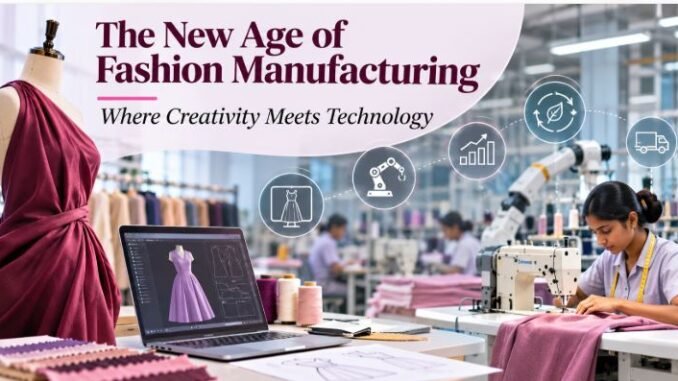
Fashion manufacturing is undergoing a significant transformation as technology, changing consumer behaviour and the growing demand for more responsible production reshape the industry’s traditional business model. What was once driven largely by bulk manufacturing, seasonal collections and lengthy supply chains is gradually evolving into a more agile and digitally connected ecosystem. Artificial intelligence (AI), automated machinery, 3D design, digital product development and intelligent inventory systems are changing how fashion businesses operate, from the first design concept to the delivery of finished garments. For manufacturers and global brands, this shift is not simply about keeping pace with technological innovation. It is about improving profitability, reducing operational inefficiencies and building supply chains capable of responding to an increasingly unpredictable marketplace. As India strengthens its position in global textile and apparel manufacturing, the intersection of traditional production expertise and modern technology is creating a new landscape of commercial opportunities.
Fashion Manufacturing Is Moving Beyond the Traditional Production Model
For many years, the fashion business has operated on a relatively straightforward principle: manufacture in large quantities, distribute through established retail networks and sell according to seasonal demand. Although this model enabled brands to achieve economies of scale, it also created persistent problems. Overstocking, unsold garments, lengthy production cycles and unnecessary material consumption have placed financial and operational pressure on businesses.
The growing popularity of on-demand and localised manufacturing is beginning to change this approach. Rather than committing to large production volumes based solely on forecasts, brands can increasingly use made-to-order, small-batch and batch-on-demand models to align production more closely with actual demand.
This offers an important commercial advantage. Manufacturers can reduce the risks associated with excess inventory, while fashion brands gain greater flexibility to respond to changing consumer preferences. Micro-factories and smaller production facilities can also help businesses serve specialised markets without depending entirely on large-scale manufacturing infrastructure.
For fashion companies, the objective is to strike a balance between production efficiency and market responsiveness. Businesses that can deliver smaller quantities at competitive costs and within shorter timeframes may find opportunities to work with emerging labels, premium fashion brands and retailers seeking greater supply-chain flexibility.
Digital Design Is Reducing the Cost of Bringing Fashion to Market
The transformation of fashion manufacturing begins long before garments reach the production floor. Digital design technologies are changing how collections are developed, tested and approved, potentially reducing the time and resources required to bring new products to market.
Traditionally, product development involved repeated physical sampling, with designers and manufacturers exchanging garments to assess fit, fabric behaviour, stitching and construction. This process could become expensive and time-consuming, particularly when production teams and international buyers were based in different locations.
Today, 3D design and virtual sampling allow designers to create digital representations of garments and make adjustments before physical samples are produced. Digital twins can take this further by providing virtual representations of products, equipment or manufacturing processes that can be used for planning and performance analysis.
For fashion businesses, the benefits extend beyond reducing sample costs. Faster approvals can shorten product-development cycles, improve communication between design and production teams and help brands respond more quickly to emerging trends.
This is particularly valuable in international sourcing, where delays in sample development can affect production schedules and delivery commitments. Digital collaboration gives manufacturers an opportunity to improve buyer relationships while making product development more efficient.
Smart Factories Are Changing the Economics of Apparel Production
The modern garment factory is becoming more connected, with automation and intelligent machinery playing an increasingly important role in manufacturing operations.
Automated cutting systems, computer vision, IoT sensors and digitally monitored production equipment are helping manufacturers improve quality control and operational visibility. These technologies can identify fabric irregularities, detect stitching defects and monitor machinery performance while production is underway.
Predictive maintenance is another important development. Instead of waiting for equipment to fail, manufacturers can use machine-performance data to identify potential problems and schedule maintenance before major disruptions occur. This can help reduce downtime, improve production continuity and protect delivery schedules.
Automation is also creating opportunities to improve repetitive activities such as fabric inspection, cutting and material handling. However, the future of smart manufacturing is not necessarily about removing human involvement. Skilled workers remain essential for specialised sewing, finishing, quality assessment and production supervision.
For factory owners, the business case for automation must be considered carefully. Investment in machinery and digital systems can be substantial, particularly for smaller manufacturers. The most effective approach is to identify processes where technology can deliver measurable improvements in productivity, quality or operating costs before expanding investment across the factory.
Artificial Intelligence Is Giving Fashion Supply Chains Greater Control
Few industries are as sensitive to changing consumer preferences as fashion. A product that attracts strong demand one season may struggle to sell the next, while unexpected changes in weather, pricing or consumer spending can disrupt even carefully planned collections.
Artificial intelligence is helping fashion companies manage this uncertainty by making demand forecasting and supply-chain planning more data-driven.
AI-powered systems can analyse sales histories, seasonal patterns, market signals and inventory movements to help businesses anticipate demand. These insights can support purchasing decisions, production scheduling and stock allocation across different retail markets.
The technology can also strengthen supplier management. By analysing delivery performance, production capacity and other operational information, businesses can identify potential supply-chain risks earlier. Manufacturers and brands may then have more time to adjust sourcing arrangements, revise production schedules or explore alternative logistics routes.
For retailers, improved forecasting can help reduce the financial burden of excess inventory and minimise the risk of popular products becoming unavailable. For manufacturers, more reliable demand information can support better use of raw materials, labour and production capacity.
However, AI is only as effective as the information available to it. Companies operating with disconnected software, inconsistent supplier records and outdated inventory systems may struggle to obtain reliable insights. Investment in data integration and digital infrastructure is therefore becoming an important part of fashion supply-chain strategy.
Traceability Is Becoming a Competitive Advantage
The commercial relationship between fashion brands and consumers is changing. Increasing attention is being paid to the origins of materials, manufacturing practices and the environmental impact of clothing. International buyers are also placing greater importance on transparency and the ability to demonstrate responsible sourcing.
This is creating opportunities for technologies that improve product traceability. RFID systems, IoT-enabled tracking and blockchain-based records can help businesses document the movement of materials and products across different stages of the supply chain.
Digital product passports are also emerging as a potential tool for making product information more accessible. Depending on the system and applicable requirements, these records can provide details about material composition, sourcing, manufacturing and opportunities for repair or recycling.
For businesses, better traceability can strengthen supplier relationships, support compliance and improve confidence among international buyers. It can also contribute to circular business models by making it easier to identify materials that can be reused, resold or recycled.
The challenge is ensuring that information is accurate, consistent and accessible across the supply chain. Technology alone cannot create transparency if suppliers do not participate or if businesses rely on incompatible data systems. Common standards and collaboration will be essential to making traceability commercially useful.
India’s Textile Industry Has an Opportunity to Lead the Next Manufacturing Shift
India occupies an important position in the global textile and apparel industry, with manufacturing capabilities extending from fibre and yarn production to weaving, processing, garment manufacturing and technical textiles. Established clusters such as Tiruppur, Surat, Ludhiana and Bengaluru contribute to this industrial ecosystem and provide a foundation for further modernisation.
The next opportunity lies in combining these existing strengths with digital manufacturing capabilities. AI-assisted quality inspection, automated cutting, digital production planning and predictive maintenance could help Indian factories improve productivity and strengthen their competitiveness in international markets.
Importantly, technology adoption does not have to begin with expensive, fully automated production facilities. Affordable digital tools that can operate alongside existing machinery may offer a practical starting point for small and medium-sized manufacturers.
India also has an opportunity to connect traditional craftsmanship with modern business systems. Handloom and artisanal textile producers can potentially benefit from digital platforms, improved order management, online market access and product traceability. These tools may help smaller enterprises reach wider customer groups while preserving the distinctive value of their products.
However, modernisation must also consider the people behind the industry. Workers need access to relevant training, digital skills and opportunities to participate in higher-value manufacturing activities. The long-term success of technology adoption will depend on whether productivity improvements translate into stronger businesses and sustainable livelihoods.
New Business and Investment Opportunities Across the Fashion Value Chain
The move towards technology-enabled manufacturing is creating opportunities well beyond conventional garment production. Software companies, machinery manufacturers, logistics providers and specialist service businesses are all becoming part of the industry’s evolving commercial ecosystem.
Technology providers can develop solutions for digital product design, AI-based forecasting, automated quality inspection and factory management. Equipment manufacturers may benefit from growing demand for smart cutting systems, connected machinery and intelligent production tools.
There is also potential for businesses specialising in supply-chain integration, traceability, data management, cybersecurity and workforce training. As fashion companies modernise their operations, demand for expertise that connects different systems and improves operational visibility is likely to become increasingly important.
For investors, the opportunity lies in identifying solutions that address genuine manufacturing challenges. A platform that reduces production errors, a digital tool that shortens sampling time or a predictive maintenance system that prevents costly breakdowns can offer a clearer commercial proposition than technology adopted simply to appear innovative.
Manufacturers that successfully integrate these solutions may also become more attractive partners for international brands seeking reliable suppliers, shorter lead times and greater production transparency.
The Challenges That Could Slow the Transformation
Despite the opportunities, the transition to digital fashion manufacturing is not without obstacles. High upfront investment remains a major concern, particularly for smaller factories operating with limited financial resources. New equipment, software subscriptions, maintenance and systems integration can increase costs before the benefits become visible.
Legacy infrastructure presents another challenge. Many factories continue to rely on disconnected systems for inventory, purchasing, production planning and quality management. Connecting these operations requires technical expertise and careful implementation.
The workforce transition is equally important. Employees must develop the skills needed to operate modern machinery, interpret production data and work alongside automated systems. Without suitable training, manufacturers may struggle to achieve the full benefits of their technology investments.
Data fragmentation, cybersecurity risks and inconsistent information-sharing practices across suppliers can further complicate digital transformation. Businesses must also consider whether their technology investments can scale as production volumes and customer requirements change.
These barriers mean that modernisation will not happen at the same pace across the industry. Larger manufacturers may invest in integrated smart factories, while smaller businesses may adopt targeted technologies over time. A practical, phased approach could allow more companies to participate without placing excessive pressure on their finances.
Conclusion:
Fashion manufacturing is moving towards a more connected, flexible and data-driven future. AI-powered forecasting, digital design, smart machinery, on-demand production and improved traceability are changing how businesses manage costs, develop products and serve global markets. For India, the opportunity is particularly significant: its established textile manufacturing base provides a strong foundation for combining traditional expertise with modern production technologies. Yet long-term competitiveness will depend on more than machinery or software. Businesses will need to invest in people, reliable infrastructure, supply-chain collaboration and practical innovation. The companies that succeed will be those that use technology to solve real commercial problems, improve the efficiency of their operations and build stronger relationships with customers and suppliers. In the next phase of the global fashion industry, the ability to manufacture smarter may prove just as important as the ability to manufacture at scale.
