
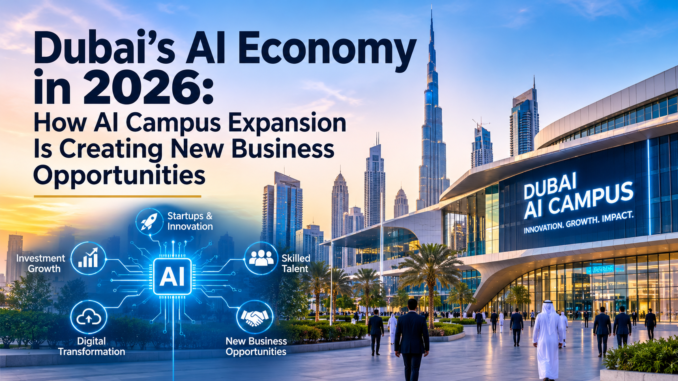
Nov 11: Dubai is strengthening its position in the global artificial intelligence market, with the Dubai AI Campus expansion creating new opportunities for technology startups, investors and established businesses. As the emirate increases investment in AI infrastructure and encourages wider adoption across industries, artificial intelligence is becoming an important part of its economic diversification strategy.
The expansion of the Dubai AI Campus at the Dubai International Financial Centre (DIFC), alongside new initiatives supporting AI commercialisation and enterprise adoption, is helping build an ecosystem that connects technology development with business opportunities.
For companies looking to enter the UAE market, the developments offer opportunities extending beyond software development. Cloud computing, cybersecurity, data management, digital marketing, recruitment and technology consulting could all benefit as businesses increase their investment in AI.
Dubai AI Campus Sets Ambitious Targets for 2030
Dubai’s AI ambitions received a significant boost in October 2026 when the government approved new growth targets for the Dubai AI Campus.
Since its launch in May 2024, the campus has attracted more than 500 AI companies, secured over AED 1 billion in investment and contributed to the creation of more than 2,000 specialised technology jobs. Having achieved its original target of attracting 500 companies two years ahead of schedule, the campus is now aiming to bring in more than 1,000 AI companies and create over 5,000 highly skilled jobs by 2030.
Another important development is the planned 100,000-square-foot purpose-built AI Campus facility within the DIFC Zabeel District expansion. The proposed facility will include GPU-ready infrastructure, secure AI development zones, digital twin environments and specialised laboratories.
These facilities are expected to support companies and government organisations in developing, testing and validating AI applications before wider commercial deployment.
For startups, access to specialised infrastructure and a wider network of investors and industry partners could reduce some of the challenges involved in developing and scaling technology products. Established businesses could also benefit from opportunities to collaborate with emerging AI companies.
The expansion therefore represents an opportunity for businesses across the technology value chain, rather than only those developing artificial intelligence products.
Global AI Investment Strengthens Dubai’s Business Opportunity
Dubai’s growing AI ecosystem is developing alongside a significant increase in global investment and enterprise adoption.
According to Stanford University’s AI Index Report 2026, global AI investment reached approximately US$581.7 billion in 2025, more than doubling from the previous year. Private investment accounted for approximately US$344.7 billion, while generative AI attracted a substantial share of funding.
The report also found that 88% of surveyed organisations used AI in 2025, while 70% reported using generative AI in at least one business function.
The UAE recorded 64% population-level adoption of generative AI in the second half of 2025, placing it among the leading countries in the report.
These findings help explain why Dubai is investing in dedicated AI infrastructure and business support programmes. As organisations move from experimenting with AI to introducing it into everyday operations, demand is likely to increase for cloud services, data infrastructure, cybersecurity and enterprise technology solutions.
For international companies, Dubai offers an opportunity to establish a regional presence and serve businesses looking to integrate AI into their operations.
AI Startups and Technology Service Providers Could Benefit
The expansion of the Dubai AI Campus is particularly relevant to startups developing solutions in generative AI, machine learning, predictive analytics, enterprise automation and specialised software.
Access to investors, industry networks and innovation infrastructure could help emerging companies develop products and explore commercial partnerships.
However, the opportunity extends beyond businesses creating AI models or applications. Companies offering software integration, cloud infrastructure, cybersecurity, data management and technical consulting could also find new customers.
As more organisations introduce AI into their operations, they will need support connecting new applications with existing business systems. This creates opportunities for specialised technology providers that can help businesses implement solutions without disrupting their day-to-day operations.
International startups could also use Dubai as a base to explore customers across the Middle East, Africa and South Asia.
Traditional Industries Are Becoming Part of Dubai’s AI Economy
Artificial intelligence is increasingly relevant to industries that have traditionally operated outside the technology sector. In Dubai, this could create opportunities for businesses that develop solutions around specific industry requirements.
Financial services companies can use AI for fraud detection, risk assessment, compliance monitoring and customer support. Healthcare organisations can explore applications involving medical data analysis, administrative automation and clinical assistance.
In real estate, AI can support property valuation, predictive maintenance, building management and customer engagement. Logistics companies can use predictive analytics to improve inventory planning, transportation and supply chain operations.
Tourism and hospitality businesses could also benefit from intelligent booking systems, personalised recommendations and demand forecasting.
For technology startups, these industries represent potential customer markets where AI can address clearly defined operational challenges.
The commercial opportunity will depend on how effectively businesses translate these applications into measurable improvements in productivity, customer experience and operating costs.
Agentic AI Could Accelerate Enterprise Automation
Dubai is also looking beyond conventional AI applications through its focus on Agentic AI.
In May 2026, the emirate launched a two-year initiative to accelerate the adoption of Agentic AI across the private sector. The programme includes specialised training for business councils, incubators for Agentic AI companies and dedicated funding mechanisms to support innovation.
Unlike conventional AI tools that primarily respond to individual instructions, Agentic AI systems can perform multi-step tasks and manage workflows with varying levels of human supervision.
Businesses could use these systems to coordinate customer enquiries, support sales operations, manage administrative processes and improve internal workflows.
For SMEs, this could make advanced automation more accessible without requiring large in-house technology teams.
The initiative could also create opportunities for software developers, AI consultants and technology integration companies that help organisations identify suitable applications and introduce them into existing business processes.
Dubai AI Sandbox Could Help Startups Move Towards Commercialisation
One of the challenges facing emerging technology companies is moving a product from experimentation to commercial deployment. Regulatory requirements, access to data and uncertainty around compliance can slow the process.
Dubai Future Foundation addressed this challenge in October 2026 with the launch of the AI Sandbox through Sandbox Dubai.
The initiative brings together startups, SMEs, established technology companies and relevant government entities to test AI-native solutions in real-world environments. Participating businesses can access technical, policy and commercial expertise, alongside regulatory guidance.
The programme covers potential applications across healthcare, education, transport, logistics, tourism, media and government services.
Companies applying to participate must have a minimum viable product or a more advanced solution and demonstrate commercialisation potential. Applications for the current programme are open until 18 December 2026.
For startups, the initiative could provide an opportunity to understand regulatory requirements, validate their products and address challenges before entering wider markets.
It also strengthens Dubai’s position as a destination for businesses seeking to develop and commercialise emerging technologies.
AI Talent and Productivity Could Create New Service Opportunities
The expansion of Dubai’s AI economy will require more than infrastructure and investment. Access to skilled professionals and the ability to integrate AI into existing business operations will remain important.
PwC’s Global AI Jobs Barometer 2025 offers useful insight into this transition. Based on an analysis of nearly one billion job advertisements across six continents, the report found that industries most exposed to AI recorded three times higher growth in revenue per employee than less-exposed industries.
It also found that workers with AI skills earned an average wage premium of 56% in 2024 compared with workers without those skills.
These findings underline the importance of AI expertise as businesses adapt to changing technology requirements.
Dubai’s expanding ecosystem could create demand for machine learning engineers, data scientists, AI researchers, software developers and cybersecurity specialists. Recruitment agencies, professional training institutions and technology consultants could also benefit.
Businesses may increasingly seek external support to train employees, integrate AI tools and develop responsible AI practices.
Digital Marketing Could Become an Important Growth Opportunity
As more AI companies establish operations in Dubai, competition for customers, investors and strategic partnerships is likely to increase.
For technology startups, developing a product is only one part of building a successful business. They must also explain their solutions, establish credibility and reach the right audiences.
This creates opportunities for digital marketing agencies, public relations companies and content specialists.
Search engine optimisation, industry-focused articles, corporate announcements, media coverage and targeted digital campaigns can help AI businesses improve their visibility and reach potential customers.
International technology companies entering the UAE may also need regional marketing strategies that reflect local business requirements and customer expectations.
Companies such as Shreyas Webmedia Solutions can support this demand through SEO-driven business content, digital marketing and media visibility strategies that help technology companies strengthen their online presence.
As the number of AI businesses increases, the demand for specialised marketing services could become an important part of Dubai’s wider technology economy.
What Dubai’s AI Expansion Could Mean for Businesses in 2027
Dubai’s developments in 2026 suggest that the emirate is moving towards a more commercially focused AI economy. The next phase will depend on how effectively companies translate infrastructure investments, research and technology adoption into products and services that generate measurable business value.
Startups could benefit from access to investors and specialised infrastructure, while established companies may find opportunities to modernise operations and introduce new revenue streams. Professional service providers could also benefit from growing demand for AI implementation, recruitment, cybersecurity and digital marketing.
However, businesses entering the market will need to consider data protection, regulatory compliance, implementation costs and the availability of skilled professionals.
Companies that identify specific business problems and develop practical AI solutions are likely to be better positioned than those adopting technology simply to follow a trend.
Dubai’s AI Economy Is Creating Opportunities Beyond Technology
Dubai’s AI Campus expansion is part of a broader effort to build an economy where technology, investment and enterprise development work together.
The target of attracting more than 1,000 AI companies and creating over 5,000 specialised jobs by 2030 reflects the emirate’s long-term ambitions.
For businesses, the opportunity extends beyond developing artificial intelligence products. There will also be demand for infrastructure, professional expertise, business consulting, recruitment and marketing services that support the sector’s expansion.
As Dubai moves towards its 2030 targets, companies that can combine technical capabilities with strong commercial strategies will have opportunities to participate in the emirate’s next phase of economic growth.
