
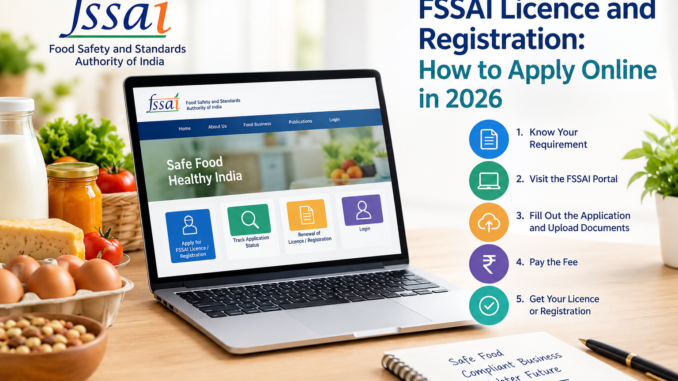
Oct 23: Starting a food business in India? Whether you plan to sell homemade cakes, open a restaurant, run a cloud kitchen or launch a food manufacturing unit, getting the appropriate FSSAI registration or licence is an important step.
The Food Safety and Standards Authority of India (FSSAI) regulates food safety across the country. Most food business operators must obtain the applicable registration or licence, depending on their activities and eligibility.
The application process is available online through the Food Safety Compliance System (FoSCoS). In 2026, FSSAI introduced significant changes to turnover thresholds and licence validity, making it important for both new entrepreneurs and existing businesses to understand the updated requirements.
This guide explains who needs FSSAI registration, which documents to prepare, how to apply online and how to make the process easier.
What Is an FSSAI Licence or Registration?
An FSSAI licence or registration is an official authorisation for eligible food businesses operating in India. It helps ensure that food operators comply with the safety and hygiene requirements applicable to their activities.
Restaurants, bakeries, food manufacturers, retailers and other food businesses must follow the relevant food safety regulations. Obtaining the appropriate authorisation is also an important way to establish credibility with customers, suppliers and business partners.
The correct category depends on factors such as annual turnover, the nature of the business and any activity-specific licensing conditions.
Types of FSSAI Registration and Licence in 2026
From 1 April 2026, FSSAI revised the general turnover thresholds used to categorise food businesses.
Category
General annual turnover threshold
FSSAI Registration
Up to ₹1.5 crore
State FSSAI Licence
Above ₹1.5 crore and up to ₹50 crore
Central FSSAI Licence
Above ₹50 crore
These thresholds are based on FSSAI’s revised framework. Turnover alone may not determine the correct category for every operator because certain food business activities have separate eligibility conditions.
For example, an importer or a business undertaking a specially regulated activity may have additional licensing requirements. Check the applicable category on the official FoSCoS portal before submitting an application.
Who Needs FSSAI Registration?
FSSAI registration or licensing requirements apply to a wide range of food businesses, including:
Restaurants, cafés and hotels
Home-based food businesses
Cloud kitchens and catering services
Bakeries, sweet shops and confectionery businesses
Food manufacturers and processors
Grocery shops and food retailers
Food wholesalers and distributors
Food storage and transportation businesses
Applicable online food sellers
Example: Suppose you want to start selling homemade cakes through Instagram and local delivery services. Before accepting commercial orders, you should check the FSSAI requirements applicable to your food business, including the appropriate registration or licence category. Operating from home does not automatically exempt a commercial food business from food safety regulations.
Documents Required for FSSAI Registration
The documents required depend on your business category and activities. Commonly requested details include:
Identity proof of the applicant or authorised signatory
PAN details, where applicable
Proof of business premises, such as a rent agreement or ownership document
Business constitution documents, where required
Details of the food products and business activities
Applicant photograph and contact details, where applicable
Additional technical documents for certain manufacturing or specialised operations
You may not need every document on this list. Review the official checklist for your selected business category before applying.
Keeping the documents ready in advance can help you complete the form accurately and reduce avoidable delays.
How to Apply for an FSSAI Licence Online
The application process can be completed through the official FoSCoS website.
Step 1: Visit the official portal
Open the FoSCoS website and select the option to apply for a new licence or registration.
Step 2: Select your state and business activity
Choose the state where your business operates and identify the relevant food business category. The options available depend on the nature of your activity.
Step 3: Check your eligibility
Review the applicable turnover thresholds and activity-specific requirements to determine whether you need registration, a State licence or a Central licence.
Step 4: Fill in the application form
Enter the required details, including your business name, address, applicant information and food business activities. Check that the information matches your supporting documents.
Step 5: Upload the required documents
Attach the documents requested by the portal. Make sure the files are clear and complete.
Step 6: Pay the applicable fee
Check the fee displayed for your selected category and pay through the official portal, where a fee is applicable. Eligible street food vendors and hawkers may qualify for a registration fee exemption under the relevant provisions.
Step 7: Submit and track your application
Save your acknowledgement or application reference number. Use the tracking facility on FoSCoS to monitor progress and respond to any official requests for clarification or additional documents.
Processing times depend on the business category, completeness of the application and applicable verification requirements. Certain eligible categories may qualify for simplified or instant processing, but approval should not be assumed for every application.
Easy Ways to Make FSSAI Registration Simpler
A few practical steps can make the application process less stressful, especially for first-time entrepreneurs.
Choose the right category. Do not select a registration or licence type simply because another business uses it. Check your own business activity and eligibility.
Organise your documents. Keep your identity proof, business address details and product information ready before starting the form.
Double-check the information. Differences between your application and supporting documents can lead to queries or delays.
Use the official portal. Apply through FoSCoS and make payments only through its authorised payment process. Be cautious of unofficial websites promising guaranteed approvals.
Ask for professional help when necessary. Businesses involved in manufacturing, importing or multiple regulated activities may benefit from advice from a qualified food safety compliance professional.
Keep your application number safe. You will need it to check the status of your application and follow up on any requests.
How Much Does FSSAI Registration Cost?
The cost depends on the applicable registration or licence category and business activity. Applicants should consult the current fee schedule on FoSCoS rather than rely on outdated figures published on other websites.
Eligible street food vendors and hawkers benefit from a registration fee exemption under the applicable provisions. Other businesses should confirm their fees before submitting an application.
If you use a private consultant, distinguish the official government fee from any separate professional service charges.
FSSAI Regulatory Updates in 2026: What Businesses Should Know
FSSAI introduced several important changes in 2026 to simplify compliance and strengthen its food safety framework.
Revised turnover thresholds: From 1 April 2026, the general turnover threshold for registration increased to ₹1.5 crore. State licensing generally applies above ₹1.5 crore and up to ₹50 crore, while Central licensing generally applies above ₹50 crore. Separate conditions may apply to certain activities.
Perpetual validity: Under the amended framework, FSSAI licences and registrations remain valid unless suspended, cancelled or surrendered. Periodic renewal is no longer required under this framework. Businesses must nevertheless continue to comply with applicable statutory requirements.
Simplified provisions for street food vendors: Eligible vendors already registered with municipal corporations or Town Vending Committees under the Street Vendors (Protection of Livelihood and Regulation of Street Vending) Act, 2014, are covered by deemed-registration provisions, subject to the applicable conditions.
Risk-based inspections: The revised framework includes risk-based inspection and food safety audit measures. This approach allows regulatory oversight to consider factors such as the nature of the food business and its compliance history.
Reduced administrative burden: The reforms aim to simplify procedures and reduce repetitive paperwork for eligible businesses while maintaining food safety standards.
Existing food business operators should check official FSSAI notifications and FoSCoS instructions to understand how the changes affect their current registration or licence.
Does an FSSAI Licence Need Renewal?
Under the revised 2026 framework, FSSAI licences and registrations have perpetual validity, so periodic renewal is no longer required.
However, perpetual validity does not remove the obligation to comply with food safety regulations. Businesses must continue to maintain appropriate hygiene standards, meet applicable statutory requirements and update their records when required.
If you expand your operations, change your business activities or start handling additional food categories, check whether a modification or another authorisation is necessary.
Conclusion
Getting an FSSAI licence or registration is an important step towards running a food business responsibly in India. Whether you are selling homemade snacks, opening a restaurant or setting up a manufacturing unit, understanding the applicable category and preparing the right documents can make the process easier.
The 2026 reforms have changed the general turnover thresholds and introduced perpetual validity for licences and registrations. Before applying, check the current rules for your business activity and use the official FoSCoS portal for the latest eligibility information, application requirements and fees.
With the right preparation and continued attention to food safety, entrepreneurs can spend less time dealing with avoidable paperwork and more time building a trusted food business.
