
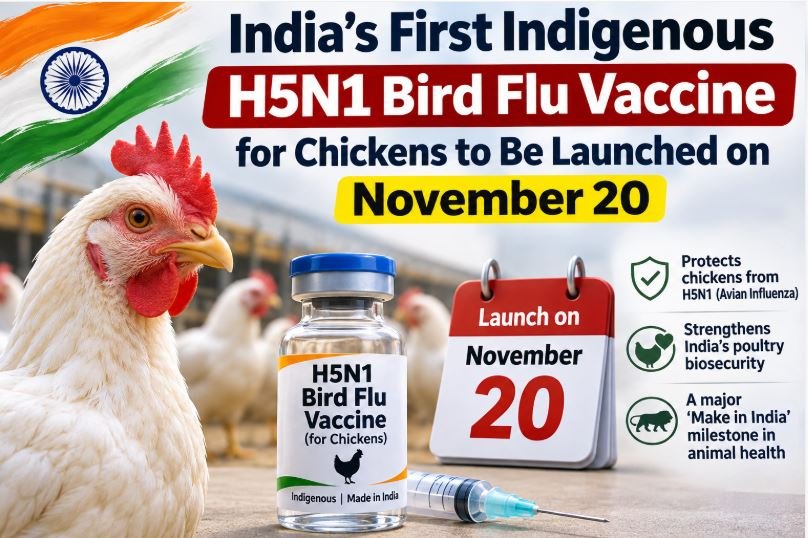
New Delhi, Nov 18: India is set to introduce its first indigenously developed vaccine against the H5N1 bird flu virus in chickens on November 20, marking an important development for the country’s poultry sector.
Union Agriculture and Farmers Welfare Minister Shivraj Singh Chouhan will dedicate the vaccine to the nation at the ICAR–National Institute of High Security Animal Diseases (ICAR-NIHSAD) in Bhopal.
Developed by scientists at ICAR-NIHSAD, the inactivated vaccine targets H5N1 Clade 2.3.2.1a, a strain linked to bird flu outbreaks in chickens. The development highlights India’s growing research capabilities in animal healthcare and its efforts to strengthen domestic solutions for major poultry diseases.
Bird flu remains a serious concern for India’s poultry industry. Outbreaks can cause high mortality among birds, leading to financial losses for farmers, disruption of poultry businesses and challenges for the wider supply chain. Since 2006, India has reported more than 500 combined outbreaks of H5N1 and H5N8 avian influenza.
The new vaccine is expected to support the country’s preparedness against the disease and provide an important tool for poultry health management. It could also help reduce dependence on imported or externally developed vaccine solutions.
The development is particularly significant for India’s poultry sector, which supports millions of livelihoods through farming, processing, transportation, feed production and retail businesses. Stronger disease prevention measures can help protect farmers’ incomes and improve confidence across the industry.
The vaccine’s wider use will depend on regulatory approvals, deployment plans and appropriate vaccination protocols. It will also need to be supported by disease surveillance, farm hygiene and effective biosecurity practices.
The November 20 launch marks a positive step in India’s efforts to strengthen animal healthcare research and protect its poultry industry through indigenous scientific innovation.
