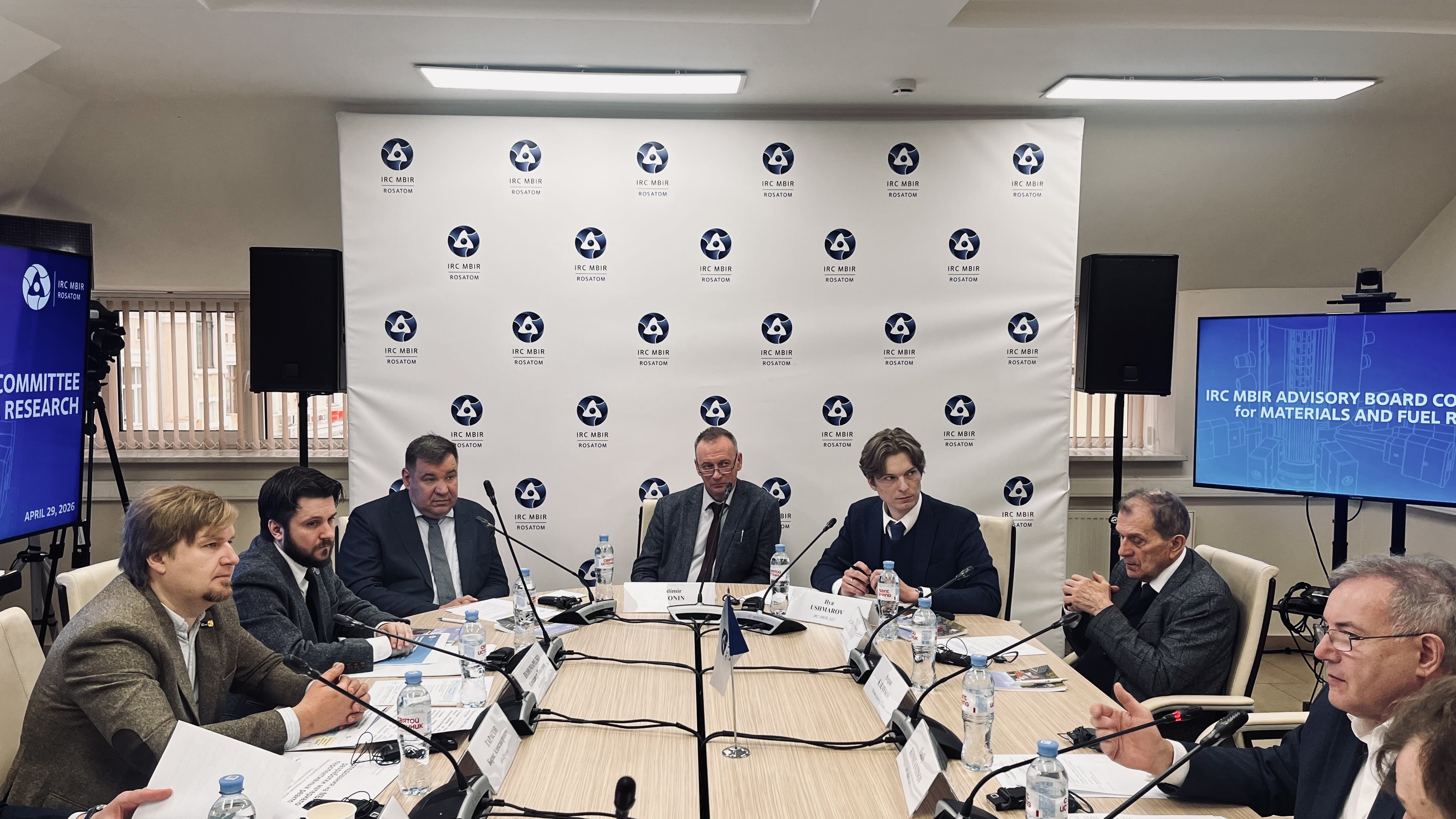
Mumbai, May 07: A meeting of the Committee on Material and Fuel Research on the International Research Centre on the basis of MBIR reactor (IRC MBIR) Advisory Board was held in Moscow. MBIR multipurpose fast-neutron research reactor is currently under construction in Dimitrovgrad, at the site of JSC “SSC RIAR” (State Scientific Centre – Research Institute of Atomic Reactors, part of Rosatom’s scientific division).
The event brought together over 80 experts from 35 organizations from Russia, China, Vietnam, Brazil, Uzbekistan, Tunisia, Jordan and other countries. Presentations were delivered by representatives of research organizations of Rosatom, the Joint Institute for Nuclear Research, the National Research Center Kurchatov Institute – St. Petersburg Institute of Nuclear Physics, the Dalat Nuclear Research Institute (VINATOM, Vietnam), and the Institute of Plasma Physics of the Chinese Academy of Sciences (ASIPP, China).
Vladimir Voronin, Deputy Director for Science at the NRC “Kurchatov Institute” – PNPI, presented an update on the development of PIK research reactor and outlined the scientific program for the International Centre for Neutron Research based on PIK high-flux reactor. At the meeting, participants put forward specific research requests for the MBIR reactor. VINATOM presented experimental work in materials science and reactor physics, and ASIPP showcased a research program in the field of controlled thermonuclear fusion. The neutron flux power and density of the MBIR reactor are designed to meet these requests, thereby ensuring the successful execution of high‑quality research experiments.
Unique research facilities capable of addressing future energy challenges are a priority for national research programs. Only a handful of countries can conduct experiments of this level, and even fewer can build such facilities. Therefore, meetings of the international community are an opportunity to compare approaches, jointly identify key objectives for the MBIR, and harmonize requirements for irradiation capabilities and research infrastructure,” noted Stepan Kalmykov, Chairperson of the IRC MBIR Advisory Board, Vice President of the Russian Academy of Sciences, and Scientific Director of the Chemistry Department of Moscow State University, in his welcoming speech.
“MBIR significantly reduces time and resources required to study the properties of cladding, core components, and vessel materials. Most importantly, the data obtained apply to the broad range of modern technologies: from high-temperature gas-cooled reactors and small modular reactors to thermonuclear fusion. Such tasks can only be solved through broad international cooperation bringing together researchers and engineers,” emphasized Vladimir Novikov, Scientific Director of the Bochvar Institute.
“Access to the capabilities of MBIR reactor opens the way for Arab countries to make progress in the creation of new nuclear materials, the advancement of radiopharmaceuticals, and the development of a safe system for radioactive waste management,” noted Salem Hamdi, Director General of the Arab Atomic Energy Agency.
One of the key outcomes of the meeting was a proposal to integrate the research capabilities of two unique scientific facilities: the PIK high‑flux beam reactor (Gatchina) and the MBIR high‑flux multifunctional reactor. Leveraging the complementary neutron spectra, equipment, and research methods available at these centres can create a synergistic effect, enabling a comprehensive solution to both applied and fundamental scientific challenges in the interests of global science.