
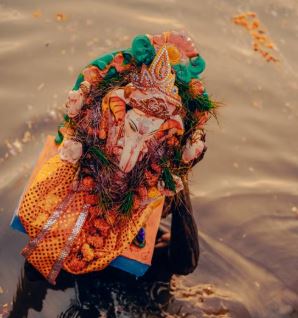
Pic Credit: Pexel
As Ganpati celebrations come to an end, the materials left behind after visarjan are finding new uses through recycling and community-led waste-management initiatives.
Instead of treating flowers, clay, plaster of Paris (PoP) and food waste as a single stream of festival garbage, several programmes are focusing on collecting these materials separately and processing them for reuse.
The approach is gradually changing the way festival waste is viewed — from a disposal problem into a potential resource for the circular economy.
PoP idols move towards material recovery
Plaster of Paris idols can remain in the environment for long periods and have traditionally posed challenges during immersion. Organised collection systems can recover PoP material from designated immersion facilities and process it for potential reuse.
Some recycling initiatives have explored converting recovered PoP into products such as furniture and other useful items. The material can also be processed for certain construction-related applications, depending on local recycling facilities and quality requirements.
The objective is to keep recovered material in productive use rather than allowing it to become unmanaged waste.
Clay can be used again
Clay idols provide a more direct route to reuse. After immersion in designated tanks, leftover clay can be recovered, cleaned and processed for further use.
Projects such as the Punaravartan initiative have focused on collecting and refining clay so it can return to the pottery cycle. The recovered material can potentially be used for new idols and other clay products.
This creates a circular process in which the same natural material can be used more than once.
Flowers turn into compost and value-added products
Flowers and other organic offerings, commonly known as nirmalya, form a major part of festival waste.
When separated from plastic, thermocol and other non-biodegradable material, flowers can be composted and converted into organic manure. Some initiatives have also experimented with turning discarded flowers into products such as natural incense and other value-added materials.
Proper segregation is critical because contaminated floral waste becomes much harder to process.
Food waste can become energy
Large pandals and community celebrations can also generate considerable quantities of leftover food.
Instead of sending biodegradable food waste directly to landfill, it can be diverted to composting or biomethanation facilities. Biomethanation can generate biogas, while the remaining organic material can be used as manure after appropriate processing.
This provides an additional route for reducing the amount of wet waste requiring disposal.
A cleaner visarjan can create economic value
The recycling of Ganpati waste is increasingly connected with the larger idea of a circular economy. Recovering materials can reduce pressure on landfills and water bodies while creating opportunities for recycling enterprises, waste workers, local groups and small businesses.
However, successful recycling depends on more than technology. Segregation, collection, transport and access to appropriate processing facilities are equally important.
With better systems in place, the end of Ganpati celebrations can become the beginning of another cycle — where clay returns to pottery, flowers become compost, food waste generates energy and recovered materials are converted into useful products.
The shift can help make festival celebrations more environmentally responsible while demonstrating how community participation and waste management can work together to create value from materials that would otherwise be discarded.
