
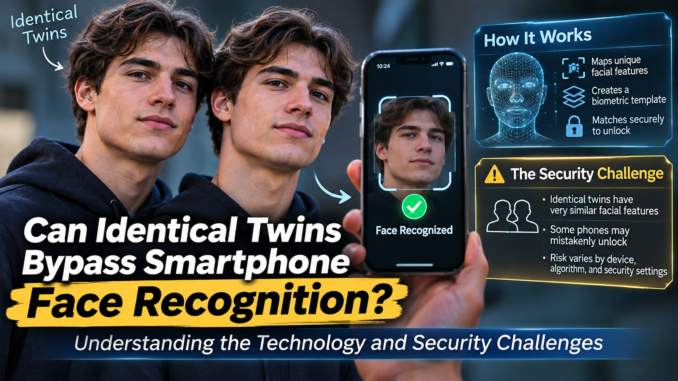
Nov 16: Smartphone face recognition has made unlocking devices easier than ever. Instead of entering a password or PIN, users can simply look at their phones to gain access. The technology is also increasingly used to authenticate payments and protect personal information.
But how reliable is this technology when two people look almost exactly alike?
Identical twins present an interesting challenge for facial recognition systems. Since they share almost identical genetic characteristics, their facial structures can be remarkably similar. Features such as eye spacing, nose shape, jawlines and cheekbones may look nearly identical, making it difficult for some recognition systems to distinguish between them.
This raises an important question: Can one identical twin unlock the other’s smartphone?
The answer depends on the facial recognition technology used by the device. While some systems may struggle to distinguish highly similar faces, others use more advanced biometric methods to improve authentication accuracy.
As smartphones become an important part of everyday life, this challenge highlights the need for stronger and more reliable biometric security.
Why Identical Twins Are a Challenge for Facial Recognition Technology
Facial recognition technology works by analysing different characteristics of a person’s face. These include the distance between the eyes, the shape of the nose, facial contours and the positioning of other features.
The system converts this information into a digital representation, often called a face embedding. When someone attempts to unlock the device, the newly captured facial data is compared with the information stored during registration.
For most people, these characteristics are sufficiently different to allow accurate identification.
Identical twins, however, are a different case. Their facial features can be so similar that recognition algorithms may find it difficult to establish a clear distinction.
This does not mean that every smartphone can be unlocked by an identical twin. The result depends on the device’s sensors, facial recognition algorithm, security settings and the accuracy of its authentication process.
Latest NIST Report Highlights the Challenge of Identifying Identical Twins
The National Institute of Standards and Technology (NIST) continues to evaluate how accurately facial recognition algorithms distinguish between individuals with similar appearances.
Its Face Recognition Technology Evaluation (FRTE) Twins Demonstration is particularly relevant to this challenge. The evaluation examines how frequently facial recognition algorithms incorrectly match one twin with another.
In its latest results update, dated November 6, 2026, NIST continued reporting false match rates for twin comparisons. The assessment measures how often an algorithm incorrectly identifies two different individuals as the same person.
The evaluation uses a false match rate of 0.0001 on mugshot images as its reference threshold and examines how algorithms perform when comparing twins. It also considers false non-match rates for genuine matches, helping assess the balance between security and recognition accuracy.
One important finding from NIST’s ongoing work is that many facial recognition algorithms produce higher false match rates when comparing identical and same-sex fraternal twins than when comparing unrelated individuals of similar age and sex.
This is significant for smartphone security because a biometric system must do more than recognise a generally similar face. It must establish that the person attempting to unlock the device is actually the registered user.
NIST’s evaluation is designed for facial recognition developers and researchers rather than being a direct test of consumer smartphone models. Nevertheless, it provides an important benchmark for understanding the limitations of facial recognition technology.
FBI’s 2026 Research Explores How Twins Test Biometric Security
Another important development came from the Federal Bureau of Investigation (FBI), which published a report on August 11, 2026, titled How Studying Twins Helps the FBI Evaluate and Improve AI Biometric Systems.
The research is conducted in partnership with West Virginia University and uses the annual Twins Days Festival in Twinsburg, Ohio, to collect biometric information from volunteers.
For more than 15 years, the researchers have used the gathering to study how biometric systems distinguish between people who share remarkably similar physical characteristics.
The research examines multiple identification methods, including facial recognition, fingerprints and iris recognition.
According to the FBI, identical twins are particularly challenging for facial recognition because their facial appearances can be almost indistinguishable. However, their fingerprints and iris patterns remain unique.
The long-term nature of the research also allows scientists to examine how biometric characteristics change as participants grow older and how recognition technologies improve over time.
The FBI emphasises that even advanced facial recognition algorithms have limitations when distinguishing identical twins. It also highlights why biometric results should be considered alongside other identifying information rather than treated as conclusive evidence on their own.
For the smartphone industry, this research reinforces the importance of evaluating biometric systems against difficult real-world identification scenarios.
Can AI Identify the Small Differences Between Identical Twins?
Artificial intelligence is opening new possibilities for improving facial recognition accuracy.
Although identical twins may share almost identical facial structures, small differences can still exist. These may include facial marks, skin patterns, slight asymmetry and other individual characteristics.
A February 2026 study published in Scientific Reports, titled Facial Mark Based Biometric Differentiation of Identical Twins Using Dynamic Feature Enhancement, explored how facial skin marks could help distinguish identical twins.
The researchers examined 319 processed images representing 74 pairs of twins. Their machine-learning framework analysed the location and distribution of facial marks to identify differences that might otherwise go unnoticed.
The study reported 96.62% cross-validation accuracy and an area under the curve (AUC) of 90.6%.
The findings suggest that even small differences in facial characteristics could help improve biometric identification.
However, this research does not mean that existing smartphones can achieve the same level of accuracy. The study examined a specific research approach rather than testing commercially available smartphone unlocking systems.
Another relevant study published in the 2026 Proceedings of the AAAI Conference on Artificial Intelligence explored facial asymmetry through a model called the Asymmetric Hierarchical Attention Network (AHAN).
The research examined differences between the left and right sides of the face and used attention-based AI techniques to identify subtle characteristics that distinguish identical twins.
The proposed framework achieved 92.3% twin verification accuracy on the ND-TWIN dataset.
Together, these studies show how researchers are looking beyond obvious facial features to identify the subtle differences that make each individual unique.
How Smartphone Face Recognition Technology Works
Not all smartphones use the same facial recognition technology. Some depend primarily on conventional camera images, while others combine multiple sensors to collect more detailed information about a user’s face.
Three approaches are particularly important.
2D Facial Recognition
Two-dimensional facial recognition analyses a flat image captured by the front camera. It examines features such as eye position, nose structure and the overall shape of the face.
This approach can offer convenient authentication, but its performance may be affected by lighting, camera quality and similarities between individuals.
3D Facial Mapping
Three-dimensional facial recognition goes beyond a conventional photograph. It uses depth information to understand the contours and structure of a person’s face.
This can make it more difficult to fool a system using a photograph or flat image. However, 3D facial mapping does not guarantee that identical twins will always be distinguished, as their facial structures may remain remarkably similar.
Infrared and Depth-Sensing Technology
Some advanced facial recognition systems use infrared illumination and depth sensors to capture additional information about the face.
These technologies can improve performance in different lighting conditions and help detect certain attempts to deceive the system using photographs or masks.
Their ability to distinguish identical twins, however, depends on the specific technology and how the collected biometric information is processed.
Can One Identical Twin Unlock the Other Twin’s Smartphone?
It is possible in some circumstances, but it is not a universal weakness of smartphone face recognition.
The likelihood of a false match depends on how the device captures and processes facial information. A system that relies heavily on two-dimensional images may face greater difficulties when two faces are extremely similar.
More advanced systems may use depth information and additional facial characteristics to improve identification.
Several factors can influence the outcome:
- Facial similarity: The closer the facial structures, the more difficult the comparison may become.
- Recognition technology: Different devices use different cameras, sensors and algorithms.
- Registration quality: The quality of the original facial scan can affect subsequent authentication.
- Environmental conditions: Lighting, camera angle and facial expressions may influence the results.
- Security settings: The system’s acceptance threshold determines how closely a captured face must match the registered user.
For this reason, it would be inaccurate to claim that identical twins can automatically unlock each other’s smartphones. Equally, facial recognition should not be considered completely immune to false matches.
What This Means for Smartphone Manufacturers
The challenges posed by identical twins highlight an important area for smartphone manufacturers and biometric technology developers.
As facial recognition becomes a standard feature, manufacturers need to consider how their systems perform when users have unusually similar facial characteristics.
This requires more than testing recognition accuracy among individuals with visibly different faces.
Some important areas of improvement include:
- Better biometric testing: Facial recognition systems should be evaluated using datasets that include identical twins.
- Advanced facial analysis: AI models could examine subtle characteristics such as facial asymmetry and skin marks.
- Additional authentication: Sensitive activities may require a PIN, password or another verification method.
- Regular security assessments: Biometric systems need continuous evaluation as technology and security threats evolve.
Improving these areas could help reduce false acceptance and strengthen confidence in facial recognition.
Is Face Recognition Enough to Protect Smartphone Users?
Facial recognition offers convenience, but it should not be the only consideration when evaluating smartphone security.
Modern smartphones contain banking applications, personal photographs, private messages, work-related information and access to several digital services. A weakness in authentication could therefore expose much more than the device itself.
Users should maintain strong PINs or passwords and enable additional verification for sensitive applications and financial transactions wherever possible.
A layered security approach can provide better protection because it does not depend entirely on a single biometric identification method.
The Future of Facial Recognition and Biometric Security
The challenge of distinguishing identical twins shows that facial recognition technology still has areas that require attention.
Recent findings from NIST and the FBI demonstrate why researchers continue to test biometric systems against individuals with extremely similar appearances. Meanwhile, academic research into facial marks and asymmetry is exploring new ways to improve identification accuracy.
Developments in artificial intelligence, 3D facial mapping and advanced biometric analysis are creating new opportunities for more reliable authentication. However, translating academic research into dependable smartphone security will require further testing under real-world conditions.
For smartphone manufacturers, the objective should not simply be to make face recognition faster or more convenient. It should also be to ensure that the technology consistently recognises the right person.
As biometric authentication becomes increasingly important in digital life, distinguishing between identical twins will remain an important test of how secure facial recognition technology can become.
