
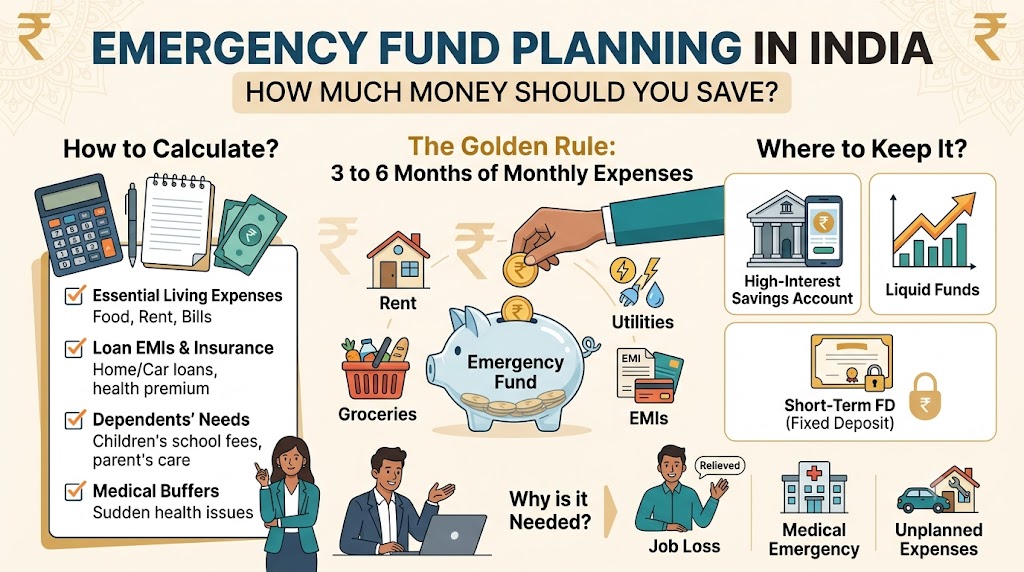
Financial security is not just about earning a steady income or investing for the future. It is also about being prepared for unexpected expenses that can disrupt everyday life. A sudden medical bill, job loss, urgent home repair or delay in business payments can put pressure on household finances. An emergency fund helps manage these situations without forcing people to sell long-term investments or depend on high-interest loans and credit cards.
An emergency fund is money set aside specifically for unexpected and essential expenses. It acts as a financial safety net, helping individuals and families meet their basic needs when income is interrupted or an urgent financial problem arises. Unlike savings for a holiday, a new vehicle or a home purchase, this money should be reserved for genuine emergencies.
For Indian households, where monthly budgets often include rent, groceries, school fees, healthcare, insurance premiums and loan repayments, having accessible savings can make a meaningful difference. It can provide breathing space during difficult periods and help families avoid making rushed financial decisions.
How Much Should You Save in an Emergency Fund?
The amount you need depends on your monthly expenses, income stability, family responsibilities and existing financial commitments. A widely used financial planning guideline is to keep three to six months of essential living expenses in an emergency fund.
People with stable employment and fewer financial responsibilities may find this a reasonable starting point. Families with children, dependent parents, substantial loan repayments or only one earning member may need savings that cover six to nine months of expenses.
Self-employed professionals, freelancers and small business owners may benefit from keeping enough money to cover nine to twelve months of essential costs, particularly when income varies or customer payments are unpredictable.
These are general guidelines, not fixed rules. The aim is to build a reserve that gives you enough time to manage a financial setback without putting essential household needs at risk.
What Should Your Emergency Fund Cover?
Your emergency fund should be based on essential expenses rather than your total salary. Start by identifying the payments you would still need to make if your income suddenly stopped.
These generally include:
-
Housing and household needs: Rent, maintenance, groceries, electricity, water, cooking gas and essential phone or internet bills.
-
Loan repayments: Home, vehicle, education and other unavoidable EMIs.
-
Healthcare expenses: Medicines, consultations, tests and medical costs that are not fully covered by insurance.
-
Insurance premiums: Payments needed to maintain essential health and life insurance coverage.
-
Family responsibilities: Necessary education costs, transport and other unavoidable expenses for dependants.
Review these expenses regularly, as rising living costs, changes in rent or additional family responsibilities can increase the amount you need to save.
Where Should You Keep Your Emergency Savings?
The main purpose of an emergency fund is to provide quick access to money when you need it. Safety and liquidity should therefore take priority over high returns.
A savings account can hold the portion you may need immediately. Keeping this money separate from your regular spending account can also help prevent unnecessary withdrawals.
Short-term or sweep-in fixed deposits may be suitable for part of the fund, depending on the bank’s withdrawal conditions. Check premature withdrawal rules and penalties before choosing this option.
Some savers also consider liquid or overnight mutual funds for a portion of their reserve. However, these are market-linked products, returns are not guaranteed, and access to money may take time. They are not substitutes for cash that must be available immediately.
It is also important to understand the protection available on bank deposits. According to the Deposit Insurance and Credit Guarantee Corporation (DICGC), eligible bank deposits are insured up to ₹5 lakh per depositor per bank, including principal and interest, subject to applicable rules. DICGC data showed that 97.5% of deposit accounts were fully protected under this system as of September 30, 2025. However, this figure refers to the proportion of accounts fully covered by deposit insurance, not the proportion of total deposit value insured. The ₹5 lakh limit applies to eligible deposits held in the same capacity and right at the same bank, rather than separately to every account.
This is one reason to understand where your money is held and what protection applies. Avoid putting your entire emergency fund into shares, long-term investments or products that are difficult to withdraw quickly. An emergency reserve is designed to protect financial stability, not to maximise investment gains.
How to Build an Emergency Fund Gradually
Building an emergency fund can feel challenging when most of your income goes towards regular bills. However, you do not need to save the full amount at once. Consistency matters more than starting with a large contribution.
Set a realistic monthly savings target and move that amount into your emergency fund as soon as you receive your salary or business income. Even a modest contribution can help establish a regular habit. Increase the amount whenever your income improves or your expenses decrease.
You can also direct part of a bonus, additional earnings or an unexpected cash inflow towards your savings. Review your progress every six to twelve months and adjust the target when your financial responsibilities change.
If you use the fund during a genuine emergency, focus on rebuilding it once your finances stabilise. Keeping the reserve updated is just as important as creating it in the first place.
What Counts as a Genuine Emergency?
A useful way to decide whether to use the fund is to ask whether the expense is unexpected, urgent and necessary.
A sudden medical expense, loss of income, essential home repair or urgent vehicle repair may justify using the money. Planned holidays, festive shopping, new gadgets and celebrations should generally be managed through separate savings.
Clear rules help protect the fund from everyday spending and ensure that it remains available when a real financial difficulty arises.
Important Financial Precautions to Remember
An emergency fund should work alongside other parts of your financial plan. Health insurance can help cover eligible medical costs, while suitable life insurance can provide protection for dependants. However, insurance policies have specific terms, exclusions and limits, so they may not cover every expense.
Avoid treating a credit card limit as emergency savings. Borrowing may provide short-term access to money, but interest and repayment obligations can make an already difficult situation more expensive.
It is also important to review your emergency fund whenever you experience a major life change, such as marriage, the birth of a child, a new home loan, a change in employment or the start of a business. These changes can affect both your monthly expenses and the amount of protection you need.
Make Emergency Savings a Financial Priority
An emergency fund may not deliver the excitement of a rising investment portfolio, but it provides something equally important: financial resilience. It can help families manage sudden expenses, protect long-term savings and reduce dependence on expensive borrowing.
The best approach is to start with a realistic target, keep the money accessible and contribute regularly. As income, living costs and family responsibilities change, review the amount and increase it when necessary.
Financial preparedness begins before an emergency occurs. Building a reserve today can help you face unexpected challenges with greater confidence and protect the financial goals you are working towards.
