
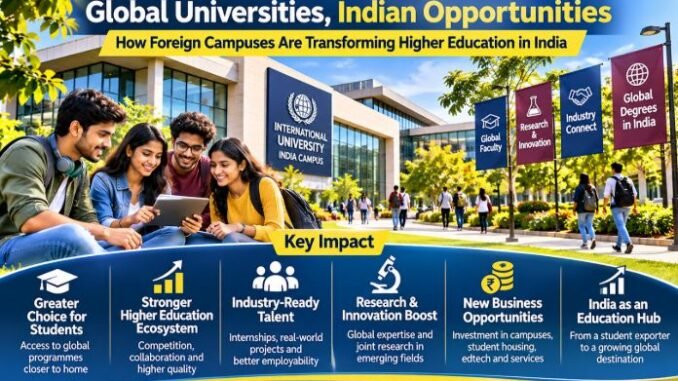
India’s higher education landscape is entering an exciting new phase. For years, the country has been a major source of international students, with thousands travelling overseas to pursue globally recognised degrees and better career opportunities. Now, that relationship is beginning to evolve. Foreign universities are increasingly looking towards India as a destination for establishing campuses, attracting students and building long-term academic partnerships.
Driven by policy reforms, rising demand for quality education and a growing need for specialised skills, this shift is creating opportunities far beyond university admissions. International campuses could change how Indian students access global education, encourage domestic institutions to raise academic standards and attract investment into education infrastructure, technology and student services.
For India, the opportunity is significant: to become not just a country that sends students abroad, but a growing centre for international education, research and business.
Policy Reforms Are Opening India’s Education Market
The National Education Policy (NEP) 2020 has given fresh direction to India’s internationalisation ambitions. It encourages global academic collaboration, multidisciplinary learning, research partnerships and greater exposure to international teaching practices. One of its major goals is to increase the Gross Enrolment Ratio in higher education to 50% by 2035.
An important step towards this ambition came with the University Grants Commission’s 2023 regulations for foreign higher educational institutions establishing campuses in India. The framework allows eligible international universities to set up campuses, subject to prescribed conditions and regulatory requirements.
Qualifying institutions can design their academic programmes, establish admission processes and award degrees in their own names. This provides foreign universities with a clearer route to entering the Indian market while giving students access to international academic programmes closer to home.
The policy shift also creates a responsibility: institutions must maintain academic quality, transparent admission practices and appropriate student safeguards. The credibility of this emerging market will depend on how effectively these standards are maintained.
International Universities Are Building a Presence in India
GIFT City in Gujarat has emerged as an early destination for international higher education. Australia’s Deakin University and the University of Wollongong have established operations there, bringing international academic programmes into a developing financial and business hub.
The University of Southampton has also commenced academic operations at its Gurugram campus for the 2025–26 academic session, offering programmes in areas including computer science, economics, finance and management.
These developments point to a wider change in how international institutions view India. Cities such as Gurugram, Hyderabad, Bengaluru and Mumbai offer access to corporate headquarters, technology companies, financial institutions and growing professional markets. Such locations can help universities connect classroom learning with real business requirements.
However, planned campuses and operating institutions should not be confused. New projects still need to progress through regulatory approvals, investment decisions, faculty recruitment and student enrolment before they become established education destinations.
What Foreign Campuses Mean for Indian Students
For students and families, the attraction is clear. A foreign university campus in India can offer an international academic environment without requiring students to relocate overseas. This may reduce travel and accommodation expenses and allow students to remain closer to family and existing support networks.
Programmes in artificial intelligence, computer science, finance, management and engineering could be particularly relevant as employers seek specialised skills.
But an international university name alone should not determine a student’s choice. Course quality, faculty experience, scholarships, total fees, internships and graduate employment outcomes matter just as much.
Students should also understand that studying at an Indian branch campus is not necessarily the same experience as attending the parent university overseas. Cultural immersion, international networking and direct exposure to another country’s employment market may differ.
The real value of these campuses will come from the quality of education and career opportunities they provide, not simply the prestige associated with their international identity.
A Growing Business Opportunity Beyond the Classroom
The expansion of foreign universities is creating a wider market for businesses and investors. Establishing a campus requires buildings, laboratories, libraries, digital learning systems, accommodation and student facilities. This creates potential demand for construction firms, architects, technology providers and campus-management companies.
The surrounding student economy can also support local businesses. Accommodation providers, restaurants, transport operators, retailers, healthcare services and recreational facilities may benefit as campuses attract students and academic staff.
Education technology is another promising area. Universities need digital platforms for admissions, student administration, online learning, assessments, research management and cybersecurity. Indian technology companies and startups could find opportunities to provide these services.
For investors, the opportunity therefore extends beyond university ownership. It includes the supporting infrastructure and services needed to build sustainable education hubs.
Stronger Industry Links Could Improve Graduate Employability
One of the biggest opportunities lies in connecting international education with India’s business and industrial requirements.
Employers increasingly need graduates who can combine academic knowledge with practical skills, digital capabilities and problem-solving experience. Universities can help address this demand through internships, industry-led projects, applied research and professional training.
A finance programme, for example, could work with banks and financial services companies. Technology courses could develop partnerships with software firms and startups, while engineering departments could collaborate with manufacturers and infrastructure businesses.
These relationships can benefit everyone involved. Students gain workplace exposure, companies develop stronger recruitment pipelines, and universities improve the relevance of their programmes.
Research partnerships could add another dimension. Collaboration in artificial intelligence, healthcare, biotechnology, clean energy and advanced manufacturing may help businesses access academic expertise while giving researchers opportunities to work on practical challenges.
Challenges That Will Shape the Market
Despite the potential, India’s international education market faces important challenges. Affordability remains a major concern. If fees are too high, foreign campuses may serve only a relatively small section of students, limiting their contribution to wider access.
Recruiting and retaining experienced faculty will also be essential. International universities must maintain consistent teaching standards and research quality while competing for skilled academics.
Regulatory clarity, degree recognition and student protection will influence public confidence. Institutions must communicate programme costs, qualifications, campus arrangements and career support clearly.
There is also a need to ensure that international campuses contribute to India’s wider education system. Collaboration with domestic universities, research institutions and businesses will be important if their impact is to extend beyond individual campuses.
India’s Opportunity to Become a Global Education Destination
Foreign university campuses could become an important part of India’s education and economic transformation. They offer students additional choices, encourage competition among institutions and create new opportunities for investment, employment and research.
For businesses, the emerging market includes education infrastructure, student accommodation, digital technology and professional services. For universities, it offers access to a large student population and closer links with one of the world’s major growth economies.
Yet the long-term success of this shift will not be measured simply by how many international institutions open campuses in India. It will depend on whether students receive quality education, graduates find meaningful career opportunities and research partnerships deliver wider economic value.
India has an opportunity to build an education ecosystem that combines international academic standards with local industry needs. If universities, businesses and policymakers work together, foreign campuses could help turn the country into a stronger global centre for education, talent and innovation.
