
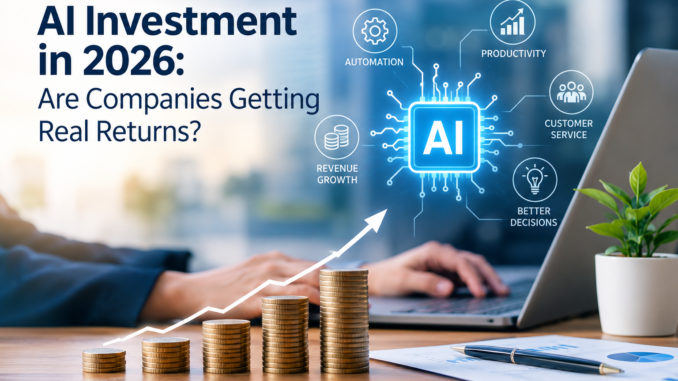
Oct 26: Artificial intelligence is attracting significant investment in 2026, but businesses are discovering that adopting AI and making money from it are two different things. While AI tools can help employees work faster, automate routine tasks and analyse complex information, turning these advantages into higher profits remains a challenge for many organisations.
The question is no longer whether AI can improve productivity. Businesses now need to determine whether their investment is reducing costs, increasing revenue and delivering measurable returns.
Recent industry research highlights this gap. McKinsey’s August 2026 survey found that 80% of respondents reported improvements in individual productivity through AI, but only 37% said AI had contributed positively to their organisations’ earnings before interest and taxes (EBIT). The findings suggest that productivity improvements do not automatically translate into stronger financial performance.
For companies planning their next round of AI investment, the priority is to identify applications that solve genuine business problems and demonstrate measurable value.
Why AI Investment Is Increasing in 2026
Businesses are expanding their use of artificial intelligence across marketing, customer service, software development, finance and operations. The technology is increasingly being considered as part of everyday business infrastructure rather than an experimental tool.
McKinsey’s 2026 survey found that 44% of respondents reported that their organisations were scaling AI across the enterprise, up from 38% a year earlier. However, financial benefits remain uneven, indicating that widespread adoption alone is not enough to guarantee business success.
Companies are investing in AI for several reasons:
To reduce the time employees spend on repetitive tasks.
To improve the speed and quality of business decisions.
To identify new sales opportunities and understand customer behaviour.
To streamline operations and reduce avoidable errors.
To develop new products, services and digital capabilities.
The challenge is to prioritise applications that deliver more value than they cost.
Where Companies Can Get Real Returns From AI
1. Business Automation and Cost Reduction
AI-powered automation can help businesses process documents, organise information, summarise reports and manage routine enquiries. These applications can reduce manual work and allow employees to concentrate on tasks that require experience and judgement.
For small businesses, automating a time-consuming process may be more useful than investing in a complex AI platform. The return should be assessed by comparing processing costs, error rates and employee time before and after implementation.
2. Digital Marketing and Sales Growth
AI tools can support keyword research, content planning, audience analysis and campaign optimisation. They can also help marketing teams identify customer interests and make better-informed decisions about advertising expenditure.
However, faster content production does not necessarily lead to more sales. Businesses should measure qualified leads, conversion rates, customer acquisition costs and revenue to understand whether AI is improving marketing performance.
3. Customer Service and Engagement
AI chatbots and virtual assistants can respond to common questions and direct customers to relevant information. This can help businesses manage high enquiry volumes without requiring employees to handle every routine interaction manually.
The benefits depend on response quality and customer satisfaction. Businesses should monitor unresolved enquiries, complaints and escalation rates alongside any reduction in support costs.
4. Data Analysis and Forecasting
AI can help organisations identify patterns in sales, inventory, customer behaviour and operational performance. Retailers may use these insights to improve stock planning, while service businesses can use demand forecasts to allocate resources more effectively.
Reliable results depend on accurate data and appropriate human oversight. Businesses should evaluate the quality of AI-generated recommendations before using them to make important financial decisions.
Why Some Businesses Are Not Seeing the Expected AI Returns
AI investment can become expensive when companies focus on purchasing technology without first identifying the outcomes they want to achieve.
Implementation costs are one concern. Software subscriptions, integration, employee training, data management and ongoing maintenance can significantly affect the overall return.
Another challenge is employee adoption. A new tool may offer useful features, but those benefits can remain unrealised if employees do not understand how to use it within their existing workflows.
Businesses may also struggle with unreliable data, security concerns and difficulty measuring the financial impact of productivity gains.
McKinsey’s 2026 research found that AI-related operating costs were constraining AI use in approximately one in five surveyed organisations. This reinforces the need to consider ongoing expenses rather than focusing only on the initial investment.
A practical approach is to start with a specific problem, test a suitable solution and expand its use only when the results justify the cost.
How to Calculate AI Return on Investment
Return on investment (ROI) helps businesses compare the financial benefits of an AI project with the amount spent on it.
The basic formula is:
AI ROI (%) = [(Financial Benefits − Total Investment Cost) ÷ Total Investment Cost] × 100
For example, suppose a business spends ₹10 lakh implementing an AI solution and receives ₹15 lakh in attributable financial benefits over a defined period. Its net benefit is ₹5 lakh, resulting in an illustrative ROI of 50%.
The calculation should include relevant costs such as software, implementation, training and maintenance. Businesses should also avoid counting the same productivity improvement more than once.
The most useful measures include:
Cost savings: Reduction in operating expenses and manual processing costs.
Productivity: More work completed within the same period without reducing quality.
Revenue growth: Additional sales attributable to AI-supported activities.
Customer satisfaction: Improvements in response times, retention and service quality.
Payback period: The time required for financial benefits to recover the investment.
Productivity gains should be distinguished from actual financial savings. An employee completing a task faster does not automatically reduce payroll costs or increase revenue.
AI Investment Opportunities for Small Businesses
Small and medium-sized businesses can explore AI without immediately committing to expensive, customised systems. Existing tools may be sufficient for tasks such as organising customer enquiries, preparing internal summaries, supporting marketing research or analysing sales information.
A phased approach can help control costs. Businesses can begin with one clearly defined process, establish baseline performance figures and compare the results after introducing AI.
Employee training and data protection should be included from the beginning. AI outputs need appropriate checks, particularly when they involve customer information, financial decisions or business-critical processes.
The objective should be to choose tools that address real operational needs rather than adopting AI simply because competitors are doing so.
AI Agents and the Next Stage of Business Automation
AI agents are creating new opportunities to automate connected tasks across business operations. Depending on their capabilities, these systems can gather information, coordinate workflows and interact with approved business applications.
Their potential value lies in reducing repetitive hand-offs between employees and systems. However, companies must establish clear permissions, monitoring procedures and human approval requirements for sensitive actions.
The financial case should be evaluated in the same way as any other AI investment: by examining the time saved, quality of work, operating costs and measurable business outcomes.
How Businesses Can Improve AI Investment Returns
Companies looking to improve AI ROI should focus on implementation rather than technology adoption alone.
First, identify a business problem with measurable costs or performance limitations. Next, select a suitable tool and establish baseline indicators before introducing it. Employees should receive practical training, while managers should monitor both the benefits and the risks.
Businesses should also review their results regularly. Applications that produce measurable value can be expanded, while those that fail to meet expectations should be improved or discontinued.
Most importantly, AI should be integrated into business workflows instead of being treated as an additional tool that operates separately from everyday work.
Conclusion: AI Investment Must Deliver Measurable Business Value
AI investment in 2026 offers businesses opportunities to improve productivity, automate routine work and make better use of data. However, the financial benefits vary according to implementation costs, employee adoption and the way the technology is integrated into existing operations.
Companies should measure more than the number of AI tools they use or the time saved on individual tasks. They need to establish whether those improvements translate into lower costs, better service, additional revenue or stronger profitability.
The businesses most likely to benefit are those that invest with a clear purpose, monitor results and adapt their approach when the evidence demands it. Ultimately, the success of AI investment will depend not on how much companies spend, but on how effectively they turn the technology into lasting business value.
