
Every successful business begins with an idea. But an idea alone cannot pay employees, develop products, attract customers, or keep the lights on. At some point, every entrepreneur faces a question that can influence the entire journey: Where will the money come from?
For some founders, the answer is simple. Start small, use personal savings, earn through customers, and reinvest whatever the business makes. Others believe that ambitious ideas need ambitious funding. They approach investors, pitch their vision, and exchange a portion of their ownership for the capital needed to grow.
This is where two popular startup financing approaches enter the picture: bootstrapping and venture capital.
Both have helped businesses grow, but they represent two very different ways of thinking about entrepreneurship. One places independence at the centre of business development; the other focuses on using external investment to accelerate growth. Neither guarantees success, and neither is without its challenges.
Bootstrapping: Growing with what you have
Imagine a young entrepreneur starting a small business with personal savings, a laptop, and a handful of customers. There is no major investor, no large office, and no substantial financial backing. Every new customer matters, every expense is considered carefully, and profits are reinvested to keep the business moving.
That is bootstrapping.
In simple terms, bootstrapping means building and developing a business primarily through personal funds, customer revenue, and retained earnings rather than depending on institutional investors.
The approach encourages founders to understand the real value of money. Instead of spending heavily on expansion, they learn to prioritise essential activities, control costs, and build products that customers are actually willing to pay for.
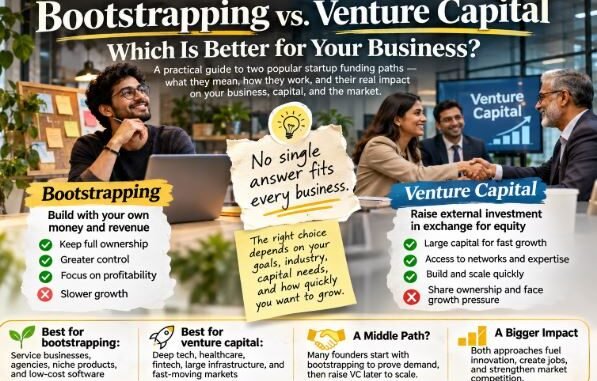
One of its biggest attractions is ownership. Founders do not have to surrender equity simply to finance their early operations. They retain greater control over business decisions and can decide their own pace of growth.
However, independence comes with a price.
Limited capital can make it difficult to hire experienced employees, invest in advanced technology, or compete with companies that have substantial financial backing. Growth may be slower, and founders can find themselves carrying considerable personal financial responsibility.
For a consultancy, creative agency, small retail business, or software company with relatively low initial costs, bootstrapping can be a practical starting point. But for a business that needs millions of rupees in research, infrastructure, or product development, internal funding may not be enough.
Venture Capital: When ambition needs bigger financial backing
Now imagine a startup developing an advanced artificial intelligence platform or a new medical technology. The idea has potential, but turning it into a commercial product requires research, skilled professionals, infrastructure, testing, and substantial investment.
Personal savings and early customer revenue may not be sufficient.
This is where venture capital becomes important.
Venture capital, commonly known as VC, is a form of equity financing in which investment firms or professional investors provide money to businesses with significant growth potential. In exchange, they receive a share of the company’s ownership.
Unlike a conventional bank loan, equity investment generally does not require regular repayment of the principal. Instead, investors expect their investment to increase in value as the company grows.
The attraction is clear: access to capital can help a startup hire talent, develop technology, expand operations, enter new markets, and compete with established companies.
But venture capital is not free money.
Founders must share ownership, and investors may receive board seats or other governance rights. They also expect measurable progress, responsible use of funds, and a credible path towards returns. This can create pressure to expand quickly, even when a slower approach might be more comfortable for the business.
For startups operating in technology, biotechnology, fintech, and other capital-intensive industries, venture capital can provide opportunities that would otherwise take years to achieve.
Yet raising more money does not automatically make a business successful. A company can attract impressive investments and still struggle if customers do not see enough value in its products.
The real difference: Ownership versus opportunity
The debate between bootstrapping and venture capital is often presented as a choice between having control and having money. In reality, the decision is more complicated.
Bootstrapping allows founders to retain greater ownership, but it can restrict their ability to move quickly. Venture capital provides access to larger financial resources, but it requires founders to share both ownership and certain aspects of decision-making.
Consider two entrepreneurs entering different markets.
The first launches a digital marketing agency. The initial investment is manageable, customers can be acquired relatively quickly, and revenue can finance future hiring. Bootstrapping makes financial sense.
The second develops a new battery technology. Research, specialised equipment, testing, and manufacturing require significant capital before meaningful revenue is possible. External investment may be essential.
The lesson is simple: the right funding strategy depends on the business, not on which financing model sounds more impressive.
Why capital matters: More than just money
Capital is the fuel that keeps a business operating and allows it to expand. But how a company obtains that capital can influence its entire financial structure.
For bootstrapped businesses, capital generally comes from internal resources. This encourages careful financial planning, efficient spending, and a stronger focus on cash flow. Since there are no external equity investors to satisfy, founders can concentrate on building a profitable and sustainable business.
For venture-backed companies, capital can arrive in much larger amounts. This allows them to invest in research, infrastructure, marketing, and talent on a scale that may be impossible through internal earnings alone.
However, this additional capital also changes expectations. Investors want to see growth, increasing market value, and a potential exit opportunity. The business must therefore balance expansion with financial discipline.
In both cases, the real measure of success is not the amount of money raised but how effectively it is converted into productive assets, customer value, revenue, and long-term business growth.
How funding shapes the market
The effects of these financing choices do not stop at company boundaries. They influence the markets in which businesses compete.
Bootstrapped businesses often strengthen smaller and specialised markets. They serve specific customer needs, encourage local entrepreneurship, and demonstrate that companies can survive without substantial external investment. Their emphasis on revenue and cost management can also introduce greater financial discipline into the business environment.
Venture-backed businesses, meanwhile, can transform entire industries. With greater investment capacity, they can develop new technologies, challenge established players, create employment, and introduce products that change how people work and live.
Think about the rise of digital payments, online platforms, electric mobility, and artificial intelligence. Significant investment has helped businesses in these sectors develop products and expand their reach.
However, there is another side to this growth. Excessive funding can encourage companies to spend aggressively, offer unsustainable discounts, chase market share, and postpone profitability. When investment becomes difficult to obtain, such companies may face serious financial challenges.
A healthy market needs both kinds of businesses: those that grow steadily through customer revenue and those willing to invest heavily in new ideas.
India’s startup story: A changing approach to funding
India offers an interesting environment in which to understand this debate. Its startup ecosystem includes small founder-led businesses, technology companies, innovative enterprises, and large venture-backed platforms.
For many first-time entrepreneurs, starting small remains a practical option. It allows them to test an idea, understand customer behaviour, and establish whether a product has genuine demand before approaching investors.
At the same time, India’s growing technology and innovation sectors have created opportunities for venture capital investment, particularly in fintech, enterprise software, healthcare, artificial intelligence, and climate technology.
Government-backed initiatives have also contributed to the financing ecosystem. Programs such as the Startup India Seed Fund Scheme and the Credit Guarantee Scheme for Startups aim to improve access to early-stage funding and eligible debt financing.
These developments are important because not every entrepreneur needs a venture capitalist. Some need a small loan, others need a grant, and some need an investor who can provide both capital and industry expertise.
The availability of different financing options gives founders greater flexibility in deciding how to build their businesses.
Is there a middle path? The rise of hybrid financing
Increasingly, entrepreneurs are recognising that bootstrapping and venture capital do not have to be opposing choices.
A startup can begin with personal savings, develop a minimum viable product, attract its first customers, and generate initial revenue. Once it demonstrates that its business model works, it can approach investors from a stronger position.
This approach offers an important advantage: founders can establish proof of demand before exchanging equity for external capital.
A business with paying customers, a clear revenue model, and a growing market has a stronger foundation for investment discussions than one with only an idea and financial projections.
Of course, this strategy is not suitable for every industry. Businesses requiring substantial research, infrastructure, or regulatory approval may need external funding from an earlier stage.
Nevertheless, a hybrid approach can provide a useful balance between financial independence and the ability to scale.
So, which one should entrepreneurs choose?
There is no universal winner.
If the goal is to retain ownership, build a sustainable business, and grow through customer revenue, bootstrapping may be the better choice.
If the goal is to develop a capital-intensive product, enter a competitive market quickly, or pursue a large-scale opportunity, venture capital may offer the necessary financial support.
Before choosing, entrepreneurs should ask themselves a few important questions:
- How much capital does the business genuinely require?
- Can the company generate revenue at an early stage?
- How quickly does the market need the business to expand?
- Is the founder comfortable sharing ownership and governance?
- Will external investment create meaningful long-term value?
These questions are more useful than simply following funding trends or comparing how much money other startups have raised.
The final word: Build a business, not just a funding story
In today’s competitive business environment, raising money can attract attention, but it does not necessarily create a successful company. Equally, growing without external investment is not always a sign of superior management.
A business succeeds when it understands its customers, manages its resources, adapts to market changes, and creates lasting value.
Bootstrapping reminds entrepreneurs that a company must learn to earn before it can sustainably grow. Venture capital demonstrates that the right investment can help ambitious ideas reach markets and audiences that would otherwise remain out of reach.
Perhaps the smartest approach is not to become loyal to one funding model, but to understand when each one makes sense.
After all, the ultimate goal of entrepreneurship is not simply to raise capital or retain ownership. It is to build something valuable, sustainable, and capable of making a difference in the market.
