
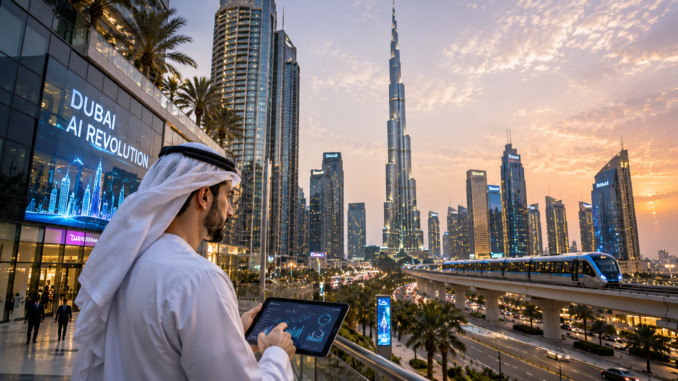
Nov 26: Dubai is strengthening its position as a global destination for artificial intelligence (AI), smart infrastructure, and digital innovation. From automated government services and intelligent transport systems to fintech and business automation, the emirate is increasingly using AI to improve public services and support economic development. This transformation is also opening new opportunities for technology companies, startups, and investors seeking to participate in the region’s expanding digital economy.
According to the Dubai State of AI Report 2026, published by Digital Dubai in collaboration with the Dubai Future Foundation in November 2026, the emirate is moving beyond experimental AI projects towards practical implementation across government operations. The report documents more than 90 AI applications across 20 government entities, highlighting the growing role of artificial intelligence in public administration and service delivery.
Released under the theme Scaling with Trust, the report emphasises responsible AI adoption, public confidence and measurable outcomes. For businesses, this shift is increasing demand for software development, cloud computing, cybersecurity, data analytics, fintech and enterprise automation solutions.
Dubai’s AI Strategy Moves Towards Real-World Applications
Dubai’s approach to artificial intelligence is evolving. Rather than simply introducing new technologies, the emirate is focusing on how AI can improve public services, strengthen government efficiency and simplify everyday processes.
The 2026 State of AI Report highlights this transition towards practical implementation. With more than 90 AI applications operating across 20 government entities, artificial intelligence is becoming an increasingly important part of public administration and service delivery.
The report also places emphasis on an AI-enabled city where public value takes priority over technological novelty. This approach means that the success of AI initiatives will increasingly be assessed through the improvements they deliver to residents, businesses and government institutions.
This shift is creating demand for companies working in generative AI, enterprise software, cloud computing, data analytics and cybersecurity. Businesses capable of developing practical solutions for government agencies and private organisations could benefit from partnerships and digital transformation projects.
Smart City Infrastructure Creates New Technology Opportunities
Dubai’s smart-city development is closely connected to its wider AI ambitions. The city has invested in digital infrastructure and connected services to improve transportation, public safety, infrastructure management and urban planning.
Artificial intelligence can help authorities analyse large volumes of information, identify potential problems and make faster operational decisions. These applications are particularly relevant to transport networks, utilities, logistics and building management.
Dubai’s progress has also received international recognition. The Boston Consulting Group’s Intelligent Cities Index 2026 reportedly ranked the emirate second among 61 cities globally and first in AI adoption and smart-city solutions.
This progress is opening up opportunities for companies specialising in:
- Smart mobility: AI-powered traffic management, transport analytics and intelligent mobility platforms.
- Infrastructure management: Predictive maintenance and automated facility management.
- Urban data analytics: Systems that help organisations interpret real-time information and improve planning.
- Public safety: Intelligent monitoring and emergency response technologies.
- Energy management: Smart grids, energy optimisation and automated building systems.
Technology providers that can integrate AI solutions with existing infrastructure will play an important role in supporting Dubai’s smart-city development.
Fintech and AI-Powered Financial Services Drive Innovation
Financial technology is another area benefiting from Dubai’s digital transformation. The growing use of AI, digital payments and automated financial services is changing how banks and financial institutions operate.
The Dubai International Financial Centre (DIFC) continues to strengthen its position as a destination for fintech companies and financial innovation. Its ecosystem brings together startups, established technology businesses, financial institutions and international investors.
AI is creating new possibilities across financial services through automated customer support, fraud detection, financial analytics and digital payment systems.
Key areas of development include:
- AI-powered banking: Personalised financial services and automated customer support.
- Fraud detection: Machine learning systems that identify suspicious transactions.
- Financial analytics: AI tools for investment research and risk assessment.
- Digital payments: Faster payment processing and improved transaction monitoring.
- RegTech: Automated compliance and regulatory reporting solutions.
For fintech startups and established technology companies, Dubai offers opportunities to develop financial products, establish partnerships and expand into regional markets.
Business Automation Is Changing How Companies Operate
Businesses across Dubai are increasingly exploring automation to reduce manual work, improve productivity and manage operational costs.
AI-powered systems can support customer service, accounting, inventory management, recruitment, document processing and supply chain coordination. Generative AI and AI agents are also helping organisations handle repetitive tasks and access information more efficiently.
Small and medium-sized enterprises (SMEs) could particularly benefit from these developments. Automation enables smaller businesses to streamline operations, reduce manual workloads and improve service delivery.
This is increasing demand for several technology solutions.
Enterprise AI software: Customised applications that help businesses manage internal operations.
Robotic process automation: Tools that automate repetitive administrative and financial tasks.
AI-powered customer support: Chatbots and virtual assistants that provide faster assistance to customers.
Predictive analytics: Solutions that help businesses forecast demand and understand customer behaviour.
AI consulting: Services that help organisations select, implement and manage artificial intelligence technologies.
Companies offering practical and affordable automation solutions could find growing demand among Dubai’s SMEs and larger enterprises.
Healthcare, Logistics and Education Explore AI Applications
Dubai’s AI transformation is extending beyond government and financial services into several other industries.
In healthcare, artificial intelligence can support medical image analysis, patient management, administrative automation and clinical decision-making. Healthcare providers are exploring ways to use technology to improve operational efficiency and service delivery while maintaining appropriate medical oversight.
The logistics industry is another potential beneficiary. AI-powered route planning, warehouse automation, predictive maintenance and supply chain analytics can help companies manage transportation and distribution more efficiently.
Education is also seeing growing interest in AI-powered learning platforms, personalised educational tools and automated administrative systems.
These developments offer scope for specialised software developers, technology consultants and companies capable of building solutions around the requirements of individual industries.
Dubai Offers Opportunities for Startups and International Technology Companies
Dubai’s expanding AI ecosystem presents opportunities for both emerging startups and established international businesses. Its focus on innovation, digital infrastructure and international business development makes it an attractive market for companies looking to introduce technology products and services.
Some promising business areas include:
AI software development: Building specialised applications for finance, healthcare, retail and logistics.
Cloud computing: Providing secure cloud infrastructure and enterprise data management solutions.
Cybersecurity: Developing intelligent systems to protect business networks and digital transactions.
AI research and development: Working with technology institutions and research organisations to develop new applications.
Digital transformation consulting: Helping traditional businesses integrate AI and automation into their operations.
Smart infrastructure: Developing connected solutions for buildings, transport systems and urban management.
International technology companies can also explore Dubai as a base for reaching customers and business partners across regional markets.
However, businesses entering the market need to consider data protection, cybersecurity, regulatory requirements and responsible AI practices. Solutions that deliver measurable value while maintaining reliability and transparency are more likely to build long-term business relationships.
Responsible AI Adoption Will Shape Dubai’s Digital Future
As artificial intelligence becomes more deeply integrated into business and government operations, responsible technology adoption is becoming increasingly important.
Dubai’s State of AI Report 2026 places particular emphasis on public trust, accountability and the practical benefits of AI. The focus is not simply on introducing more applications but on ensuring that these technologies improve services and deliver meaningful results.
The report also examines the challenges governments face when scaling AI, including the need to balance innovation with governance, transparency and human oversight.
For businesses, this means addressing data privacy, security and transparency throughout the development and deployment of AI products.
Technology companies that combine innovation with responsible development practices will be better positioned to work with large organisations, financial institutions and government-related projects.
Dubai’s AI Outlook for 2027: What Businesses Can Expect
Dubai’s AI ecosystem is expected to create further business opportunities as the emirate moves towards wider implementation of intelligent technologies.
The next phase is likely to focus on connecting existing systems, improving productivity and expanding applications that have demonstrated practical results.
Businesses should watch developments in:
- AI agents and enterprise automation.
- Advanced cloud computing and data infrastructure.
- Digital banking and financial technology.
- Smart mobility and urban management.
- Cybersecurity and data protection.
- AI-powered healthcare and logistics.
- Technology consulting and digital transformation.
The 2026 report also provides a foundation for tracking progress in future assessments. Continued evaluation will be important in identifying successful applications, implementation challenges and areas requiring further investment.
For technology companies, the opportunity will extend beyond introducing new AI products. Businesses will increasingly need solutions that address specific industry requirements, integrate with existing systems and deliver measurable operational improvements.
Conclusion
Dubai’s AI revolution is creating new opportunities for technology companies, startups and investors. The Dubai State of AI Report 2026 highlights the emirate’s progress in moving from experimental projects towards practical AI applications across government services and public administration.
The expansion of smart-city infrastructure, fintech, business automation and digital services is also increasing demand for companies specialising in software development, cybersecurity, cloud computing and AI integration.
As Dubai continues its digital transformation, its ability to combine innovation with responsible governance, skilled talent and sustainable infrastructure will shape its long-term competitiveness. For technology businesses looking to expand in the region, the emirate offers an increasingly important market for developing solutions that support the next generation of digital services and industries.
