
The travel industry is undergoing a significant shift as technology changes the way people discover destinations, plan holidays and make booking decisions. Travellers increasingly expect convenient planning, personalised recommendations, quick responses and services that match their budgets and preferences. For tourism businesses, meeting these expectations while managing costs and remaining competitive has become an important priority.
Artificial intelligence (AI) is emerging as a valuable tool in this changing landscape. From helping travellers build personalised itineraries to supporting hotels with pricing decisions, travel agencies with customer enquiries and tour operators with demand forecasting, AI is creating new possibilities across the tourism sector.
Its influence goes beyond making holiday planning easier. It could reshape how tourism businesses attract customers, manage operations, develop travel products and generate revenue. As adoption grows, businesses that understand where AI can add practical value will be better positioned to respond to changing traveller expectations and compete in the evolving travel marketplace.
From Endless Searching to Smarter Travel Planning
One of the biggest frustrations of planning a holiday is the amount of research involved. Travellers often move between different websites to compare accommodation, check transport connections, explore attractions and understand local costs.
AI is making this process more conversational. Instead of searching for every detail separately, travellers can explain what they have in mind. They can mention their budget, travel dates, interests, food preferences and the pace at which they want to travel.
An AI assistant can then help organise these details into a suggested itinerary, recommend suitable places to stay and identify activities that may fit the traveller’s requirements.
For travel agencies, this presents an opportunity to prepare initial holiday proposals more quickly. What once required considerable manual research can now be supported by AI-generated suggestions, leaving travel professionals more time to refine plans, confirm arrangements and understand individual customer needs.
The real value lies in combining faster planning with accurate information and dependable service.
The Growing Role of AI Across the Tourism Industry
AI is gradually becoming a useful business tool across different parts of the travel and hospitality sector. Its role extends from the first customer enquiry to the completion of a trip.
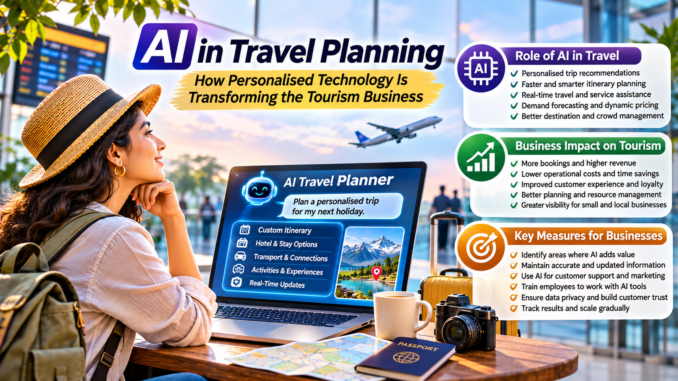
Personalised travel recommendations: AI can analyse customer preferences and travel patterns to suggest suitable destinations, accommodation, activities and packages. This helps businesses offer more relevant services rather than relying on the same packages for every customer.
Customer service and communication: AI-powered assistants can respond to routine enquiries, provide booking information, explain hotel facilities and answer frequently asked questions. They can also support communication across different languages.
Demand forecasting and pricing: By analysing booking history, seasonal trends, availability and customer demand, AI can help businesses make better-informed pricing and inventory decisions.
Marketing and customer engagement: Tourism companies can use AI to understand customer interests, prepare promotional content, identify potential customer groups and create more relevant marketing campaigns.
Operational efficiency: Hotels and travel agencies can use AI to organise enquiries, assist with administrative work, manage routine tasks and reduce time spent on repetitive activities.
Destination management: Tourism authorities and destination businesses can use visitor data to understand travel patterns, anticipate busy periods and improve the management of facilities and services.
Together, these applications can help businesses improve both the customer experience and their internal operations.
Personalised Recommendations Are Changing the Travel Experience
Not every traveller wants the same kind of holiday. Some prefer luxury accommodation and fine dining, while others look for affordable stays, local food and outdoor adventures. Families may prioritise convenience and child-friendly activities, whereas solo travellers might be more interested in cultural experiences and flexible itineraries.
AI can help businesses respond to these differences by analysing available customer information, preferences and travel patterns. Based on this information, systems can suggest accommodation, restaurants, activities and experiences that are more relevant to individual travellers.
For hotels, this could mean recommending room upgrades, spa services or local experiences that match a guest’s interests. Tour operators could create different versions of the same holiday package for families, couples, adventure seekers and senior travellers.
This kind of personalisation can make customers feel better understood. For businesses, it may also create opportunities to increase bookings, encourage additional purchases and build long-term customer relationships.
However, personalisation should never come at the expense of privacy. Tourism companies need to handle customer information responsibly and make sure travellers understand how their data is being used.
Smarter Pricing Can Help Businesses Manage Demand
Pricing is one of the most important parts of the tourism business. Hotels, airlines and travel operators regularly deal with changing demand, seasonal fluctuations and differences in booking patterns.
AI can support pricing and revenue management by analysing information such as previous bookings, room availability, customer demand, seasonal trends and major events.
For example, a hotel may use demand forecasts to plan room rates during holiday periods, while a tour operator could identify quieter months when special packages might help attract visitors.
AI can also assist businesses in putting together travel packages by comparing the cost of accommodation, transport and activities.
For tourism companies, the benefit is better-informed decision-making and more efficient management of available resources. However, pricing strategies must remain transparent. Customers are unlikely to trust businesses that offer confusing price changes or appear to charge unfairly.
The aim should be to balance business revenue with a fair and satisfying customer experience.
How AI Can Improve the Business Impact of Tourism
The adoption of AI has the potential to influence tourism businesses in several practical ways. Its value should be measured not simply by how advanced the technology appears, but by whether it produces meaningful business results.
More enquiries converted into bookings: Faster responses and relevant recommendations can help businesses engage potential customers while they are actively planning a trip.
Lower administrative workload: Automating repetitive tasks can reduce the time employees spend preparing standard itineraries, answering common questions and organising customer information.
Improved revenue opportunities: Personalised offers, better package design and demand forecasting can help businesses identify opportunities to increase bookings and additional sales.
Better customer retention: More relevant recommendations and responsive service can improve customer satisfaction, encourage repeat visits and generate positive word-of-mouth.
Greater visibility for smaller businesses: Accurate online information and well-presented services can help independent hotels, guides, restaurants and tour operators become easier for travellers to discover.
More informed business decisions: Analysing booking trends, customer preferences and seasonal demand can help businesses plan staffing, marketing expenditure and available resources more effectively.
The impact will differ from one business to another. AI does not guarantee higher profits or more bookings. Results depend on the quality of implementation, the accuracy of information and the ability of businesses to turn insights into better services.
Practical Measures Tourism Businesses Can Take to Adopt AI
Businesses do not need to introduce complicated technology across every department at once. A gradual approach can help them understand where AI offers the greatest value while managing costs and risks.
1. Identify the biggest operational challenges
Start by examining tasks that consume considerable time or create delays. These might include answering repetitive customer enquiries, preparing travel proposals, managing reservations or creating marketing material. Choose one or two areas where AI could provide a measurable improvement.
2. Improve the quality of business information
AI tools depend on reliable information. Hotels should maintain accurate room details, facilities, prices and availability. Travel agencies should regularly update package information, while tour operators should provide clear descriptions, schedules and service conditions.
3. Introduce AI-assisted customer support
Businesses can begin with automated responses to common questions about bookings, check-in procedures, facilities, transport and services. More complicated requests should be transferred to a staff member who can provide personal assistance.
4. Use data to understand customers and demand
Businesses can study booking patterns, seasonal changes, customer feedback and service preferences. These insights can support decisions about pricing, promotions, staffing and package development.
5. Train employees to work with AI
Staff should understand how to use AI tools, check generated information and recognise situations that require human judgement. Training is important because technology creates value only when employees know how to use it effectively.
6. Protect customer privacy and business information
Tourism companies should establish clear policies for collecting, storing and using customer data. Sensitive personal and payment information must be handled through appropriate secure systems, and businesses should comply with applicable data-protection requirements.
7. Measure results before expanding
Businesses should monitor whether AI is improving response times, reducing administrative effort, increasing enquiry-to-booking conversion, improving customer satisfaction or supporting revenue growth. If a particular application is not producing useful results, it should be reviewed before further investment.
A phased approach allows businesses to learn, make adjustments and expand AI adoption according to their actual needs.
AI Is Becoming a Travel Companion, Not Just a Planning Tool
The usefulness of AI does not end once a holiday is booked. It can also support travellers while they are on the move.
A traveller facing a sudden change in weather, a delayed connection or an unexpected change of plans can use AI-assisted tools to explore alternative arrangements. These tools can also help with language translation, local transport information, nearby restaurant suggestions and destination guidance.
Hotels and other hospitality businesses can use digital assistants to answer common questions about check-in, facilities, dining options and local attractions.
This can reduce the pressure on front-desk teams, particularly during busy periods. Staff can spend less time answering repetitive questions and more time helping guests with requests that require personal attention.
For hotels, resorts and airports, the opportunity is to make the visitor experience smoother without losing the human interaction that remains central to good hospitality.
Helping Small and Independent Tourism Businesses Compete
AI is not only useful for large travel companies. Small and medium-sized businesses can also benefit from it.
A small travel agency can use AI to prepare draft itineraries, respond to routine enquiries and organise customer information. A boutique hotel can improve guest communication, while a local tour operator can create more detailed descriptions of its experiences for potential visitors.
Restaurants, transport providers, guides and activity organisers may also benefit when their services become easier to discover through digital travel recommendations.
This is particularly important for independent tourism businesses that may not have large marketing budgets or dedicated technology teams.
A well-presented online profile, accurate service information, clear pricing and updated availability can help these businesses become more visible to travellers researching their next holiday.
However, visibility alone is not enough. The quality of the actual service, reliability and customer experience will determine whether visitors recommend a business or return.
AI Could Help Destinations Manage Tourism More Responsibly
Popular tourist destinations often struggle with overcrowding, traffic congestion and pressure on public facilities. At the same time, smaller attractions and less-visited communities may receive relatively little attention.
AI-based data analysis can help tourism authorities and destination managers understand visitor patterns, forecast demand and identify periods when particular attractions are likely to become crowded.
This information can support better planning of transport, visitor facilities and tourism services.
Travel recommendations can also encourage visitors to explore alternative attractions, local food experiences, cultural activities and nature-based destinations rather than concentrating all demand on a few famous places.
For local businesses, this could create opportunities to attract visitors who might otherwise spend their entire holiday in the main tourist areas.
However, technology alone cannot make tourism sustainable. Responsible planning, environmental protection and the involvement of local communities remain essential.
The Challenges Behind the Technology
Despite its growing potential, AI is not a perfect solution for travel planning.
One of the biggest concerns is the accuracy of information. An AI-generated itinerary may include outdated prices, incorrect opening hours, unavailable accommodation or unrealistic travel schedules. Such mistakes can cause inconvenience and damage a business’s reputation.
Data privacy is another important issue. Personalised recommendations often depend on customer information, so businesses must take care when collecting, storing and using personal data.
There is also the possibility that automated recommendation systems may repeatedly promote well-known destinations and established businesses while overlooking smaller operators with limited online visibility.
The cost of technology, staff training and integration with existing booking or management systems can also create challenges, particularly for smaller businesses.
This is why businesses should treat AI as a supporting tool rather than a replacement for professional judgement. Human verification, local knowledge and reliable customer assistance remain essential.
Why Human Expertise Still Matters
Travel is personal. A holiday may be a family’s first international trip, a couple’s honeymoon, a special anniversary or a long-awaited break after months of work. In such situations, customers often want more than an automated recommendation.
They may need reassurance, practical advice and someone who can take responsibility when plans change.
An experienced travel advisor can understand individual concerns, recommend suitable alternatives and use professional contacts to solve problems. A hotel employee can provide a warm welcome, while a local guide can share stories and insights that a digital tool may not capture.
AI can make research and routine tasks faster, but it cannot automatically replace the value of trust, experience and genuine hospitality.
For tourism businesses, combining technology with personal service could become one of the most effective ways to stand out.
The Future of Travel Will Be More Personal and Business-Driven
Artificial intelligence is creating new possibilities for the travel and tourism industry, changing how businesses attract customers, develop travel packages, manage bookings and deliver hospitality services. As travellers increasingly expect personalised experiences and faster assistance, the ability to use technology effectively could become an important competitive advantage.
For tourism businesses, the opportunity is both operational and commercial. AI can help travel agencies respond to enquiries more efficiently, hotels understand guest preferences, tour operators develop customised packages and destination businesses make better use of visitor-demand information. When implemented thoughtfully, these applications can support better customer experiences, improved productivity and new revenue opportunities.
However, successful adoption requires more than simply introducing an AI tool. Businesses need reliable information, trained employees, responsible data practices and clear ways to measure whether the technology is delivering results. They must also ensure that automation does not weaken the personal service and local expertise that make travel meaningful.
The future of tourism will therefore depend on how effectively businesses combine digital capabilities with human knowledge and hospitality. AI may make travel planning faster and business operations smarter, but lasting success will come from using that technology to create better journeys for travellers and sustainable growth for the businesses that serve them.
