

New Delhi, Sep 16: At the INNOPROM India International Industrial Exhibition in New Delhi, Rosatom demonstrated the capabilities of Russian additive technologies, including achievements in industrial 3D printing and production localisation. The Corporation showcased the first localised 3D scanner, a Russian-developed product whose production has been localised in India in cooperation with a local partner. The scanner has been integrated into the additive manufacturing corporation’s ecosystem since 2025. The professional handheld laser 3D scanner is designed to digitise objects with complex geometries. It can be used in industry, automotive manufacturing, architecture and construction for reverse engineering, design and quality control. In the Indian market, the product is promoted under the Smart Scan brand.
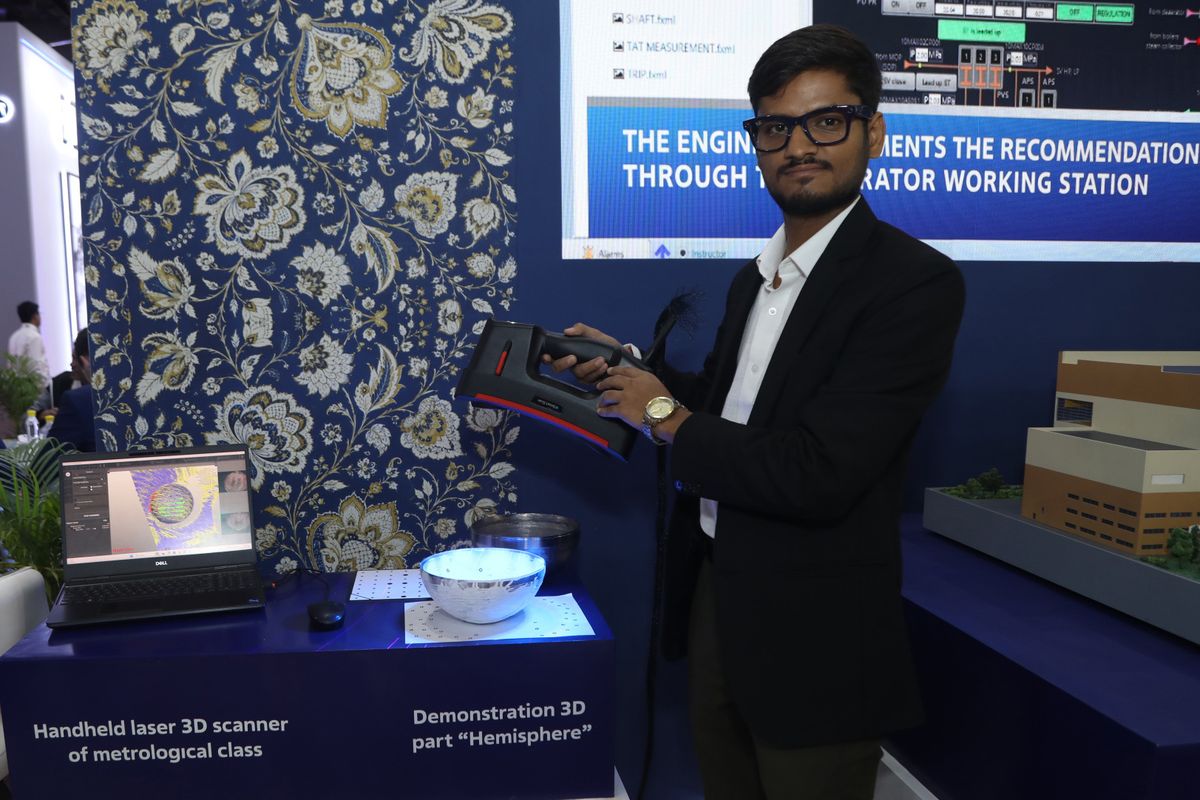
Rosatom initiated cooperation with an Indian partner company to localise industrial 3D scanning and facilitated the entry of the Russian-developed product into the Indian market. Local production of Russian 3D scanners in India began this year and has reduced equipment costs for customers by 40% in the domestic market, while enabling the product to obtain ‘Make in India‘ status.
During the session “Additive Manufacturing: A New Vector for the Development of Russian-Indian Partnership”, Indian and Russian experts discussed the possibility of moving from a “supplier-buyer” model to jointly creating an entire additive manufacturing industry ecosystem in the Indian market. Session participants, including representatives of relevant government agencies, the National Centre for Additive Manufacturing , Indian partners and Russian companies, considered ways to combine Russian expertise with India‘s manufacturing scale, regulatory mechanisms that could accelerate the partnership, and prospects for bringing jointly developed solutions to Global South markets. They concluded that additive manufacturing could become one of the promising areas of Russian-Indian industrial .
Dr. Vijay Kumar Saraswat, Member of the National Institution for Transforming India also highlighted the potential to deepen Russia-India cooperation through joint research and development, domestic equipment manufacturing and the development of advanced materials for additive manufacturing. He noted that future joint work could extend to materials development, process qualification and indigenous subsystems, helping build domestic capabilities rather than relying solely on imported equipment.
“Previously, our Indian partners used a traditional method, stamping, to manufacture such products. By supplying a large-format DISC 2800 3D printer to India, Rosatom proposed replacing the multi-stage stamping process with an electron beam in a vacuum, achieving production speeds of up to 5 kg of metal per hour. A seven-litre cylinder of this type can be produced on the Russian printer in just four hours,” commented Ilya Kavelashvili, Director of Rosatom‘s Additive Technologies Business Unit