
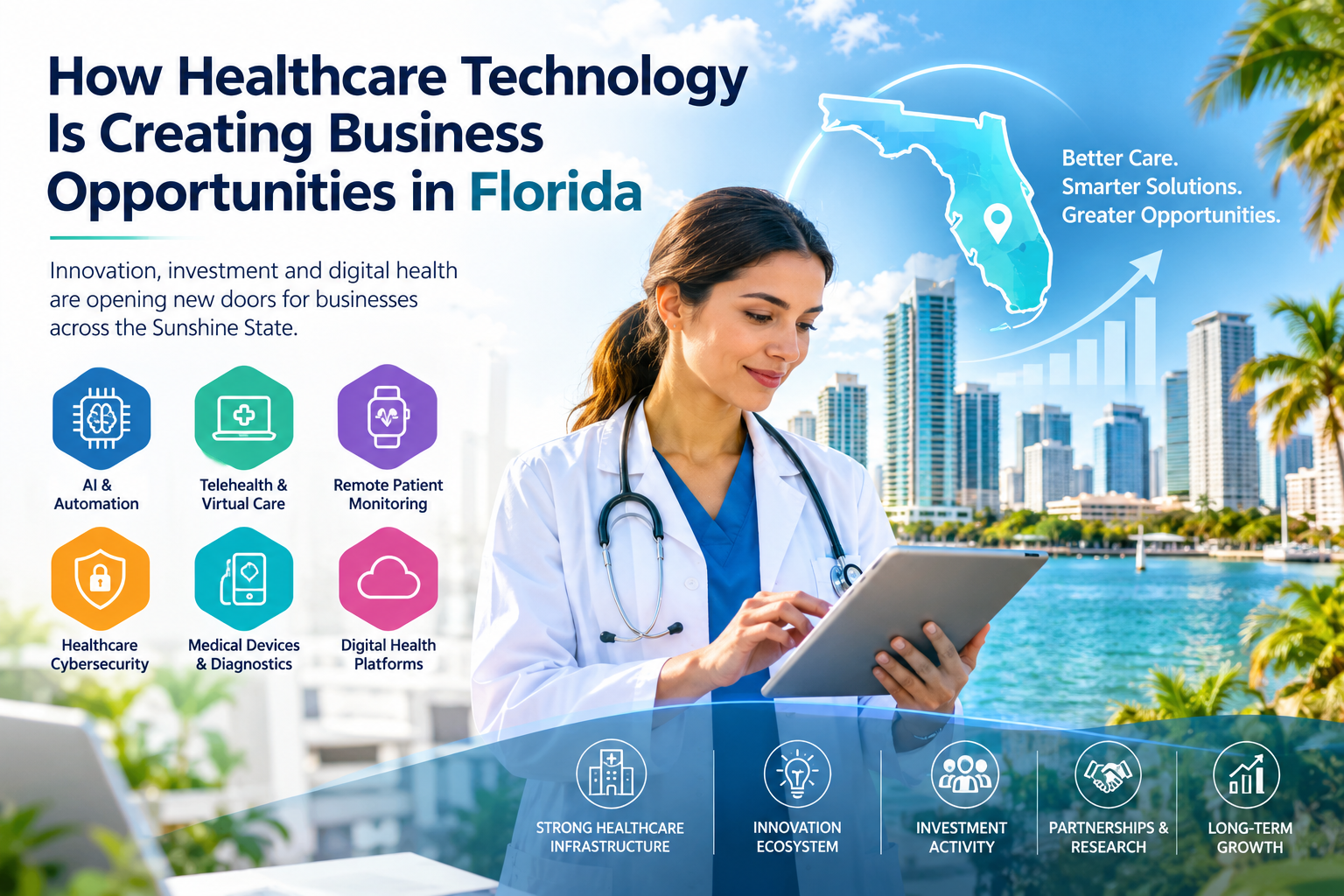
Oct 13: Healthcare technology is changing how medical services are delivered, how healthcare providers manage their operations and how patients access care. In Florida, these changes are creating opportunities for technology startups, medical device companies, software developers and service providers looking to solve practical challenges across the healthcare industry.
From artificial intelligence (AI) and telehealth to remote patient monitoring and cybersecurity, healthcare innovation is opening new markets for businesses. Florida’s established life sciences sector, research institutions and healthcare infrastructure provide a foundation for companies developing solutions that improve efficiency, support clinical teams and make healthcare services more accessible.
For entrepreneurs, the opportunity lies not simply in adopting new technology but in understanding where healthcare organisations need help and building solutions that deliver measurable value.
Florida’s Healthcare Industry Creates Opportunities for Innovation
Florida has developed a substantial life sciences ecosystem that includes medical technology, pharmaceuticals, biotechnology and digital health. Research institutions, healthcare providers and innovation centres across the state offer opportunities for businesses to collaborate, test products and develop commercial partnerships.
FloridaCommerce’s 2025 Target Industry Report identifies life sciences as an important contributor to the state’s economy. The sector’s broad scope includes medical device technology and digital health alongside pharmaceuticals and other health-related activities.
For technology companies, this creates opportunities beyond developing medical products. Businesses can provide software integration, clinical research support, data management, specialised manufacturing and technical services to healthcare organisations.
Orlando’s Lake Nona Medical City, Gainesville’s research and biotechnology ecosystem, and South Florida’s growing technology community provide examples of the different environments in which healthcare innovation can develop.
Startups can use these networks to understand provider needs, establish partnerships and refine their products before expanding into larger markets.
Artificial Intelligence Creates New Markets in Healthcare
Artificial intelligence is opening opportunities to improve healthcare administration, organise information and support clinical workflows. Healthcare providers often deal with extensive documentation, appointment coordination, billing processes and patient communication. Software that simplifies these tasks can help reduce administrative pressure.
AI-powered documentation tools, for example, can assist clinicians with preparing consultation notes. Other systems can help practices manage appointment requests, organise records and handle routine patient enquiries.
These applications create opportunities for software developers, AI companies and specialised technology consultants. Rather than attempting to build a platform for every healthcare organisation, a startup could focus on one clearly defined customer group, such as independent medical practices, diagnostic centres or outpatient clinics.
Several business models are possible, including monthly software subscriptions, implementation fees and ongoing technical support. Companies can also develop customised solutions for larger healthcare networks.
However, healthcare AI requires careful oversight. Businesses must consider data privacy, accuracy, bias and applicable regulatory requirements, particularly when products influence clinical decisions. Solutions that integrate smoothly into existing workflows and maintain appropriate human supervision are more likely to earn the confidence of healthcare providers.
Telehealth Expands Access to Healthcare Services
Telehealth enables patients to consult healthcare professionals through video calls and other telecommunications technologies. It can reduce the need for travel for certain consultations and follow-up appointments, particularly when patients face mobility, distance or scheduling difficulties.
Florida’s mix of urban, suburban and rural communities creates potential demand for services that connect patients with healthcare professionals remotely. Businesses can explore opportunities in virtual consultation platforms, patient scheduling, remote follow-up services and technology support for smaller medical practices.
The Florida Department of Health’s Telehealth Maternity Care Program illustrates how digital services can support access to care. A Florida Senate presentation reported 9,945 enrolments during fiscal year 2024–2025. It also recorded an increase in postpartum visit attendance among programme participants from 37% in fiscal year 2023–2024 to 52% in fiscal year 2024–2025. These are programme-specific findings, not statewide telehealth adoption figures.
For businesses, the opportunity extends beyond building consultation software. Providers may also need secure communication systems, patient onboarding, technical support and integrations with existing medical records.
Companies must account for professional licensing rules, privacy obligations and applicable telehealth requirements. Their solutions should complement appropriate clinical care rather than promise that remote consultations can replace every in-person visit.
Remote Patient Monitoring Opens Opportunities in Connected Care
Remote patient monitoring allows healthcare providers to receive health information collected through connected devices outside traditional clinical settings. Depending on the care plan, these devices may measure blood pressure, blood glucose levels, heart rate or other relevant indicators.
For patients who require ongoing monitoring, connected technologies can support follow-up care and help healthcare teams review information between appointments. They may also reduce some routine visits when remote monitoring is clinically appropriate.
This creates opportunities for medical device manufacturers, software developers and businesses specialising in connected healthcare systems. Companies can generate revenue through device sales, software subscriptions, integration services and technical support.
There is also demand for solutions that make connected care easier to use. Patients may need assistance setting up devices, understanding instructions and transmitting information correctly. Healthcare organisations, meanwhile, need reliable systems for managing incoming data and incorporating it into clinical workflows.
Businesses entering this market must demonstrate that their products are secure, reliable and suitable for their intended use. They should also understand applicable medical device regulations and reimbursement requirements before investing heavily in product development.
Medical Devices and Digital Health Support Business Growth
Florida’s life sciences ecosystem offers opportunities for businesses developing diagnostic technologies, connected medical equipment, digital rehabilitation tools and software that supports healthcare delivery.
South Florida’s investment activity provides another indication of interest in healthcare innovation. According to eMerge Americas’ eMerge Insights 2025 Report, healthcare-related venture activity in South Florida reached $821 million across 56 deals in 2025, compared with $572 million in 2024. The figures cover health technology, medical devices, biotechnology, pharmaceuticals and wellness services, rather than digital health alone.
This investment activity may create opportunities for founders seeking capital, research partnerships and commercial connections. However, funding is not guaranteed, and investors generally need a clear understanding of a company’s product, customer demand, regulatory pathway and potential to scale.
Businesses developing medical devices should consider testing, quality management, manufacturing requirements and regulatory review early in the development process. Establishing relationships with healthcare providers and research institutions can help founders understand clinical needs and assess whether their products offer practical benefits.
Healthcare Cybersecurity Creates Demand for Specialised Services
Healthcare organisations manage sensitive patient information and rely on interconnected systems for records, billing, appointments and clinical operations. As more services move online, protecting this information becomes an important business priority.
Cybersecurity companies can help healthcare providers assess vulnerabilities, manage access permissions, secure cloud systems, monitor networks and prepare incident response plans. Smaller practices may particularly benefit from outsourced security services when they lack dedicated internal IT teams.
Potential business models include recurring managed security contracts, compliance support, employee training and security assessments.
Companies serving this market must understand applicable federal and state requirements, including relevant provisions of the Health Insurance Portability and Accountability Act (HIPAA). They should also recognise that healthcare security involves more than installing software. Staff training, access controls, system updates and incident preparedness are equally important.
For technology providers, a clear specialisation in healthcare security can help distinguish their services from general IT support.
Digital Administration Offers Opportunities for Smaller Businesses
Not every healthcare technology business needs to develop advanced AI or manufacture medical devices. Many healthcare organisations need straightforward tools that make everyday operations easier.
Appointment scheduling, digital forms, billing workflows, patient reminders and records management are areas where better software can reduce manual work. Integration services can also help connect separate systems and minimise repetitive data entry.
Small technology companies can focus on particular customer groups, such as dental practices, independent physicians, outpatient clinics or diagnostic centres. By specialising in the needs of one segment, businesses can develop more relevant products and provide targeted implementation and training.
Recurring software subscriptions can create predictable revenue, while technical support and system maintenance provide additional income. For healthcare providers, the value of these services depends on whether they save time, reduce errors and work reliably with existing systems.
How Healthcare Technology Businesses Can Build Sustainable Revenue
Entering Florida’s healthcare market requires more than developing a promising product. Businesses need a clear commercial strategy and an understanding of how healthcare organisations select and purchase technology.
Several approaches can help companies build sustainable operations:
-
Start with a specific problem: Identify an operational challenge faced by a clearly defined group of healthcare providers.
-
Validate demand before scaling: Speak with potential customers and test whether they are willing to pay for the proposed solution.
-
Choose an appropriate revenue model: Consider subscriptions, licensing, device sales, implementation fees or recurring service contracts.
-
Build strategic partnerships: Collaborate with healthcare providers, research institutions and established technology companies where appropriate.
-
Prioritise compliance and security: Address privacy, data protection and relevant regulatory obligations from the beginning.
-
Demonstrate measurable value: Show how the product can improve workflow efficiency, patient access, system reliability or other relevant outcomes.
Healthcare purchasing decisions can involve several stakeholders and lengthy evaluation processes. Businesses should therefore plan for product testing, staff training, integration and customer support rather than relying on rapid sales alone.
Government Initiatives and Research Partnerships
Public-sector initiatives and research partnerships can provide additional routes for healthcare innovation. Florida’s Health Care Innovation Council was established to examine ways to improve healthcare quality, access, efficiency and affordability.
Florida also has financing initiatives for eligible healthcare facilities and educational institutions implementing qualifying innovations. Businesses should review the current programme requirements carefully, as these initiatives are not automatically available to every private healthcare technology startup.
Partnerships with hospitals, universities and research centres can help companies test products, understand clinical requirements and build relationships with potential customers. Depending on the product and partnership, businesses may also need formal agreements covering data access, research responsibilities, intellectual property and regulatory compliance.
For early-stage companies, these relationships can be valuable when developing products that must perform reliably in real healthcare environments.
Challenges Healthcare Technology Businesses Must Overcome
Despite the opportunities, the healthcare technology market can be difficult to enter. Businesses must navigate regulatory requirements, protect confidential information and demonstrate that their products deliver meaningful benefits.
Integration with existing systems can be expensive, and healthcare organisations may take time to approve new suppliers. Medical products can also require extensive testing and regulatory review before they are ready for commercial use.
Competition is another consideration. A technology that works well in a demonstration may struggle to gain adoption if it adds complexity to a clinician’s workload or fails to address a priority problem.
Businesses can reduce these risks by focusing on a manageable market segment, testing their assumptions with customers and establishing realistic financial plans. Products that solve a specific problem reliably may have a stronger commercial foundation than broad platforms built without sufficient customer validation.
Conclusion: Practical Innovation Will Shape Florida’s Healthcare Technology Market
Healthcare technology is creating business opportunities across Florida, from AI-enabled administration and telehealth to remote patient monitoring, medical devices and cybersecurity. The state’s life sciences ecosystem, research networks and healthcare innovation initiatives provide a foundation for companies looking to develop solutions for a changing industry.
Research on healthcare investment and digital services points to areas of commercial interest, but success depends on more than market growth alone. Businesses must understand healthcare providers’ needs, protect patient information, meet applicable regulations and demonstrate measurable value.
For entrepreneurs and established companies, the most promising opportunities may come from addressing everyday healthcare challenges with secure, reliable and easy-to-use technology. By combining innovation with a clear revenue model and a practical understanding of healthcare operations, businesses can build stronger foundations for growth in Florida.
