
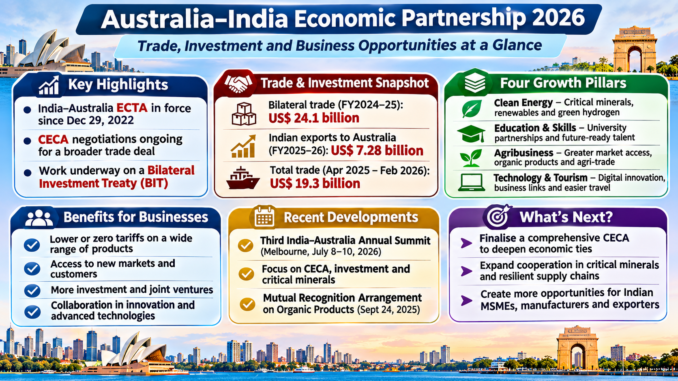
India and Australia are taking their economic relationship to a new level, with growing trade, investment and business cooperation creating opportunities across several industries. From manufacturing and critical minerals to renewable energy, education and digital technology, both countries are looking to build a stronger and more diversified economic partnership.
The relationship has gained momentum following the implementation of the India-Australia Economic Cooperation and Trade Agreement (ECTA) in December 2022. The agreement has reduced trade barriers and improved market access, helping businesses explore new customers, suppliers and investment opportunities in both countries.
With negotiations for a broader Comprehensive Economic Cooperation Agreement (CECA) continuing, the partnership is moving towards a wider framework covering trade, services, investment and professional mobility.
India-Australia Trade Growth Creates New Business Opportunities
Bilateral trade has expanded since the implementation of ECTA. According to India’s Ministry of Commerce and Industry, two-way trade in goods and services reached US$24.1 billion in FY2024-25.
Indian exports to Australia increased from US$4 billion in FY2020-21 to US$7.28 billion in FY2025-26, representing growth of more than 80% over the period.
The government also reported that total bilateral trade reached US$19.3 billion during April 2025–February 2026, reflecting continued commercial engagement between the two economies.
From January 1, 2026, all Indian exports are eligible for zero-duty market access in Australia under ECTA, subject to applicable rules of origin and other agreement requirements.
This development is particularly important for Indian manufacturers, textile companies, pharmaceutical businesses, engineering exporters and agricultural producers looking to expand their international presence.
July 2026 Summit Gives Fresh Direction to Economic Partnership
An important development came during the third India-Australia Annual Summit, held in Melbourne from July 8 to 10, 2026.
Prime Minister Narendra Modi and Australian Prime Minister Anthony Albanese discussed ways to strengthen economic cooperation, improve investment flows and expand business-to-business relationships.
Both leaders reaffirmed their commitment to progressing an ambitious and mutually beneficial CECA. They also highlighted the importance of reducing non-tariff barriers and improving cooperation between private-sector investors.
The summit placed particular emphasis on critical minerals, resilient supply chains, manufacturing, technology and energy security.
The leaders also welcomed stronger business engagement through the CEO Forum and highlighted opportunities to connect India’s Make in India programme with Australia’s Future Made in Australia initiative.
Four Key Sectors Driving India-Australia Business Cooperation
1. Clean Energy and Critical Minerals
Clean energy is emerging as one of the most promising areas of bilateral cooperation.
Australia has substantial reserves of critical minerals, while India is increasing its demand for materials required in electric vehicle batteries, solar equipment, renewable energy systems and advanced manufacturing.
Both countries are exploring opportunities in mineral exploration, processing, technology development and long-term supply arrangements.
For Indian companies, this could create opportunities in battery manufacturing, renewable energy infrastructure, mineral processing and clean technology.
2. Manufacturing and Industrial Investment
Manufacturing is another important area where both countries can benefit from closer cooperation.
Indian manufacturers can use Australia’s market access to expand exports, while Australian companies can explore India’s growing industrial base and consumer market.
Potential areas of collaboration include engineering goods, pharmaceuticals, chemicals, mining equipment, food processing and advanced manufacturing.
Stronger industrial partnerships could also help businesses diversify their supply chains and reduce dependence on a limited number of international markets.
3. Education and Skill Development
Education continues to connect businesses, institutions and professionals in both countries.
Australian universities are expanding their engagement with India through academic partnerships, research collaboration and education programmes.
The growing demand for skilled professionals in artificial intelligence, information technology, engineering, healthcare and renewable energy also creates opportunities for joint training and skill development.
These initiatives can strengthen the availability of industry-ready talent while creating new opportunities for education providers and technology companies.
4. Agriculture, Food Processing and Agribusiness
Agriculture offers another area of strong commercial potential.
Australia is an important supplier of pulses, raw cotton and other agricultural commodities to India. Indian businesses, meanwhile, have opportunities to expand exports of processed food, textiles, spices and agricultural products.
A significant development was the Mutual Recognition Arrangement on Organic Products, signed by India and Australia on September 24, 2025.
The arrangement recognises the respective organic certification systems, helping reduce duplicate certification requirements and making trade in eligible organic products easier.
CECA and Bilateral Investment Treaty: What Businesses Should Know
While ECTA has improved tariff access, the proposed CECA could take economic cooperation further.
The agreement is expected to address a broader range of issues, including trade in goods and services, digital commerce, investment, professional mobility and market access.
Another important development is the proposed India-Australia Bilateral Investment Treaty (BIT).
In October 2026, Commerce and Industry Minister Piyush Goyal indicated that both countries were working towards a comprehensive economic agreement and a bilateral investment treaty.
The proposed investment framework could provide clearer rules and protections for investors, supporting greater confidence in long-term business projects.
However, both agreements remain under development and should not be treated as completed arrangements.
How Indian MSMEs Can Benefit from the Partnership
Small and medium-sized enterprises could become important beneficiaries of stronger India-Australia economic cooperation.
With improved tariff access, Indian businesses have opportunities to reach Australian customers across several product categories.
Textile manufacturers, engineering companies, pharmaceutical exporters, food-processing businesses and technology service providers can explore partnerships with Australian distributors and buyers.
However, successful market entry will require businesses to understand Australian product standards, customs requirements, certification procedures and rules of origin.
Government-supported business exchange programmes can also help companies identify potential partners and understand market conditions before investing.
What Lies Ahead for India-Australia Economic Relations?
The next phase of the partnership will depend on how effectively both governments and businesses translate trade agreements into commercial results.
The expansion of clean energy, critical minerals processing, digital technology, advanced manufacturing and education partnerships offers considerable long-term potential.
For India, Australia represents an important source of raw materials, technology, investment and access to international business networks. For Australia, India offers a growing consumer market, manufacturing capabilities and opportunities for long-term commercial partnerships.
As CECA and investment treaty discussions progress, businesses on both sides will be watching for clearer market-access rules, investment opportunities and stronger supply-chain connections.
Conclusion
The India-Australia economic partnership is developing beyond traditional trade relations. With ECTA already delivering improved market access and further negotiations focused on investment, technology and industrial cooperation, both countries have an opportunity to build a stronger commercial relationship.
For Indian exporters, manufacturers, MSMEs and investors, the partnership could open new international markets and support sustainable business growth in the years ahead.
