
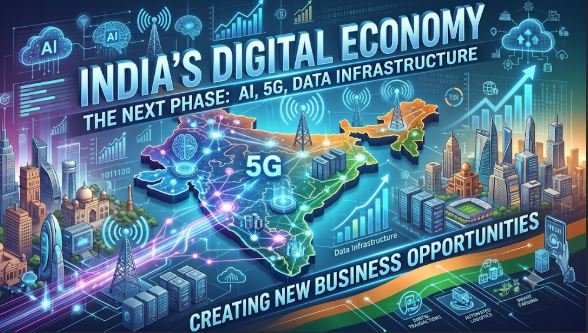
India’s digital economy is moving beyond the expansion of internet connectivity and digital payment services. A new phase of growth is taking shape, driven by artificial intelligence (AI), 5G connectivity and large-scale data infrastructure. Together, these technologies are changing how businesses operate, how consumers access services and how companies compete in an increasingly digital marketplace.
Over the past decade, India has built a strong foundation through affordable mobile internet, digital public infrastructure, online payments and cloud-based services. Now, the focus is shifting towards building the technology infrastructure required to support a more intelligent and connected economy.
For businesses, this transition is creating opportunities across several industries, including telecommunications, banking, manufacturing, healthcare, retail, logistics and information technology.
The next stage of India’s digital growth may not simply be about connecting more people to the internet. It will increasingly be about what businesses can build, automate and deliver using that connectivity.
Artificial Intelligence Opens New Business Opportunities
Artificial intelligence is emerging as one of the most important drivers of India’s next digital growth cycle.
The government’s IndiaAI Mission, backed by an allocation of more than ₹10,300 crore over five years, is aimed at strengthening the country’s AI ecosystem through computing infrastructure, research, innovation and startup support.
Access to affordable computing resources is particularly important for smaller companies. Developing and running advanced AI applications requires substantial computing power, which can create financial barriers for startups and emerging technology businesses.
The expansion of shared GPU infrastructure and subsidised computing access could help reduce these barriers and encourage more domestic companies to develop AI-powered products.
Another important opportunity lies in India’s linguistic diversity.
AI models and language technologies supporting Indian languages could help businesses reach consumers who are less comfortable using English-based digital platforms. This has potential applications in banking, healthcare, agriculture, education and government services.
For example, a farmer could use a voice-based AI application to access agricultural information in a regional language, while a bank could offer automated customer assistance to people in smaller towns and rural areas.
This could make AI adoption more inclusive while creating new markets for Indian technology companies.
5G Is Moving Beyond Faster Internet
India’s 5G expansion has created another important foundation for digital business growth.
According to government-linked figures cited in industry reports, 5G connectivity had reached 99.9% of India’s districts, supported by more than 5.23 lakh base stations by early 2026.
However, the next challenge for telecom companies is monetisation.
Building a large 5G network requires significant investment in spectrum, infrastructure and technology. Telecom operators must now identify ways to generate additional revenue beyond traditional mobile subscriptions.
One promising area is Fixed Wireless Access (FWA), which can provide high-speed internet to homes and businesses without requiring conventional fibre connections to every premises.
Private 5G networks also offer opportunities for industrial applications. Manufacturing companies, warehouses and logistics operators can use dedicated wireless networks to connect machines, sensors and operational systems.
In factories, for instance, 5G connectivity could support real-time monitoring, automated production lines and connected equipment. In logistics, it could improve the tracking of vehicles, inventory and shipments.
Telecom operators may also find new revenue opportunities in enterprise connectivity, cybersecurity, cloud services and network-based digital solutions.
The commercial success of 5G will therefore depend not only on network coverage but also on how effectively businesses use its capabilities.
India’s Data Centre Industry Prepares for a Major Expansion
Behind the growing demand for AI and digital services is another industry attracting increasing attention: data centres.
Every AI application, cloud service, digital transaction and online platform requires computing infrastructure to store, process and manage information.
As businesses move more operations online and AI workloads become more demanding, the need for reliable and high-capacity data centres is increasing.
Industry estimates cited in the supplied research place India’s operational data centre capacity at approximately 1.5–1.6 GW in 2026, with projections suggesting potential growth towards 6–8 GW by 2029–2030.
This expansion could create opportunities well beyond the construction of data centre buildings.
Companies involved in server manufacturing, power management, cooling systems, optical fibre, networking equipment and cloud infrastructure could benefit from rising investment.
AI-ready data centres are particularly important because advanced computing systems require higher power density and more sophisticated cooling arrangements.
Traditional facilities may not always be suitable for these demanding workloads. As a result, investment in advanced cooling technologies, reliable electricity supply and high-performance computing infrastructure is becoming increasingly important.
The sector could also attract investment from infrastructure developers, technology companies, institutional investors and global cloud service providers.
Why Local AI and Data Governance Matter
As India’s digital economy expands, data management and regulatory compliance are becoming increasingly important.
Businesses are handling growing volumes of customer information, financial records and operational data. This creates opportunities for companies offering cybersecurity, data storage, cloud management and compliance solutions.
India’s Digital Personal Data Protection framework also places greater importance on responsible handling of personal information.
For companies deploying AI and cloud-based services, maintaining data security, controlling access and ensuring compliance will be essential.
There is also growing interest in data sovereignty, particularly among organisations that handle sensitive financial, government and business information.
This could encourage further development of domestic cloud infrastructure and secure data management services.
Which Industries Could Benefit the Most?
The expansion of AI, 5G and data infrastructure could create opportunities across several parts of the Indian economy.
Banking and financial services: AI-powered fraud detection, automated customer support, risk assessment and digital lending could improve operational efficiency.
Healthcare: AI-assisted diagnostics, digital health platforms and remote patient monitoring could expand access to medical services.
Manufacturing: Private 5G networks, predictive maintenance and connected production systems could improve productivity and reduce operational downtime.
Agriculture: Regional-language AI tools, digital advisory platforms and connected monitoring systems could help farmers access better information.
Retail and e-commerce: AI-based demand forecasting, personalised customer experiences and automated supply-chain management could improve business efficiency.
Telecommunications and technology: Growing demand for connectivity, cloud services, data centres and cybersecurity could create new revenue streams for infrastructure and technology providers.
The Challenges That Could Slow India’s Digital Growth
Despite the opportunities, India’s digital transformation faces several important challenges.
The first is the cost of infrastructure. Data centres require reliable power, advanced cooling systems and significant capital investment. Rising electricity consumption could become a major concern as AI workloads expand.
The second challenge is the availability of skilled professionals. Companies will need engineers, cybersecurity specialists, data scientists and AI developers to build and maintain advanced digital systems.
Cybersecurity is another major concern. As more businesses depend on interconnected systems, the risks associated with data breaches, service disruptions and cyberattacks also increase.
There is also a need to ensure that the benefits of digital development reach smaller businesses and rural communities rather than remaining concentrated among large technology companies.
Addressing these challenges will be important if India wants to turn its digital infrastructure investments into long-term economic growth.
What Lies Ahead for India’s Digital Economy?
The coming years could mark an important transition for India’s technology industry.
AI adoption is expected to move deeper into business operations, while 5G networks could generate new enterprise applications. At the same time, expanding cloud demand and AI computing requirements may accelerate investment in data centres and supporting infrastructure.
For startups, this creates opportunities to develop specialised AI products, regional-language applications, cybersecurity solutions and industry-specific digital platforms.
For established companies, the priority will be integrating these technologies into existing operations and identifying business models that can generate sustainable returns.
Investors may also pay closer attention to companies operating across digital infrastructure, telecom equipment, cloud services, power management and data centre development.
However, the scale of opportunity should not be confused with guaranteed commercial success. Companies will still need strong financial performance, execution capabilities and competitive advantages to benefit from the transformation.
Conclusion:
India has already made significant progress in expanding digital connectivity and building public technology platforms. The next stage will depend on how effectively the country combines AI, 5G and data infrastructure to support businesses and economic activity.
Artificial intelligence could improve productivity, 5G could enable new industrial applications, and data centres could provide the computing foundation needed to support both.
Together, these technologies are creating opportunities that extend far beyond the traditional IT sector.
The real opportunity for India lies in building an ecosystem where technology companies, telecom operators, infrastructure developers, startups and established businesses can grow together.
India’s next digital growth story will not be written by connectivity alone. It will be shaped by the ability to turn technology infrastructure into innovation, productivity and new economic opportunities.
