
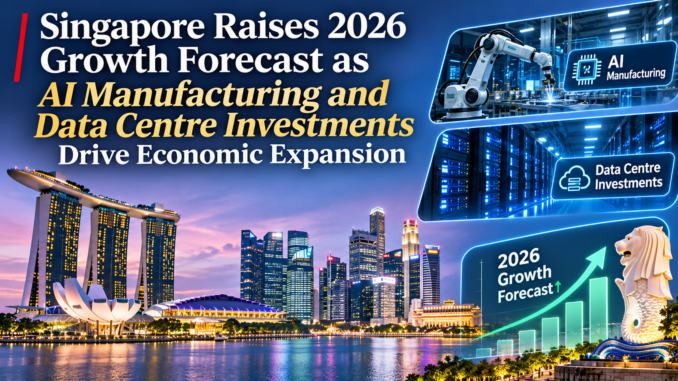
Nov 26: Singapore’s economy is gaining momentum in 2026, supported by growing global demand for artificial intelligence (AI), semiconductor manufacturing and digital infrastructure. According to the Ministry of Trade and Industry (MTI), Economic Survey of Singapore – Third Quarter 2026, released on November 24, 2026, the country’s gross domestic product (GDP) grew by 6.1% year-on-year in the third quarter. Following this stronger-than-expected performance, the government upgraded its full-year 2026 economic growth forecast from 4.5%–5.5% to around 6%.
The government report identifies strong global AI-related demand as an important factor behind the expansion of manufacturing and wholesale trade, particularly in electronics, precision engineering, machinery and equipment. The expansion of data centre infrastructure is also contributing to demand for AI-related products and technology equipment. However, Singapore’s economic growth is expected to moderate to between 2.5% and 4.5% in 2027 as global investment activity and demand from major trading partners gradually normalise.
The latest performance reinforces Singapore’s position as a major Asian technology, manufacturing and financial services hub, while highlighting how investments in AI and digital infrastructure are influencing the country’s economic outlook.
AI Manufacturing Becomes a Major Driver of Singapore’s Economic Growth
Singapore’s manufacturing industry is benefiting from the worldwide expansion of artificial intelligence. The growing need for advanced chips, computing equipment and electronic components is creating fresh demand for semiconductor manufacturers and technology suppliers.
According to the third-quarter economic survey, Singapore’s manufacturing sector expanded by 8.5% year-on-year. Electronics manufacturing recorded 14.8% growth, while the precision engineering cluster expanded by 26.5%. Transport engineering also contributed, with growth of 10.4%.
The performance reflects the increasing importance of Singapore’s manufacturing capabilities in supporting global technology supply chains. As companies invest in AI infrastructure, demand is increasing for semiconductor equipment, advanced electronic components and high-performance computing systems.
This is creating opportunities for businesses involved in precision engineering, industrial automation and specialised manufacturing. Singapore’s established semiconductor ecosystem, skilled workforce and international business connections also strengthen its ability to attract investments linked to the global AI industry.
Data Centre Investments Strengthen Singapore’s Digital Economy
Data centres are becoming an increasingly important part of Singapore’s digital economy. The rapid adoption of AI across businesses requires greater computing capacity, cloud infrastructure, data storage and reliable digital connectivity.
The global expansion of AI infrastructure is encouraging demand for specialised electronic components, computing equipment and supporting technology services. Singapore is well positioned to benefit from this development because of its established telecommunications networks, international connectivity and access to major Asian markets.
Data centre development also creates opportunities across IT infrastructure, cybersecurity, networking, cooling systems and energy management. Businesses are increasingly looking for infrastructure capable of supporting demanding AI applications while maintaining operational efficiency.
However, expanding data centre capacity brings challenges. High electricity consumption, land availability and environmental requirements are important considerations for investors. Energy-efficient cooling systems, sustainable power solutions and improved infrastructure management will therefore be essential for future development.
Singapore’s ability to balance digital infrastructure expansion with its sustainability objectives will be an important factor in attracting the next phase of technology investments.
Wholesale Trade and Financial Services Support Economic Expansion
Technology is not the only factor contributing to Singapore’s economic performance. Wholesale trade, financial services and construction have also supported growth.
The wholesale trade sector expanded by 14.5% year-on-year in the third quarter. Demand for machinery, equipment, telecommunications products and electronic components contributed to this performance, reflecting the influence of global AI-related demand on Singapore’s trade activity.
The finance and insurance sector recorded growth of 3.8%, while construction expanded by 9.5%. These developments demonstrate the broader contribution of business services, infrastructure projects and international trade to the economy.
However, growth has not been equally strong across all industries. Retail trade contracted by 2.7%, while food and beverage services declined by 2.1%. This indicates that the benefits of stronger export and technology activity have not translated equally across consumer-facing businesses.
Singapore Economic Outlook 2027: What Businesses Should Expect
Although Singapore is expected to close 2026 on a strong note, the government anticipates slower economic growth in 2027. MTI has projected GDP expansion of 2.5% to 4.5% next year.
One reason for the more moderate outlook is the expected slowdown in the pace of new global AI investments from the exceptionally high levels recorded in 2026. Growth among several of Singapore’s major trading partners is also expected to moderate, potentially affecting export demand and manufacturing activity.
Nevertheless, several industries are likely to offer business opportunities.
AI and semiconductor manufacturing: Continued demand for advanced chips, computing systems and electronic components could support Singapore’s manufacturing industry.
Data centre infrastructure: Growing adoption of cloud computing and AI applications will sustain demand for data storage, computing capacity and digital infrastructure.
Sustainable technology: Energy-efficient data centres, smart cooling systems and sustainable industrial solutions could attract greater investment.
Financial and technology services: Businesses offering digital banking, cybersecurity, enterprise technology and AI-powered financial solutions could benefit from Singapore’s established financial ecosystem.
Industrial automation: Manufacturers are increasingly exploring AI-powered systems to improve productivity, manage operations and strengthen supply chain efficiency.
For businesses planning their regional expansion, these developments highlight the importance of Singapore as a potential base for technology partnerships, infrastructure investments and access to Asian markets.
Challenges That Could Affect Singapore’s Economic Growth
Despite the positive outlook, Singapore’s dependence on international trade makes it vulnerable to changes in the global economy. Geopolitical tensions, supply chain disruptions and changing trade policies could affect exports and manufacturing activity.
The technology industry also faces uncertainty around semiconductor demand and the pace of global AI spending. If major technology companies reduce their infrastructure investments, the impact could extend to equipment manufacturers, suppliers and related service providers.
Energy requirements are another concern. Semiconductor facilities and data centres require significant electricity, making energy availability and sustainability important factors in Singapore’s long-term development plans.
The government has also highlighted the possibility of sharper corrections in global financial markets if concerns emerge about the sustainability of the AI investment cycle.
Managing these challenges while continuing to attract international investment will be important for maintaining Singapore’s competitive position.
Conclusion
Singapore’s stronger economic performance in 2026 highlights the growing contribution of AI manufacturing, semiconductor production and digital infrastructure to its development. The 6.1% GDP growth recorded in the third quarter and the revised full-year forecast of around 6% demonstrate the strength of its technology and trade sectors.
While economic growth is expected to moderate in 2027, investments in AI infrastructure, advanced manufacturing and digital services are likely to remain important business opportunities.
For Singapore, the next phase of economic development will depend on how effectively it converts technology investments into productivity, innovation and sustainable business growth. Its ability to strengthen digital infrastructure while managing energy requirements and global trade challenges will shape its position as one of Asia’s leading business and technology hubs.
Shreyas Webmedia Solutions covers emerging business and technology developments, offering insights into the economic trends and investment opportunities shaping international markets.
