
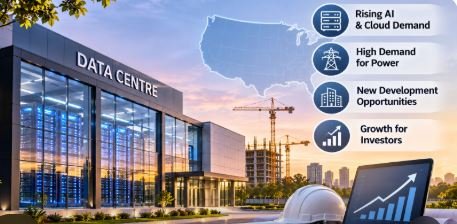
The growing demand for artificial intelligence (AI), cloud computing and digital services is reshaping the US commercial real estate market. At the centre of this shift are data centres — specialised facilities that store, process and manage the enormous volumes of information used by businesses, governments and consumers.
Once considered a relatively small part of the property market, data centres have become one of its fastest-growing sectors. Technology companies are investing heavily in new facilities to support AI applications, cloud platforms and other digital services. This is creating opportunities not only in data centre development but also across the wider commercial property market.
For investors and property developers, the opportunity extends beyond owning data centre buildings. Demand is also increasing for suitable land, industrial facilities, power infrastructure, accommodation and other services needed to support large-scale projects.
AI Is Driving a New Wave of Property Demand
The expansion of AI is changing the scale and technical requirements of data centre development. Traditional facilities were largely designed to support conventional data storage and cloud computing. New AI-focused facilities require significantly more computing capacity and electricity.
This is driving demand for larger campuses, advanced cooling systems and reliable power supplies. Some planned AI data centre developments are expected to require 300 to 500 megawatts or more of power, making them major infrastructure projects as well as property investments.
The scale of investment is attracting interest from institutional investors, specialist developers, infrastructure funds and real estate investment trusts (REITs).
As technology companies compete to secure computing capacity, developers with access to suitable sites and reliable electricity are gaining an advantage.
Power Availability Is Becoming a Key Investment Advantage
Electricity has become one of the most important factors influencing where new data centres are built. A site may have plenty of land and good road access, but without sufficient power capacity, development can be delayed or become commercially unviable.
Connecting a large facility to the electricity grid can take four years or longer in some locations. This is making land with secured power access, approved connections or development-ready infrastructure particularly valuable.
For commercial property investors, this is changing how potential sites are assessed. Location remains important, but access to electricity, grid capacity and the speed of power delivery are increasingly central to investment decisions.
Developers are also exploring alternative energy solutions, including natural gas, nuclear power, geothermal energy, solar and wind generation, and battery storage. These options can help meet growing electricity requirements, although planning approvals, construction costs and local concerns can affect project timelines.
Data Centres Are Becoming a Larger Part of the Commercial Property Market
The growing importance of data centres is reflected in their increasing share of US commercial real estate investment activity.
Data centres now account for close to 10% of US commercial real estate transaction volume, compared with less than 2% historically. This illustrates how quickly the sector has moved from a specialist property category to a significant investment market.
Investors can gain exposure through several routes, including direct property ownership, private real estate funds, REITs and infrastructure investment vehicles. Debt markets are also playing a role, with financing available through bonds, asset-backed securities and commercial mortgage-backed securities.
This broader range of investment options is attracting capital from investors who want exposure to the long-term growth of digital infrastructure without necessarily developing or operating facilities themselves.
The Benefits Extend Beyond Data Centre Buildings
One of the most important effects of data centre expansion is the demand it creates for other types of commercial property.
Large developments require construction contractors, engineering services, equipment suppliers, logistics operations and ongoing maintenance. They also bring workers and specialist businesses into surrounding areas.
This can support demand for industrial warehouses, distribution facilities, hotels, serviced accommodation and short-term housing. In some locations, the arrival of a major data centre project can strengthen the local commercial property market by attracting additional businesses and investment.
The impact can also be felt in land values. Sites near major data centre developments may become more attractive to industrial operators and businesses that provide services to the technology sector.
For property investors, these indirect opportunities may be worth examining alongside the data centre market itself.
Investment Is Spreading Beyond Traditional Data Centre Locations
Northern Virginia has long been one of the most important data centre markets in the United States. However, the rapid growth in demand is encouraging developers to consider other regions where land and electricity may be more readily available.
Markets along the Sun Belt and the I-20 corridor are attracting attention, alongside states such as Alabama, Mississippi, Louisiana, Georgia, Florida, South Carolina, North Carolina, Virginia and Pennsylvania.
These locations offer different combinations of land availability, energy resources, transport links, tax conditions and access to business markets.
The shift is important because data centre development is no longer determined by proximity to major cities alone. Power infrastructure, planning conditions and the ability to bring facilities online quickly are becoming equally important.
For investors, this creates opportunities in emerging markets that may previously have received less attention from the data centre industry.
Rising Construction Costs and Development Risks
Despite the sector’s growth prospects, data centre investment is not without challenges. These are complex buildings requiring substantial capital, specialist equipment and reliable infrastructure.
Construction costs have risen significantly, with capital expenditure reaching nearly $161 per square foot in 2025 — almost double earlier levels. Higher costs can affect project returns, particularly where electricity connections, cooling systems and specialised equipment add to development budgets.
There are also risks associated with technological change. Data centre facilities must be designed to accommodate evolving computing requirements, and buildings that cannot adapt may lose their competitive appeal.
Other challenges include planning delays, power shortages, construction cost inflation and dependence on a small number of major tenants. A project may appear attractive on paper but still face significant financial and operational risks if its power supply or tenant commitments are uncertain.
Investors therefore need to look beyond headline demand forecasts and assess the quality of the site, infrastructure, financing arrangements and long-term tenant requirements.
What the Data Centre Boom Means for Investors and Businesses
The growth of data centres is creating a new set of opportunities across the US commercial real estate market. Investors can participate directly through data centre properties or indirectly through REITs, private funds, infrastructure investments and related industrial assets.
Businesses may also benefit from the wider economic activity generated by these developments. Construction companies, energy providers, equipment manufacturers, logistics operators, engineering firms and accommodation businesses can all find opportunities as data centre projects expand.
However, success will depend on understanding the specific requirements of this market. Access to reliable electricity, suitable land, planning approvals and strong tenant demand will be essential factors in determining which projects deliver sustainable returns.
A Long-Term Shift in the US Property Market
The expansion of AI and cloud computing is changing the role of data centres in the US economy. They are no longer simply specialist technology facilities; they are becoming an increasingly important part of the country’s commercial and infrastructure landscape.
For the property sector, this shift is creating opportunities that reach well beyond the buildings themselves. From industrial property and development land to energy infrastructure and local business services, the effects are spreading across multiple areas of the market.
As digital demand continues to grow, data centres are likely to remain an important investment theme. The strongest opportunities, however, will belong to investors and developers who can identify locations with reliable power, sound infrastructure and the ability to meet the changing needs of technology companies.
