
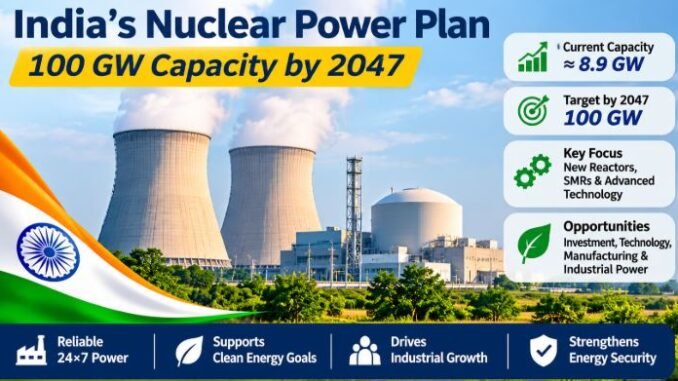
New Delhi: India’s plan to increase its nuclear power capacity to 100 gigawatts (GW) by 2047 could open major opportunities for businesses, investors and technology companies. The ambitious target is expected to give nuclear energy a bigger role in meeting the country’s growing electricity needs while supporting industrial development and the transition towards cleaner power.
As India expands its manufacturing, infrastructure and digital sectors, the demand for reliable electricity is increasing. Nuclear power could help meet this demand by providing a steady supply of electricity alongside renewable sources such as solar and wind.
The expansion could also create opportunities for international technology providers, domestic manufacturers, engineering companies and investors looking to participate in India’s growing energy market.
Nuclear Power Set for Major Expansion
India currently has around 8.9 GW of installed nuclear power capacity. The government aims to increase this to 100 GW by 2047, marking a major expansion of the country’s nuclear energy sector.
Achieving this target will require substantial investment in new power plants, advanced reactor technology, equipment manufacturing and supporting infrastructure.
The expansion is also expected to encourage greater cooperation between domestic and international businesses. Companies with expertise in nuclear technology, engineering, project development and safety systems could find opportunities through long-term partnerships.
For investors, the planned expansion represents a potential opportunity in a sector that will require significant capital and technical expertise over the coming years.
Small Modular Reactors Could Create New Business Opportunities
Small Modular Reactors (SMRs) are emerging as an important part of India’s nuclear energy plans.
These smaller reactors could provide reliable electricity to industries that require a continuous power supply. Sectors such as steel, cement, chemicals and manufacturing may benefit from dependable low-carbon energy as they look to improve efficiency and reduce emissions.
India is also working towards developing its own small reactor technologies. The proposed Bharat Small Reactors and other indigenous designs could support the country’s long-term energy requirements.
For businesses, this could create opportunities in equipment manufacturing, engineering services, technology development and industrial power solutions.
However, commercial deployment will depend on investment, technical development, regulatory approvals and project execution.
Global Technology Companies Could Find New Opportunities
India’s nuclear expansion is likely to require expertise from different parts of the global energy industry.
International companies could explore partnerships in areas such as reactor technology, specialised equipment, engineering, construction and safety systems.
However, entering India’s nuclear sector will require more than simply supplying technology. Companies will need to understand local regulations, work with domestic partners and support the development of local manufacturing capabilities.
For Indian businesses, this could create opportunities to participate in supply chains, develop technical expertise and build long-term relationships with international partners.
The growing focus on domestic manufacturing may also encourage investment in specialised components and engineering services.
Fast Breeder Reactor Marks Progress in Indigenous Technology
India is also making progress in developing advanced nuclear technology.
The Prototype Fast Breeder Reactor at Kalpakkam, Tamil Nadu, achieved first criticality in April 2026. This marked an important milestone in the country’s efforts to develop its own advanced reactor capabilities.
The development is significant because fast breeder technology forms an important part of India’s long-term nuclear energy programme.
The reactor still needs to complete further testing and commissioning before commercial electricity generation. Once fully operational, it is expected to strengthen India’s experience in advanced nuclear technology.
This progress could support future research, engineering development and opportunities for domestic industries involved in the nuclear supply chain.
Industrial Growth Could Increase Demand for Nuclear Energy
India’s growing industrial economy is creating a need for reliable and continuous electricity.
Manufacturing facilities, steel plants, chemical industries and data centres require large amounts of power to operate efficiently. Any interruption in electricity supply can affect production and increase business costs.
Nuclear energy could become an important option for meeting some of these requirements because it can generate electricity continuously.
For industrial companies, access to reliable low-carbon power could support long-term planning and help them meet sustainability goals.
The development of nuclear power could also encourage investment in related industries, including equipment manufacturing, construction, maintenance and technical services.
Investment and Safety Remain Important Challenges
Despite the opportunities, expanding nuclear power capacity to 100 GW will not be easy.
Nuclear projects require substantial investment, advanced technology, skilled professionals and strict safety standards. They also involve long planning and construction periods.
Financing will be another important consideration. Investors and businesses need clear regulations, predictable project timelines and suitable partnership arrangements before committing significant capital.
India will also need to strengthen its domestic supply chain and develop the skilled workforce required to support a much larger nuclear industry.
Managing these challenges will be essential if the country wants to achieve its long-term target.
Conclusion
India’s ambition to reach 100 GW of nuclear power capacity by 2047 could create significant opportunities across the energy and industrial sectors.
The expansion may attract investment in reactor technology, equipment manufacturing, engineering, construction and long-term power solutions. Small modular reactors and indigenous nuclear technology could also open new opportunities for industrial users and domestic businesses.
However, achieving the target will require careful planning, strong safety standards, investment and effective partnerships.
For businesses and investors, India’s nuclear energy sector is becoming an important area to watch. Its growth could support industrial development, improve energy security and strengthen the country’s transition towards a more reliable and lower-carbon power system.
