
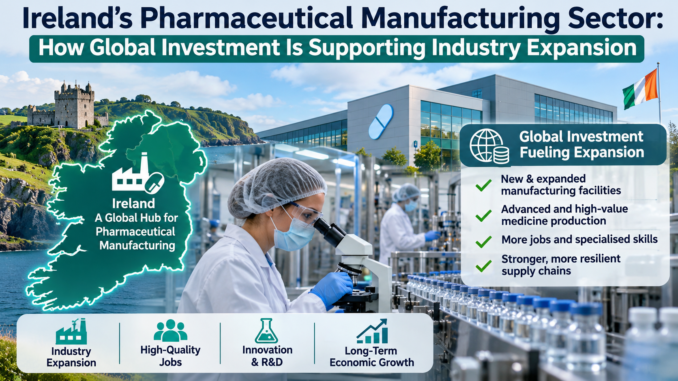
Nov 20: Ireland has established itself as one of the world’s important pharmaceutical manufacturing destinations. Supported by global investment, a skilled workforce, advanced production facilities and a strong regulatory environment, the country continues to attract pharmaceutical companies looking to expand their international operations.
The industry’s growth is increasingly linked to the production of complex medicines, biologics and advanced therapies. At the same time, developments in automation, digital manufacturing and research are changing how pharmaceutical products are developed and manufactured.
For Ireland, this expansion represents more than an increase in industrial capacity. It strengthens the country’s position in global supply chains, creates opportunities for skilled employment and supports the wider economy.
Ireland’s Pharmaceutical Manufacturing Industry Continues to Expand
Ireland’s pharmaceutical manufacturing sector has benefited from decades of international investment. Major global pharmaceutical companies have established manufacturing, research and development and commercial operations across the country.
Its appeal comes from several factors, including access to European markets, an established life sciences ecosystem, a skilled talent pool and experience in producing medicines for international distribution.
The sector is also moving towards higher-value manufacturing activities. Instead of relying only on conventional pharmaceutical production, companies are investing in specialised facilities capable of handling biologics, complex formulations and advanced medicines.
This shift is creating opportunities for suppliers, engineering companies, technology providers, logistics businesses and specialist service firms.
Global Investment Is Strengthening Ireland’s Pharmaceutical Industry
Foreign direct investment remains an important driver of Ireland’s pharmaceutical manufacturing growth. International companies continue to invest in production facilities, equipment upgrades and technology that can support future demand.
The Central Statistics Office’s September 2026 publication, Pharmaceutical and Medical Manufacturing in Ireland 2019–2025, highlights the scale of this industrial expansion. Combined employment across pharmaceutical and medical technology enterprises increased from 60,537 in 2019 to 96,848 in 2025. Sales of goods rose from €105 billion to €211 billion during the same period.
The publication also reported that foreign-owned enterprises accounted for 83,317 employees, representing approximately 86% of combined employment in these sectors.
These figures demonstrate the importance of international investment to Ireland’s wider life sciences manufacturing ecosystem. However, the CSO statistics cover pharmaceutical and medical technology businesses together and should not be interpreted as pharmaceutical-sector figures alone.
The IDA Ireland whitepaper, The Future of Biopharma in Ireland: Unlocking Growth Through Innovation, Investment, and Collaboration, also highlights the importance of innovation, advanced therapies, skilled talent and collaboration in sustaining the country’s competitiveness.
Biologics Manufacturing Is Creating New Investment Opportunities
One of the most important developments in Ireland’s pharmaceutical industry is the growing importance of biologics.
Unlike conventional medicines that are generally produced through chemical processes, biologics are developed using living systems. They include treatments for cancer, autoimmune conditions, diabetes and other complex diseases.
The growing demand for these treatments is encouraging pharmaceutical companies to invest in specialised manufacturing infrastructure.
Biologics production requires advanced facilities, sophisticated quality-control systems and highly trained professionals. This creates opportunities for businesses involved in cleanroom technology, laboratory equipment, temperature-controlled storage, process engineering and pharmaceutical packaging.
Ireland’s established life sciences ecosystem provides a foundation for attracting further investment in these specialised manufacturing activities.
Advanced Manufacturing Technology Is Changing Pharmaceutical Production
Technology is becoming increasingly important to pharmaceutical manufacturing. Companies are adopting automation, robotics, artificial intelligence and digital monitoring systems to improve production efficiency and maintain consistent quality.
Modern manufacturing facilities can use connected equipment to monitor production conditions, identify potential issues and improve operational performance.
Artificial intelligence and data analytics can also support predictive maintenance, production planning and quality management. These technologies help companies reduce avoidable downtime and improve the use of manufacturing resources.
However, pharmaceutical manufacturing requires strict quality and regulatory controls. Technology adoption must therefore be supported by validation, documentation, data integrity and compliance with applicable manufacturing standards.
For technology companies, this creates opportunities to develop specialised software, automation systems and digital solutions for pharmaceutical production environments.
Astellas Expansion Highlights Continued Investment in Ireland
Recent investment announcements demonstrate how pharmaceutical companies are strengthening their manufacturing operations in Ireland.
In September 2026, IDA Ireland announced an expansion by Astellas at Kerry Technology Park in Tralee. The project includes a second aseptic filling line, which is expected to double the facility’s drug product manufacturing capacity.
The expansion follows an earlier €330 million commitment and is expected to create skilled employment opportunities by 2029. The facility is expected to open in early 2027.
Aseptic filling is an important stage in pharmaceutical production, particularly for medicines that require sterile manufacturing conditions.
The investment illustrates how companies are expanding specialised production capabilities rather than simply increasing conventional manufacturing capacity. It also demonstrates the potential for regional locations to benefit from pharmaceutical investment through employment, infrastructure development and demand for supporting services.
Skilled Employment Is Supporting Industry Growth
Pharmaceutical manufacturing requires professionals across a wide range of disciplines. These include biotechnology, chemical engineering, pharmaceutical sciences, microbiology, quality assurance, regulatory affairs, automation and supply chain management.
As manufacturing facilities become more technologically advanced, demand is also growing for professionals who can work with digital production systems, data analytics and automated equipment.
The Central Bank of Ireland’s Quarterly Bulletin for the second quarter of 2026 reported that pharmaceutical employment increased from approximately 19,000 in 1998 to 73,600 in 2025.
This long-term expansion highlights the industry’s growing contribution to the Irish labour market.
The development of specialist training programmes and collaboration between industry and educational institutions will remain important for meeting future workforce requirements.
Pharmaceutical Supply Chains Are Becoming More Strategic
The pharmaceutical industry depends on complex international supply chains involving active pharmaceutical ingredients, specialised chemicals, laboratory materials, packaging, machinery and temperature-controlled logistics.
Global disruptions, changing trade conditions and the need for reliable access to essential medicines have encouraged companies to review their supply chain strategies.
Ireland’s manufacturing infrastructure and access to international markets make it an important location for companies seeking to strengthen their production networks.
However, maintaining supply chain resilience requires investment in logistics, supplier diversification, inventory management and regulatory compliance.
This also creates opportunities for Irish businesses involved in pharmaceutical distribution, cold-chain transportation, warehousing and specialised packaging.
Opportunities for Small and Medium-Sized Businesses
The expansion of pharmaceutical manufacturing creates opportunities beyond large multinational companies.
Small and medium-sized enterprises can participate in the industry’s growth by providing specialised services and supporting infrastructure.
Potential areas include:
-
Cleanroom design, maintenance and validation.
-
Pharmaceutical packaging and labelling.
-
Laboratory equipment and testing services.
-
Industrial automation and software solutions.
-
Temperature-controlled logistics.
-
Engineering and equipment maintenance.
-
Regulatory consulting and quality management.
-
Specialist recruitment and workforce training.
Businesses that understand pharmaceutical quality standards and regulatory requirements may be better positioned to build long-term relationships with manufacturers.
For service providers, the opportunity lies in offering specialised solutions that meet the operational needs of highly regulated manufacturing environments.
Challenges That Could Influence Future Growth
Despite its strong position, Ireland’s pharmaceutical manufacturing industry faces several challenges.
The cost of establishing and operating advanced manufacturing facilities remains high. Companies must also manage energy requirements, infrastructure availability, skilled labour shortages and increasingly complex regulatory expectations.
International competition is another consideration. Other countries are offering incentives and investing in life sciences infrastructure to attract pharmaceutical manufacturing projects.
Changes in global trade policies and supply chain arrangements could also influence future investment decisions.
Ireland’s ability to maintain its competitiveness will depend on continued investment in infrastructure, workforce development, innovation and a supportive business environment.
The Future of Pharmaceutical Manufacturing in Ireland
Ireland’s pharmaceutical manufacturing industry is likely to become increasingly focused on advanced medicines, biologics, digital production and specialised manufacturing capabilities.
As global healthcare demand evolves, pharmaceutical companies will need facilities that can support complex treatments while meeting stringent quality and safety requirements.
The country’s established manufacturing base, international investment relationships and skilled workforce provide a strong foundation for future expansion.
Continued investment in research, technology and specialist training will be essential to maintaining this position. The opportunities will also extend to smaller businesses that can provide the technology, logistics and technical services required by modern pharmaceutical facilities.
Conclusion
Ireland’s pharmaceutical manufacturing sector is entering an important phase of development, supported by global investment and a shift towards advanced production capabilities. Investments in biologics, aseptic manufacturing, automation and digital technologies are strengthening the country’s role in the international pharmaceutical supply chain.
The benefits extend beyond multinational manufacturers. Engineering firms, technology providers, logistics companies, training institutions and specialist service businesses can all participate in the industry’s expansion.
As pharmaceutical companies continue to modernise their operations and invest in high-value manufacturing, Ireland’s ability to combine innovation, skilled talent and reliable infrastructure will remain central to its long-term industrial growth.
