
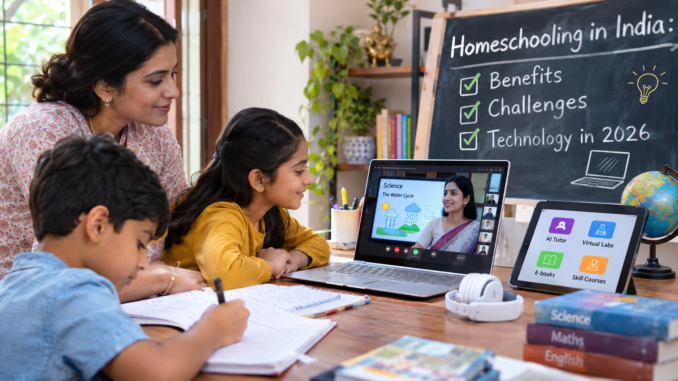
Nov 26: Homeschooling is becoming an increasingly discussed alternative to conventional education as families look for more flexible and personalised ways to support children’s learning. Recent research from the Johns Hopkins Institute for Education Policy suggests that homeschooling participation in the United States continued to increase during the 2025–26 academic year, although the pace of growth slowed.
According to its September 2026 analysis, 17 of the 22 US states that had reported homeschooling figures recorded an increase in participation. However, the combined growth rate across these same states declined from 6.3% in 2024–25 to 1.5% in 2025–26.
Another Johns Hopkins study, conducted in partnership with RAND’s American Life Panel, found that 88% of surveyed homeschooling parents used additional educational resources or support. These included online learning materials, tutors, learning cooperatives and online classes.
Although these findings relate to the United States and do not represent homeschooling participation in India, they highlight how home-based education is evolving. Families are increasingly combining parent-led instruction with digital learning platforms, external educators and other educational resources.
In India, this development raises important questions about personalised learning, alternative education pathways and the role of technology in making education more accessible.
What Is Homeschooling and How Does It Work?
Homeschooling is an educational approach in which parents or guardians take primary responsibility for their children’s education outside a conventional school environment.
The teaching process can involve textbooks, online classes, educational applications, private tutors, practical projects and independent study. Some families follow a structured homeschooling curriculum similar to that of traditional schools, while others prefer a more flexible approach based on their children’s interests and learning requirements.
One of the main differences is the flexibility to organise lessons around individual progress rather than following a common classroom timetable.
For example, a child who needs additional support in mathematics can spend more time understanding difficult concepts. Another child interested in science, technology or creative subjects can explore those areas through additional projects and online resources.
However, flexibility does not mean learning should lack structure. A well-planned homeschooling programme still needs clear academic goals, regular assessments and opportunities for children to develop practical and social skills.
Why Are Parents Considering Homeschooling?
Families explore homeschooling for different reasons. Some want to provide individual attention, while others prefer greater flexibility in daily schedules or a learning environment that better suits their children’s educational needs.
Personalised Learning
Children do not all learn in the same way. Some understand concepts through reading, while others benefit from demonstrations, discussions or practical activities.
Homeschooling allows parents to adjust teaching methods according to these differences. Children can revisit difficult topics, progress through subjects at their own pace and explore areas where they show particular interest.
This approach can make learning more responsive to individual strengths, although its success depends on the quality of instruction and consistency.
Flexible Learning Schedules
Traditional schools generally operate according to fixed academic calendars and classroom schedules. Homeschooling gives families more control over how they organise learning.
This flexibility may be useful for children involved in sports, performing arts, specialised training or activities that require additional time. It can also help families manage education when frequent relocation makes conventional school attendance difficult.
Greater Parental Involvement
Parents who choose homeschooling become directly involved in their children’s education. They can monitor academic progress, identify learning gaps and adjust lessons when necessary.
At the same time, this responsibility requires commitment. Parents need to dedicate time to planning lessons, finding suitable educational resources and ensuring that children receive a balanced learning experience.
Learning Beyond Traditional Textbooks
Homeschooling can create opportunities for children to learn through practical experiences. Science experiments, reading programmes, creative projects, educational visits and independent research can complement regular academic lessons.
These activities may help children connect classroom concepts with real-world situations.
How Technology Is Transforming Online Homeschooling
Technology has significantly expanded the resources available to homeschooling families. Online homeschooling platforms, virtual classrooms, recorded lessons and digital libraries allow children to access educational material from different locations.
Artificial intelligence is also introducing new possibilities for personalised education. AI-powered tools can explain difficult concepts, generate practice questions and help students revise subjects according to their learning pace.
Parents can use digital platforms to organise lessons, monitor progress and identify areas where additional support may be required. Online tutors and virtual learning communities can also provide access to specialist educators.
However, technology should complement rather than replace effective teaching. Excessive screen time, unreliable educational content and limited physical interaction can create challenges if digital learning is not managed carefully.
A balanced online homeschooling routine should include books, practical activities, physical exercise, discussions and opportunities to interact with other learners.
Homeschooling in India: Education Rules and Alternative Learning Pathways
India’s education landscape includes conventional schools, open schooling and different forms of home-based learning. Families considering homeschooling need to understand the distinction between independent home education and recognised educational programmes.
The Right of Children to Free and Compulsory Education Act, 2009, establishes the right to free and compulsory elementary education for children between six and fourteen years of age. India’s National Education Policy 2020 also recognises home-based education as an option for children with severe and profound disabilities who are unable to attend school.
UNESCO’s India education profile notes that homeschooling does not have a dedicated regulatory framework in the country and is not recognised as a school under the RTE framework. Families should therefore carefully consider applicable educational requirements and future certification needs.
Understanding the Role of NIOS
The National Institute of Open Schooling (NIOS), which operates under the Ministry of Education, provides an alternative through open and distance education.
Its programmes include Open Basic Education, Secondary and Senior Secondary courses, and vocational education. The system offers flexibility in subject selection, learning pace and examination opportunities.
NIOS also provides self-learning materials, audio-visual educational resources and academic support through its study centres.
For families exploring alternatives to conventional schooling, NIOS may provide a route towards recognised academic qualifications. Its Secondary and Senior Secondary programmes can be particularly relevant for learners who need a more flexible educational arrangement.
However, NIOS enrolment and independent homeschooling are not the same. Parents should check the latest admission requirements, eligibility criteria, examination rules and certification provisions before selecting an educational pathway.
What Are the Benefits and Challenges of Homeschooling?
While homeschooling offers flexibility, it also requires careful planning. Its suitability depends on a child’s learning needs, family circumstances and access to educational resources.
Benefits of Homeschooling
Some of the commonly discussed advantages include:
- Individual attention and the flexibility to learn at a suitable pace.
- Greater parental involvement in academic development.
- Freedom to explore subjects beyond the standard curriculum.
- Flexible schedules for children with specialised interests.
- Opportunities to combine classroom learning with practical activities.
- Access to online educational resources and specialist tutors.
These benefits are not automatic. They depend on how effectively parents organise lessons and provide academic support.
Challenges Families Need to Consider
Time and parental commitment: Planning lessons, teaching subjects and monitoring academic progress can be demanding, particularly for parents managing professional responsibilities.
Social interaction: Children need opportunities to develop friendships, communication skills and teamwork. Sports clubs, community activities, workshops and learning groups can help provide these experiences.
Curriculum planning: Parents must select appropriate learning materials, establish academic goals and ensure that children receive instruction across essential subjects.
Access to qualified educators: Parents may not have specialist knowledge in every subject. Tutors and online educators can provide additional support, but their availability and cost may influence the overall learning arrangement.
Future qualifications: Families should consider how children will complete recognised examinations and meet eligibility requirements for higher education or professional courses.
What Does Recent Research Say About Homeschooling and Child Development?
The discussion around homeschooling extends beyond academic performance. Children’s emotional well-being, social development and ability to interact with others are also important considerations.
An October 2026 scoping review published in the journal Children examined 23 studies on home education and the psychosocial well-being of children and adolescents.
The review found that the available comparative evidence did not consistently associate home education with either better or poorer psychosocial outcomes. Findings varied according to the children studied, educational arrangements, previous school experiences, family resources and opportunities for social interaction.
This suggests that homeschooling should not automatically be viewed as superior or inferior to conventional schooling. The quality of the learning environment and the support available to children play an important role in shaping their experiences.
The researchers also highlighted the need for more long-term studies involving different groups of learners.
Homeschooling and the Future of Education in India
The future of education is likely to include a wider range of learning arrangements. Traditional schools will continue to play an important role, while online education, open schooling, hybrid learning and homeschooling may serve families with different requirements.
Artificial intelligence and digital learning platforms could make personalised education more accessible. At the same time, educators and policymakers will need to address questions around academic standards, student assessment, social development and recognised qualifications.
For India, the discussion is particularly relevant as families explore how technology and alternative learning methods can complement existing education systems.
The focus should not simply be on replacing classrooms with home-based instruction. It should be on ensuring that children receive quality education, meaningful learning experiences and opportunities to develop the skills needed for the future.
Conclusion
Homeschooling is becoming an important part of the wider discussion about personalised education and flexible learning. Recent international research shows that many families are combining parent-led instruction with online resources, tutors and educational communities.
In India, understanding the available education pathways, including NIOS, is essential for families considering alternatives to conventional schooling.
While homeschooling offers flexibility and greater individual attention, it also requires consistent parental involvement, structured learning, academic assessments and opportunities for social development.
As technology continues to reshape education, the priority should remain on creating balanced learning experiences that help children build knowledge, confidence, practical skills and opportunities for the future.
