
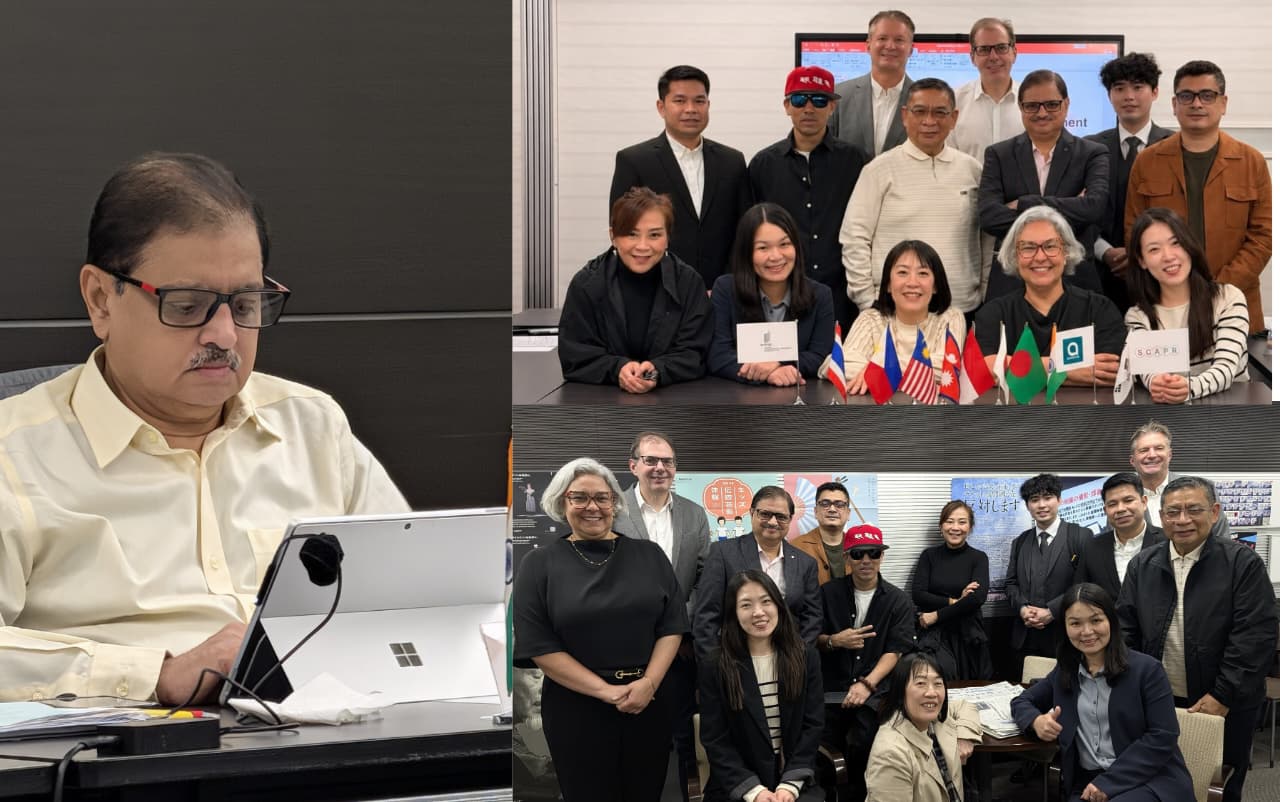
Dr Sanjay Tandon calls for stronger international cooperation and cross-border royalty flows to ensure singers and musicians receive their rightful recognition and remuneration worldwide.
Tokyo, Japan: Music may transcend geographical boundaries, but the rights of those who bring it to life must travel just as far. Carrying this message from India to the world, the Indian Singers and Musicians Rights Association (ISAMRA) participated in the Asia CMO Forum 2026 in Tokyo, Japan, reaffirming its commitment to ensuring that singers and musicians receive rightful recognition, protection and remuneration for their creative contributions, irrespective of national borders.
The international forum brought together representatives of Collective Management Organisations (CMOs) from Bangladesh, India, Indonesia, Japan, Malaysia, Nepal, South Korea, Thailand, the Philippines and Vietnam, alongside representatives from the World Intellectual Property Organization (WIPO), SCAPR and Brazil. The gathering provided a significant platform for strengthening international partnerships, exchanging experiences and exploring collaborative approaches to protecting performers’ rights in an increasingly interconnected music industry.
For ISAMRA, the participation marked another important step in India’s journey towards building a stronger, more transparent and internationally connected ecosystem for singers and musicians. As music travels across streaming platforms, digital networks, broadcasts and international markets, ensuring that performers receive fair compensation for the use of their performances has become a shared global responsibility.
Speaking about the significance of the Forum, Dr Sanjay Tandon, Founder and Managing Director of ISAMRA, said, “Indian music has travelled across the world for generations, but the rights of the singers and musicians who give that music its soul must travel with it. Our participation at the Asia CMO Forum in Tokyo is about building bridges that go beyond geographical boundaries, strengthening international cooperation and ensuring that every performer receives the recognition and royalties they rightfully deserve. We are working towards an ecosystem where an Indian singer is fairly compensated when their performance is used anywhere in the world, just as an international performer must receive their rightful dues in India.”
He added, “With the support of the Government of India, DPIIT and our international partners, we envision an India that not only celebrates its musical heritage but also leads the global conversation on performers’ rights. Music knows no borders, and neither should the rights of those who create it.”
The discussions at the Forum focused on strengthening collective management systems, improving cooperation between rights organisations and facilitating more effective international royalty flows. They also highlighted the importance of creating mechanisms through which performers can benefit from the commercial use of their work beyond their home countries.
ISAMRA’s engagement with international counterparts reflects its larger vision of ensuring that Indian singers and musicians are not confined by geographical limitations when it comes to exercising their rights. Equally important is the creation of a reciprocal ecosystem in which foreign performers receive their rightful remuneration when their performances are used in India.
The Forum also offered an opportunity to share India’s experiences in developing a framework for performers’ rights while learning from established international practices. Such exchanges are particularly relevant as the global music industry undergoes rapid transformation, with digital consumption creating new opportunities alongside complex challenges in rights administration, royalty collection and distribution.
At the heart of ISAMRA’s international outreach is a conviction that every singer’s voice and every musician’s contribution deserve to be valued, protected and fairly rewarded. While audiences celebrate the songs and melodies that become part of their lives, the performers behind those creations must also receive their rightful share of the economic value their work generates.
India’s growing engagement with international collective management organisations also underscores the importance of a progressive policy environment. Continued cooperation between the Government of India, the Department for Promotion of Industry and Internal Trade (DPIIT), rights organisations and international institutions can further strengthen India’s position as an influential participant in shaping a fair, transparent and effective global framework for performers’ rights.
Beyond policy and royalty administration, the Tokyo discussions reflected a larger shift in how the creative world recognises the people behind music. While songs travel effortlessly across languages, cultures and continents, the singers and musicians whose talent gives those compositions their identity must not be left behind in the economic value their performances generate.
For ISAMRA, building international relationships is therefore not merely an institutional exercise. It is an investment in the future of India’s creative community, opening pathways for stronger rights protection, greater transparency, international royalty collection and sustainable livelihoods for performers.
The Asia CMO Forum 2026 reinforced a growing international consensus that meaningful progress in performers’ rights depends on cooperation rather than isolation. By strengthening relationships with its global counterparts, ISAMRA continues to contribute to a future in which artists are recognised not only for the music they perform but also for the economic and cultural value they generate.
As India strengthens its presence on the global creative stage, ISAMRA’s message from Tokyo resonates beyond the conference halls: Music knows no borders, and neither should the rights of those who bring it to life.
