
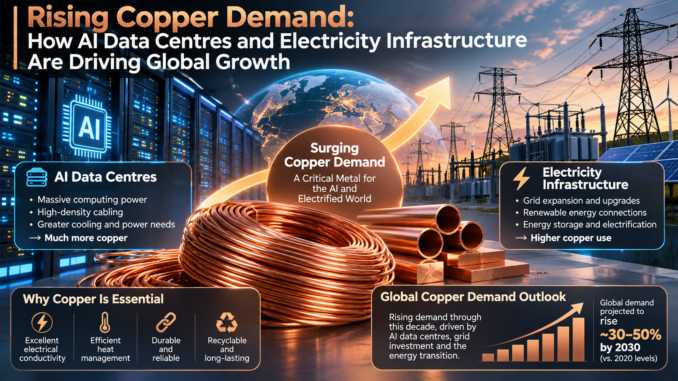
Nov 24: Copper is becoming increasingly important as artificial intelligence (AI), data centres and electricity infrastructure reshape the global economy. The growing use of AI tools, cloud computing and high-performance computing is creating fresh demand for the metal, which plays a vital role in electrical systems, power distribution and industrial development.
Technology companies are investing heavily in data centres to support the growing demand for digital services. However, building and operating these facilities requires more than servers and advanced computing equipment. They also need reliable electricity supplies, efficient cooling systems and extensive power networks. Copper is an essential part of this infrastructure.
The growing investment in digital technology, combined with the expansion of electricity networks, is creating new opportunities for the global copper industry. It is also raising questions about whether mining companies and suppliers can keep pace with future demand.
Why AI Data Centres Need More Copper
Data centres depend on extensive electrical infrastructure to keep servers, networking equipment and cooling systems running around the clock. Copper is widely used in these facilities because of its excellent electrical conductivity, durability and thermal performance.
The growing adoption of artificial intelligence is changing the way data centres are designed. AI applications require powerful computing systems, often supported by high-density server racks and sophisticated cooling arrangements. This increases the need for electrical cables, busbars, connectors and power distribution equipment.
According to the International Energy Agency (IEA), in its Global Critical Minerals Outlook 2025, copper consumption by data centres could reach between 250,000 and 550,000 tonnes by 2030. This could account for approximately 1% to 2% of global copper demand.
As businesses continue to adopt generative AI, machine learning and cloud-based services, investment in computing infrastructure is expected to remain an important source of demand.
While fibre-optic technology is increasingly used for data transmission, copper continues to play a major role in supplying electricity and connecting essential equipment within data centres.
Rising Electricity Consumption Is Supporting Copper Demand
The expansion of data centres is closely linked to the growing demand for electricity. AI applications, cloud computing platforms and digital services need a continuous and reliable power supply to operate efficiently.
The IEA’s Electricity 2026 report forecasts that global electricity demand will grow by an average of 3.6% annually between 2026 and 2030. Data centres, electric vehicles, industrial activity and air conditioning are among the factors contributing to this increase.
Meeting this demand will require significant investment in electricity generation, transmission and distribution networks.
This is where copper becomes particularly important. It is widely used in electrical cables, transformers, generators, substations and power distribution systems. As countries expand their electricity networks and modernise existing infrastructure, the demand for copper-based equipment is also likely to increase.
The IEA estimates that annual grid investment will need to rise by approximately 50% by 2030 from the current level of around USD 400 billion to support growing electricity requirements.
For copper producers and electrical equipment manufacturers, this creates opportunities that extend well beyond the data centre industry.
How Artificial Intelligence Is Changing the Copper Industry
Artificial intelligence is bringing the technology and metals industries closer together.
Traditional data centres primarily support cloud storage, enterprise applications and digital services. AI-focused facilities have different requirements because they need to process increasingly complex workloads, including generative AI, machine learning and large language models.
These operations require powerful servers, advanced cooling systems and carefully designed electrical infrastructure.
As computing capacity increases, so does the need for reliable power distribution. Copper is used in busbars, cables, connectors and several other electrical components that help these facilities operate.
The impact is not limited to the buildings themselves. Data centres also need connections to electricity grids, reliable backup power and access to sufficient generation capacity.
This means that the expansion of AI is creating business opportunities across several industries, including copper mining, electrical equipment manufacturing, energy and infrastructure development.
Electricity Grid Expansion Could Create a Bigger Opportunity
The growing number of data centres is putting additional pressure on electricity networks. Large computing facilities need dependable power connections, often requiring new substations, transmission lines and distribution infrastructure.
In some markets, access to electricity and delays in grid connections are becoming important considerations for data centre developers.
According to the IEA’s Electricity 2026 outlook, more than 2,500 gigawatts of projects, including renewable energy, storage and large electricity-consuming facilities, remain in grid connection queues worldwide.
Addressing these challenges will require investment in power networks, electrical cables, transformers and distribution equipment.
For the copper industry, this represents a significant opportunity. The demand for the metal is not driven by data centre construction alone. Renewable energy projects, electric vehicle charging networks, industrial electrification and electricity grid upgrades are also contributing to its long-term consumption.
Can Global Copper Supply Keep Pace With Demand?
While demand for copper is expected to increase, expanding production remains a challenge for the mining industry.
Developing new copper mines requires considerable investment, exploration, regulatory approvals and supporting infrastructure. Existing mines also face challenges such as declining ore grades, operational disruptions and rising production costs.
The IEA’s Global Critical Minerals Outlook 2025 projects that global copper demand under its Stated Policies Scenario could increase from approximately 26.7 million tonnes in 2024 to 34.1 million tonnes by 2040.
The International Copper Study Group (ICSG), in its April 2026 market forecast, projected refined copper usage of approximately 28.7 million tonnes in 2026 and 29.2 million tonnes in 2027.
The organisation also projected refined copper market surpluses of approximately 96,000 tonnes in 2026 and 377,000 tonnes in 2027.
These figures highlight an important point: rising long-term demand does not necessarily mean that the market will face an immediate shortage. Copper prices and market conditions are also influenced by mine production, refining capacity, inventories and changes in industrial activity.
However, expanding mining capacity and improving production efficiency will remain important if the industry is to meet future requirements.
Copper Recycling Could Help Address Supply Challenges
As global consumption increases, recycling is becoming an important part of the copper supply chain.
Copper can be recovered from old electrical cables, industrial machinery, construction materials, vehicles and discarded electronic equipment. One of its biggest advantages is that it can be recycled repeatedly without losing its essential properties.
Greater investment in recycling facilities could help reduce dependence on newly mined copper while supporting more sustainable industrial production.
However, recycling alone may not be enough to meet the additional demand coming from electricity networks, renewable energy, electric vehicles and data centres.
The industry will therefore need to combine new mining projects with better recycling systems and more efficient use of existing resources.
What Rising Copper Demand Means for Businesses and Investors
The changing demand landscape is opening up opportunities across the copper value chain.
Mining companies could benefit from sustained demand for the metal. Manufacturers of electrical cables, transformers, power distribution equipment and industrial components may also gain from increased infrastructure investment.
Businesses involved in renewable energy, electricity grid modernisation and data centre construction are other areas worth watching.
A June 2026 analysis by Wood Mackenzie, titled Data Centre Metals Demand: It’s All About the Infrastructure, Not Internals, draws attention to the importance of the wider infrastructure required to support data centre development.
For investors, copper offers an interesting way to understand the connection between technology growth and industrial demand. However, increasing consumption does not automatically translate into higher copper prices or stronger returns for every company.
Investors should look closely at production costs, mining reserves, debt levels, capital expenditure, supply conditions and the ability of individual companies to expand production.
The broader economic environment, geopolitical developments and currency movements can also influence copper prices.
The Future of Copper in an Increasingly Digital Economy
The growing connection between copper, artificial intelligence, electricity and data centres reflects a major shift in the global economy.
As businesses adopt AI and digital services become more widespread, the need for reliable electricity infrastructure will continue to grow. Copper plays an important role in making this possible, from power generation and transmission to the electrical systems inside data centres.
Although data centres currently account for a relatively small share of global copper consumption, their expansion could become a more significant source of demand over the coming decade.
The larger opportunity lies in the combined growth of digital infrastructure, electricity networks, renewable energy and industrial electrification.
Ultimately, copper demand will depend not only on how quickly artificial intelligence develops but also on how much countries and businesses invest in the infrastructure needed to support it.
As the digital economy expands, copper is proving to be more than just an industrial metal. It is becoming an essential part of the infrastructure powering the next phase of global technological and economic growth.
