
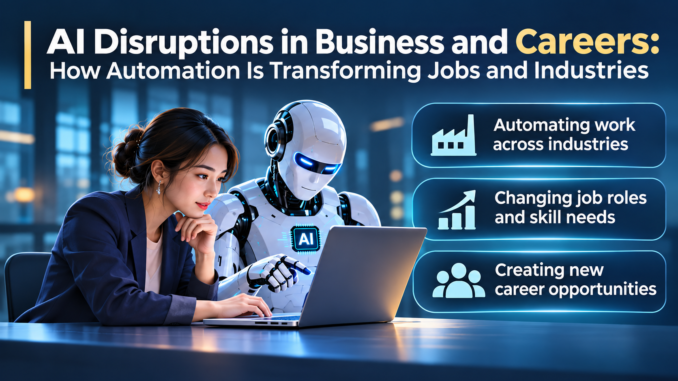
Nov 24: Artificial intelligence is moving beyond the experimental stage and becoming an integral part of everyday business operations. From banks analysing financial transactions to technology companies using AI-assisted software development, automation is changing how organisations work, make decisions and serve customers.
For businesses, the appeal lies in the ability to improve productivity, reduce repetitive work and manage operations more efficiently. For employees, however, the growing use of AI raises important questions about job security, changing responsibilities and the skills needed to remain competitive.
India is particularly important in this transformation. Its large banking system, expanding technology services industry, growing fintech ecosystem and skilled workforce offer considerable opportunities for AI adoption. At the same time, companies and professionals must prepare for changes in the nature of employment.
The discussion around AI is therefore no longer limited to what technology can accomplish. It is increasingly about how businesses will adapt, which jobs will evolve and where new career opportunities will emerge.
AI Is Changing the Way Businesses Operate
Businesses are increasingly using AI to improve processes that traditionally required significant manual effort. AI-powered systems can analyse large volumes of information, identify patterns, prepare reports and support routine decision-making.
In practical terms, companies can use automation to manage customer enquiries, process documents, monitor inventory, analyse sales performance and streamline administrative activities. These applications can help employees spend less time on repetitive tasks and more time on activities that require judgement and problem-solving.
For Indian businesses, this transition could be particularly relevant as companies expand digital operations and look for ways to improve efficiency across departments.
However, successful AI adoption requires more than purchasing software. Businesses must consider data quality, cybersecurity, implementation costs, employee training and the reliability of automated results.
Companies that connect AI investment with clearly defined business objectives are more likely to achieve meaningful improvements.
AI in Banking: How Automation Is Reshaping Financial Services
Banking is among the industries where AI is creating opportunities to improve operational efficiency and customer experience. Financial institutions manage enormous volumes of transactions, customer records and regulatory documentation, making several processes suitable for automation.
In India, the Reserve Bank of India’s October 2024 research on AI adoption examined annual reports from 32 commercial banks over eight financial years. It found that AI adoption was gaining momentum, with private-sector banks emerging as leaders in this area. The study identified applications including fraud detection, customer segmentation and chat automation.
AI is influencing banking operations in several ways.
Fraud detection and transaction monitoring: AI systems can analyse transaction patterns and flag unusual activity, helping banks identify potentially suspicious transactions more quickly.
Customer service: AI-powered chatbots and virtual assistants can respond to routine questions, provide basic assistance and guide customers through common banking services.
Loan processing: Automated systems can support document verification, information analysis and credit-risk assessment. Important lending decisions still require appropriate oversight.
Compliance and reporting: AI tools can help organise financial documents, identify inconsistencies and support regulatory monitoring.
Personalised banking: By examining customer behaviour and financial patterns, banks can develop more relevant services and recommendations.
The Reserve Bank of India’s FREE-AI committee report, released in August 2025, also highlighted the importance of responsible and ethical AI adoption in financial services. Its recommendations address innovation alongside risks involving data protection, transparency, accountability and security.
For banks, the challenge will be to introduce automation without compromising customer confidence or the reliability of financial services.
India’s Technology Industry Faces a Major AI Transition
India’s technology services industry is another sector experiencing significant change. Software development, IT support, business process management and digital services are increasingly incorporating AI-powered tools.
Generative AI applications can assist developers with writing code, identifying errors, explaining programming concepts and automating parts of software testing. This can reduce the time required for certain activities and allow technology teams to concentrate on complex projects.
However, software development involves more than generating code. Developers must understand business requirements, design reliable systems, evaluate security risks and ensure that applications perform as expected.
This means the role of technology professionals is evolving. Businesses will increasingly value employees who can combine technical knowledge with the ability to use AI tools effectively.
The employment implications are also significant. In October 2025, NITI Aayog released its Roadmap for Job Creation in the AI Economy. The roadmap highlighted the potential for India’s technology services sector to face significant job displacement by 2031, while also identifying an opportunity to create up to four million new jobs over the next five years.
The central challenge is to equip the workforce with the skills needed to transition into emerging roles as the technology services sector evolves.
Which Jobs Are Most Likely to Be Affected by AI Automation?
AI is expected to change many professional responsibilities, but it is important to distinguish between automating tasks and replacing entire occupations.
Jobs involving repetitive processes, structured information and predictable activities may be more exposed to automation.
Some areas already experiencing changes include:
- Customer service: AI assistants can handle routine enquiries, basic troubleshooting and appointment scheduling.
- Banking operations: Data entry, document verification and certain transaction-monitoring activities can be automated.
- Software development: AI tools can support coding, debugging and software testing.
- Marketing: Content drafting, campaign analysis and customer segmentation can be assisted by AI.
- Accounting: Invoice processing, data reconciliation and routine reporting offer opportunities for automation.
- Human resources: Recruitment administration, candidate screening support and employee query management can become more efficient.
The World Economic Forum’s Future of Jobs Report 2025 estimates that broader labour-market changes could create 170 million jobs and displace 92 million by 2030, resulting in a net increase of 78 million jobs globally. These projections cover several economic and technological trends, not AI alone.
The report also identifies clerical and administrative roles among occupations facing declining demand, while AI and machine learning specialists, big data specialists and fintech engineers feature among the fastest-growing roles.
For employees, the important takeaway is that job responsibilities and skill requirements are changing. Professionals who understand these changes can prepare for new opportunities rather than focusing only on the possibility of job displacement.
New Career Opportunities Emerging From AI
While automation may reduce the need for certain repetitive activities, it is also creating demand for specialised skills and new professional roles.
Businesses need people who can develop, implement, manage and monitor AI systems. This is supporting opportunities in areas such as:
- Artificial intelligence and machine learning engineering
- Data science and analytics
- Cybersecurity and information security
- Cloud computing and infrastructure
- AI governance and risk management
- Automation consulting
- Fintech and digital banking solutions
India’s growing AI talent ecosystem could benefit from this demand. The Government of India’s 2025 update on AI and the labour market reported that the share of AI-related job postings in South Asia increased from 2.9% in January 2023 to 6.5% in March 2025. This is a regional figure rather than an India-only estimate, but it reflects the growing demand for AI-related capabilities.
Career opportunities are not limited to people with advanced technical qualifications. Professionals who understand how AI can be applied within banking, marketing, finance, healthcare, logistics and other industries can also contribute to business transformation.
Combining industry expertise with practical AI knowledge could become a significant career advantage.
Why Employee Reskilling Will Become a Business Priority
Technology investment alone cannot guarantee successful AI adoption. Businesses also need employees who understand how to work with automated systems.
The World Economic Forum’s Future of Jobs Report 2025 estimates that 39% of workers’ existing skill sets could be transformed or become outdated between 2025 and 2030. It also identifies AI and big data, cybersecurity and technological literacy among the fastest-growing skill areas.
This makes employee reskilling an important part of business planning.
Companies can prepare their workforce through training in AI applications, data analysis, digital tools and cybersecurity awareness. Employees should also develop analytical thinking, communication, creativity and problem-solving abilities.
For example, a banking employee may not need to build an AI model but could benefit from understanding how automated fraud detection works. A marketing professional may not need to develop software but should know how to use AI tools to analyse campaigns and evaluate content.
Businesses that invest in employee development can make the transition more manageable while retaining valuable industry knowledge and experience.
The Risks of AI Adoption Businesses Cannot Ignore
Despite its advantages, AI adoption comes with risks that companies must address before expanding automation across critical operations.
Data privacy is particularly important for banking, healthcare and other industries that handle sensitive customer information. Businesses must ensure that AI systems follow appropriate data protection and security practices.
Cybersecurity is another concern. AI can support threat detection, but it can also be misused to create convincing phishing messages, fraudulent communications and sophisticated cyberattacks.
Accuracy and accountability also matter. AI systems can generate incorrect information or misleading recommendations. Important decisions, especially those involving finance, employment and customer rights, should not rely entirely on automated outputs.
Companies must also consider implementation costs, infrastructure requirements, employee training and ongoing maintenance.
A responsible approach to AI adoption should balance efficiency with transparency, human oversight and customer trust.
The Future of Work: Human Skills and AI Must Work Together
The future workplace is likely to involve closer collaboration between employees and intelligent systems. AI can process information, automate repetitive activities and support faster analysis. People bring creativity, judgement, leadership, communication and the ability to understand complex situations.
This balance will be important as Indian businesses expand their use of automation.
For companies, the priority will be to identify where AI can improve operations without compromising quality, security or customer relationships. For professionals, continuous learning and the willingness to adapt will become increasingly important.
Banking may become more automated, software development may become increasingly AI-assisted and business operations may rely more heavily on data-driven decisions. Yet human expertise will continue to play an important role in making these systems effective and responsible.
Conclusion
AI disruptions in business and careers are reshaping how companies operate and how professionals prepare for the future. India’s banking and technology sectors demonstrate how automation can improve efficiency, transform job responsibilities and create opportunities in emerging areas.
However, managing this transition will require more than investment in technology. Businesses must focus on employee reskilling, responsible AI adoption and the development of skills that complement automation.
For professionals, understanding AI and learning how to work alongside it could become as important as traditional industry experience.
Ultimately, the future of work will not be determined by artificial intelligence alone. It will depend on how effectively businesses and people use it to improve productivity, develop new capabilities and create sustainable long-term value.
