
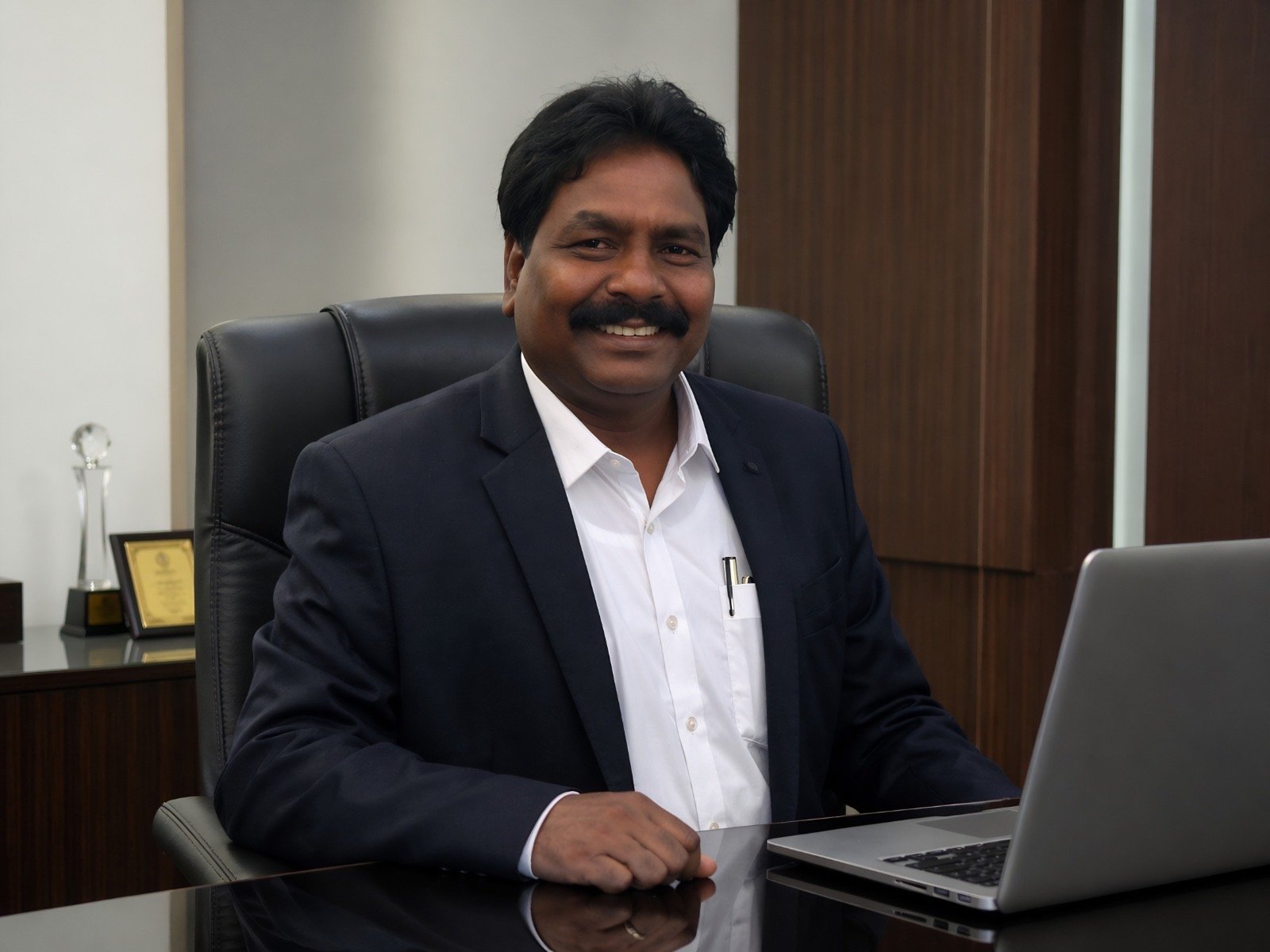
Naga Venkateswar Rao’s manufacturing journey started long before Aditya Precitech joined India’s defence and aerospace sector. It began in a small village near Machilipatnam in Andhra Pradesh. Neither of his parents had any formal education. Even so, he says he wanted to be an entrepreneur from childhood.
From mechanical engineering to entrepreneurship
Rao completed a Diploma in Mechanical Engineering in Machilipatnam before moving to Hyderabad in 1990. His first professional experience came through a manufacturing company, where he worked as a trainee supervisor.
In an interview, Rao recalled that entrepreneurship had been an ambition since childhood. With encouragement from his parents, he eventually decided to establish his own manufacturing business.
The starting point was modest. Rao says he began with approximately ₹1 lakh in capital. Access to institutional finance proved difficult. Banks were reluctant to extend loans because he could not provide the collateral they required, despite his technical experience and business ambitions.
Building Aditya Precitech
Aditya Precitech’s origins date back to 1994, when it was established as a partnership firm. It was incorporated as a private limited company in 2004. Rao was one of its promoters, alongside R.V.K.Kishore, according to CRISIL’s company profile.
The company initially concentrated on precision engineering and mechanical components. Its first order from a defence public sector undertaking came in 2005, followed by an opportunity to manufacture mechanical components for DRDO laboratories in 2006.
The subsequent expansion into subassemblies, electromechanical systems, digital controllers and RF technologies reflected a deliberate move towards more complex engineering requirements.
A 2013 DRDO industry compendium documents the company’s contribution to rocket and missile programmes, including rocket motor hardware, fins, injectors, thruster assemblies and pressure regulators.
A shift towards strategic partnerships
One of the important decisions in Rao’s entrepreneurial journey was recognising the role international technology partnerships could play in expanding India’s domestic defence manufacturing capabilities.
This led to two significant collaborations.
The first was Blue Horizon Strategic Engineering, established in January 2021 with Israel’s Elbit Systems Land. The venture focuses on research, design, development and manufacturing of defence equipment and weapon systems.
The second was AVision Systems, established with Israel’s UVision Air for manufacturing canister-launched precision attack loitering munitions in India.
Building scale and institutional relationships
The company’s expansion has also involved substantial manufacturing investments.
An Infomerics assessment published in October 2025 recorded operations across six locations around Hyderabad, with approximately 1.2 lakh square feet of built-up manufacturing space and 390 employees across the consolidated group.
The assessment reported consolidated operating income of ₹144.02 crore in FY25, compared with ₹62.97 crore in FY24. Profit after tax increased to ₹13.59 crore from ₹9.53 crore.
Rao has also spoken about the importance of institutional finance in supporting manufacturing expansion. In his podcast with Sidbi, he discussed Aditya Precitech’s relationship with SIDBI, including financing support used to acquire more than 20 machines.
The entrepreneur’s larger ambition
Rao’s journey is closely connected to the evolution of India’s private defence manufacturing sector. His company’s development demonstrates how an engineering business can progressively move from manufacturing components to building more sophisticated systems through technical development and international collaboration.
For a first-generation entrepreneur who began with limited capital and struggled to secure his first institutional loan, building a business with documented contributions to DRDO programmes and partnerships with global defence technology companies represents a significant journey.
For Rao, Aditya Precitech’s story is ultimately one of continuous capability-building: an ambition that began with a small manufacturing operation and has evolved into a much broader presence in India’s defence and aerospace ecosystem.
