
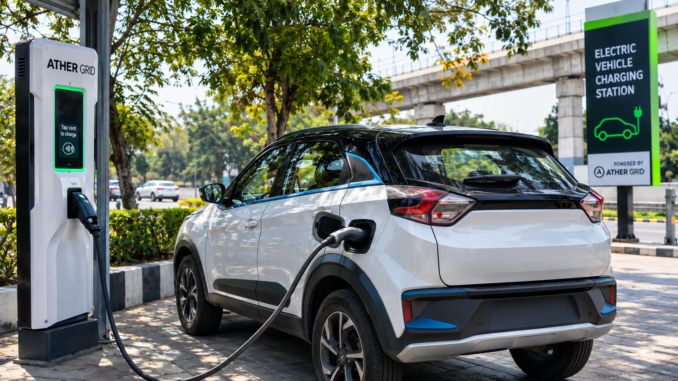
Nov 25: India’s electric vehicle market is gradually changing the way consumers approach car ownership. With rising interest in fuel-efficient transportation, increasing petrol expenses and a wider selection of electric cars, more buyers are considering whether switching to an electric vehicle makes financial sense. This shift is also reflected in research by the Council on Energy, Environment and Water (CEEW), whose June 2025 study, What Drives Vehicle Ownership Costs in India?, examines the financial implications of owning electric and conventional vehicles across different Indian states. The study highlights how purchase prices, electricity tariffs, fuel expenses, maintenance, insurance and resale value influence the overall cost of vehicle ownership. Its findings indicate that electric cars can offer lower ownership costs than conventional alternatives in several states, although the financial advantage varies depending on local conditions.
The International Energy Agency (IEA), in its Global EV Outlook 2026, also reported that worldwide electric car sales exceeded 20 million in 2025, accounting for approximately one-quarter of new car sales. This growing adoption reflects the changing direction of the global automobile industry and the increasing availability of electric mobility options.
Electric cars are no longer limited to technology enthusiasts or early adopters. They are becoming an option for families, working professionals and daily commuters looking for lower running costs and a more convenient driving experience.
The ₹10 lakh to ₹20 lakh segment is particularly interesting because it offers several electric cars designed for everyday use, including electric SUVs and family-oriented models. However, the initial purchase price is only one part of the investment.
Charging expenses, battery performance, maintenance, insurance, depreciation and resale value all influence the actual return on investment (ROI).
So, are electric cars worth buying in India? A closer look at their five-year ownership costs can help buyers understand the financial benefits and limitations of making the switch.
Why Are More Buyers Considering Electric Cars?
One of the biggest reasons behind the growing interest in electric cars is the possibility of reducing everyday transportation expenses.
Unlike petrol and diesel vehicles, electric cars use rechargeable batteries to power their motors. They also have fewer moving mechanical components, which can reduce certain maintenance requirements.
Some of the key advantages include:
-
Lower running costs: Charging an electric car at home can be considerably cheaper than purchasing petrol.
-
Reduced maintenance: EVs do not require engine oil changes and have fewer conventional engine components.
-
Convenient charging: Owners with dedicated parking can charge their vehicles overnight.
-
Modern technology: Many electric cars offer connected features, digital displays and advanced safety equipment.
-
Environmental benefits: Electric cars have no tailpipe emissions, although their overall environmental impact also depends on electricity generation and battery manufacturing.
For people who commute regularly, these advantages can make electric cars an attractive alternative.
Electric Cars in the ₹10 Lakh to ₹20 Lakh Segment
The availability of electric cars across different price categories is giving Indian consumers more flexibility. Buyers looking for an everyday family vehicle can now consider several electric SUVs and practical passenger vehicles.
Some models worth comparing include:
-
Tata Nexon EV
-
MG Windsor EV
-
Maruti Suzuki e Vitara
-
VinFast VF 6
-
Tata Curvv EV
These vehicles offer different combinations of driving range, cabin space, battery capacity and technology. Buyers should compare the actual variant prices, battery warranties, charging capabilities and real-world range before making a decision.
Five-Year Cost of Ownership: Electric Car vs Petrol Car
The real financial advantage of an electric car becomes clearer when its expenses are examined over several years rather than just one month or one year.
Consider a buyer who travels approximately 12,000 kilometres annually and plans to keep the vehicle for five years.
For this comparison, assume:
-
Petrol car efficiency: 12 km per litre.
-
Electric car efficiency: 6 km per kWh.
-
Petrol price: ₹105 per litre.
-
Electricity tariff: ₹9 per kWh.
-
Additional upfront cost of the EV: ₹2 lakh.
Five-year energy expenditure
| Expense | Petrol car | Electric car |
|---|---|---|
| Annual distance | 12,000 km | 12,000 km |
| Five-year distance | 60,000 km | 60,000 km |
| Annual energy expense | ₹1,05,000 | ₹18,000 |
| Five-year energy expense | ₹5,25,000 | ₹90,000 |
Potential five-year energy savings
₹4.35 lakh
Illustrative calculation based on assumed petrol and electricity prices and vehicle efficiencies.
If the electric car costs ₹2 lakh more initially, the buyer could have an estimated ₹2.35 lakh advantage after accounting for the additional purchase cost and five years of energy savings.
This is before considering maintenance differences, insurance, financing, charging equipment and resale value.
The calculation demonstrates why EV ownership can become financially attractive for people who drive regularly.
Depreciation and Resale Value: What Should EV Buyers Expect?
Depreciation is an important factor that buyers sometimes overlook when calculating the ROI of electric cars.
Every vehicle loses value over time, but electric cars have additional factors that can influence their resale prices. Battery condition, remaining warranty, driving range and improvements in newer EV models can all affect what a second-hand buyer is willing to pay.
For example, a vehicle with a healthy battery, complete service history and transferable battery warranty may be more attractive in the used-car market.
Before purchasing an electric car, buyers should consider:
-
Battery health and available diagnostic reports.
-
Remaining battery and vehicle warranty.
-
Availability and cost of replacement components.
-
Demand for the particular model in the used-car market.
-
Expected improvements in battery technology.
-
Manufacturer support and availability of servicing facilities.
There is no single reliable depreciation rate applicable to every electric car. Buyers should avoid assuming that an EV will retain the same percentage of its original value as a petrol vehicle.
For a more accurate five-year ROI calculation, estimated resale value should be deducted from the total purchase and ownership expenses.
Battery Performance and Replacement Costs
The battery is arguably the most important component influencing the long-term economics of an electric car.
Modern EV batteries are designed to operate for several years, but their capacity gradually declines with use and repeated charging cycles. Battery performance can also be influenced by temperature, charging habits and vehicle usage.
Buyers should pay attention to:
-
Battery warranty duration and kilometre limits.
-
Conditions covering battery capacity degradation.
-
Availability of battery diagnostics.
-
Manufacturer support for battery repairs.
-
Replacement costs and availability of battery components.
A longer warranty and a well-established service network can provide greater confidence when purchasing an electric vehicle.
Home Charging vs Public Charging: Which Is More Economical?
Charging arrangements can have a direct impact on the ROI of an electric car.
Home charging is generally more economical and convenient for people with dedicated parking. Owners can charge their vehicles overnight and avoid making frequent trips to charging stations.
Public charging, particularly DC fast charging, can be useful during long journeys. However, commercial charging tariffs can be higher than residential electricity rates.
| Factor | Home charging | Public charging |
|---|---|---|
| Cost | Generally lower | Depends on charging provider |
| Convenience | Suitable for overnight charging | Requires visiting a charging station |
| Charging speed | Depends on installed charger | DC fast charging can be quicker |
| Best suited for | Daily commuting | Long-distance journeys |
For buyers without dedicated parking, charging accessibility should be evaluated before purchasing an electric car.
India’s Electric Car Market Is Expanding
The increasing interest in electric cars is reflected in India’s passenger vehicle sales.
According to the Federation of Automobile Dealers Associations (FADA), electric passenger vehicle retail sales reached 1,99,923 units in FY2026, compared with 1,08,873 units in FY2025. This represented year-on-year growth of 83.63%.
Tata Motors, JSW MG Motor India and Mahindra were among the leading manufacturers in the electric passenger vehicle segment.
The growth indicates that electric cars are gradually gaining acceptance among Indian consumers. Manufacturers are also expanding their product portfolios, giving buyers more options across different vehicle categories and price ranges.
Is an Electric Car Worth Buying in India?
The decision ultimately depends on how frequently the vehicle is used and how easily it can be charged.
Electric cars can be particularly attractive for:
-
Daily commuters travelling substantial distances.
-
Families with access to home charging.
-
Buyers planning to retain their vehicles for five years or longer.
-
Consumers looking to reduce monthly transportation expenses.
-
People whose regular journeys are covered by the available charging network.
On the other hand, buyers who travel occasionally, depend entirely on public charging or frequently undertake long-distance journeys should examine the practical and financial implications carefully.
An electric car is not automatically cheaper for every household. The purchase price, financing, charging arrangements and expected resale value all influence the final outcome.
The Future of Electric Car Ownership in India
India’s electric vehicle industry is moving towards a more competitive market, with manufacturers investing in battery technology, vehicle platforms, charging infrastructure and customer services.
The ₹10 lakh to ₹20 lakh segment is particularly important because it gives a wider group of consumers access to electric mobility. As more models become available, buyers can compare vehicles based on affordability, driving range, safety and long-term operating expenses.
For automobile manufacturers, the challenge will be to make electric cars more accessible while improving battery reliability, charging convenience and after-sales support.
For consumers, the opportunity lies in looking beyond the initial purchase price and understanding the complete economics of vehicle ownership.
Electric cars are increasingly becoming a practical alternative to petrol and diesel vehicles. Their long-term financial value will depend on how effectively lower running costs balance the initial investment, depreciation and other ownership expenses.
