
In the business world, success is often measured by revenue, profit and market performance. Investors celebrate companies that report strong earnings, while business owners focus on expanding sales and attracting new customers. But there is another important question that deserves attention: how financially healthy is the company behind those numbers?
A business may generate impressive revenue and still struggle to pay its bills. It may report profits while carrying a heavy debt burden or facing a shortage of cash. This is why understanding a company’s financial position is just as important as knowing how much it earns.
One of the best ways to assess this position is through its balance sheet. Often seen as a technical accounting document, a balance sheet is actually a useful guide to understanding a company’s financial strength. It tells the story of what a business owns, what it owes and how much value remains for its shareholders.
For investors, entrepreneurs and business professionals, learning to read a balance sheet can make financial information easier to understand and business decisions more informed.
What Does a Balance Sheet Really Tell You?
A balance sheet is a financial statement that presents a company’s financial position on a particular date. Unlike an income statement, which records performance over a period, a balance sheet provides a snapshot of the business at a specific point in time.
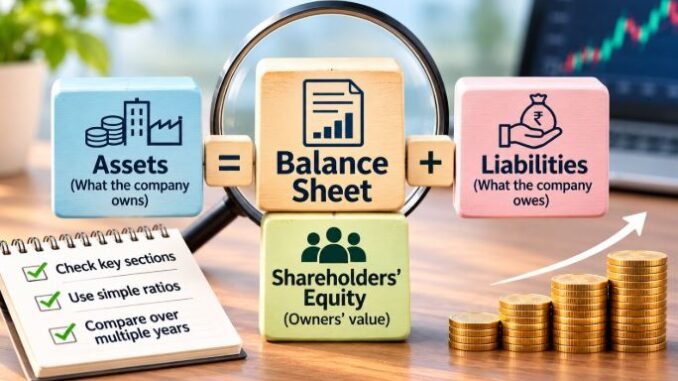
It is built around one fundamental accounting equation:
Assets = Liabilities + Shareholders’ Equity
The equation is simple. Everything a company owns is financed either through money borrowed from others or through funds contributed and retained for its owners.
For example, if a company has assets worth ₹100 crore and liabilities of ₹60 crore, its shareholders’ equity is ₹40 crore.
This basic relationship is the starting point for understanding the financial structure of any business.
Start With What the Company Owns
The first section to examine is assets. These are the resources a company owns or controls and uses to run its operations, generate income and support future growth.
Assets are generally divided into two categories.
Current assets include resources that are expected to be converted into cash, sold or used within the normal operating cycle, generally within 12 months. These include cash and bank balances, short-term investments, inventory and money customers owe the company.
Non-current assets are resources held for longer periods. They include land, buildings, machinery, equipment, long-term investments, patents and other intangible assets.
But a large asset base does not automatically mean a company is financially strong. Investors should also consider the quality of those assets.
For instance, a business with substantial cash reserves may be in a better position to meet immediate expenses than one whose assets are mostly tied up in buildings, machinery or unsold inventory. Similarly, a rise in customer payments due may indicate growing sales, but it could also point to delays in collecting money.
The important question is not simply how much a company owns, but how effectively it can use those resources.
Look Beyond the Debt: What Does the Company Owe?
The next step is to examine liabilities. These represent the financial obligations a company must pay to banks, suppliers, employees and other parties.
Current liabilities include short-term loans, payments due to suppliers, outstanding expenses and other obligations generally payable within 12 months or the normal operating cycle.
Non-current liabilities include long-term borrowings, bonds, deferred tax liabilities and other obligations due over a longer period.
Debt is not always a warning sign. Many successful companies borrow money to expand operations, purchase equipment, enter new markets or invest in technology. When borrowing supports profitable growth, it can be a useful business tool.
However, excessive debt can become a burden. Rising interest payments may reduce profits, while large repayment obligations can put pressure on cash flow.
Investors should therefore examine whether the company is using borrowed money productively and whether its earnings and cash generation are sufficient to meet its obligations.
Shareholders’ Equity: Understanding the Company’s Net Worth
Shareholders’ equity represents the value left for the owners after all liabilities are deducted from total assets.
It generally includes share capital, reserves and retained earnings. Retained earnings are profits that a company keeps in the business instead of distributing them entirely as dividends.
A growing equity base can indicate that a company is building financial strength through retained profits and additional investment. It can also provide a stronger foundation for future expansion.
However, equity should not be judged by its size alone. Investors should understand how it has changed over time and whether the company is generating sustainable profits.
Three Financial Checks Every Reader Should Know
A balance sheet contains many figures, but a few basic financial ratios can help readers understand the company’s position more clearly.
1. Current Ratio: Can the Company Pay Its Short-Term Bills?
The current ratio compares current assets with current liabilities.
Formula: Current Assets ÷ Current Liabilities
It indicates whether a business has sufficient short-term resources to meet its immediate obligations. A stronger ratio may suggest better liquidity, although the ideal level depends on the industry. A very high ratio may also indicate that resources are not being used efficiently.
2. Debt-to-Equity Ratio: How Much Does the Company Depend on Borrowing?
This ratio compares a company’s total debt with shareholders’ equity.
Formula: Total Debt ÷ Shareholders’ Equity
It helps investors understand how much of the business is financed through borrowing. A high ratio can indicate greater financial risk, but debt levels should always be compared with industry standards and the company’s ability to generate cash.
3. Working Capital: Does the Business Have Room to Operate?
Working capital is the difference between current assets and current liabilities.
Formula: Current Assets − Current Liabilities
It provides an idea of the resources available to manage everyday business activities, including paying suppliers, managing inventory and meeting operating expenses.
Why One Year’s Numbers Are Never Enough
A single balance sheet can offer useful information, but it cannot explain the complete financial journey of a company. The real picture becomes clearer when figures are compared over two or three years.
Are cash reserves increasing? Is the company borrowing more every year? Are customers taking longer to pay? Is inventory growing faster than sales?
These trends can reveal whether a business is becoming financially stronger or gradually facing pressure.
Comparing a company with others in the same industry is equally important. A manufacturing company, for example, may naturally have more machinery and inventory than a technology services business. Financial ratios and asset levels must therefore be understood in the context of the industry.
The Small Details That Can Make a Big Difference
One part of the balance sheet that readers should never overlook is the notes to accounts. These provide additional information about borrowings, asset values, accounting policies, legal disputes, guarantees and other financial commitments.
Some risks may not be immediately visible in the main financial statement. A company, for instance, may have pending legal cases or guarantees that could create financial obligations in the future.
Reading these notes gives investors a more complete understanding of the company’s financial position and helps them avoid relying only on headline figures.
Why Balance Sheets Matter Beyond the Stock Market
Understanding a balance sheet is not just for investors. It plays an important role in everyday business decisions.
Banks and financial institutions examine company balance sheets before approving loans. They want to know whether a business has enough financial strength to repay borrowed money.
Suppliers may review a company’s financial position before offering credit, while business owners use balance sheets to manage working capital, plan expansion and control debt.
For entrepreneurs, a regular review can highlight cash shortages, rising liabilities and inefficient use of resources before they become serious problems.
For investors, it can help identify businesses with manageable debt, sound liquidity and a stable financial foundation.
The Bigger Picture: Never Judge a Business by Profit Alone
A company’s success cannot be measured by revenue or profit figures alone. Strong sales may attract attention, but financial stability depends on how well a business manages its assets, controls its liabilities and uses its resources.
A balance sheet helps bring these elements together. It reveals whether a company has the capacity to meet its commitments, withstand difficult periods and invest in future opportunities.
For anyone looking to understand the real strength of a business, the balance sheet is more than an accounting statement. It is a window into the company’s financial discipline, management decisions and long-term sustainability.
The most successful businesses are not simply those that earn more; they are those that manage what they earn wisely, borrow responsibly and build lasting financial strength. Learning to read a balance sheet is one of the first steps towards recognising that difference.
