
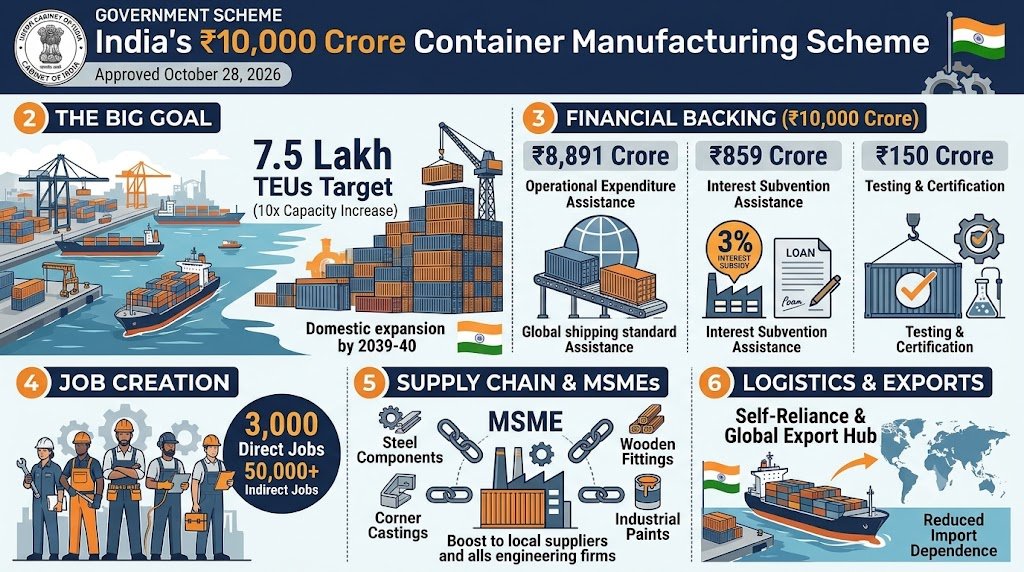
India is taking a major step towards strengthening its manufacturing and logistics industries with a ₹10,000 crore container manufacturing scheme. Approved by the Union Cabinet on October 28, 2026, the initiative aims to expand domestic production, reduce dependence on imported shipping containers and create new employment opportunities. The move comes at a time when reliable supply chains are essential for businesses competing in domestic and international markets.
While shipping containers may appear to be a small part of global trade, they play a vital role in moving everything from industrial equipment and textiles to food products and consumer goods. By encouraging local manufacturing, India aims to build a stronger industrial base, support smaller businesses and improve the efficiency of its trade network.
Building a Stronger Manufacturing Industry
The India container manufacturing scheme has a total outlay of ₹10,000 crore and will run until the financial year 2039–40. Its main objective is to increase annual domestic manufacturing capacity nearly tenfold, reaching up to 7.5 lakh twenty-foot equivalent units (TEUs).
At present, dependence on imported containers can expose businesses to international supply disruptions, changing prices and equipment shortages. Expanding local production could help improve availability and provide greater flexibility to shipping companies, exporters and logistics operators.
The initiative also reflects a broader effort to strengthen India’s domestic manufacturing capabilities and make industrial supply chains more resilient.
New Opportunities for MSMEs and Suppliers
The impact of the scheme could extend well beyond container manufacturing plants. Producing shipping containers requires a wide network of suppliers, including businesses that manufacture specialised steel components, corner castings, wooden fittings, industrial paints and other materials.
This creates potential opportunities for micro, small and medium enterprises (MSMEs) to become part of expanding industrial supply chains. Engineering firms, fabrication units, transport operators and maintenance providers could also benefit from increased demand.
For smaller businesses, working with larger manufacturers can open access to new customers and encourage investment in machinery, skills and production quality. However, the scale of these benefits will depend on how effectively MSMEs can meet industry standards and compete on cost.
Government Incentives to Encourage Investment
The scheme includes financial support designed to help manufacturers establish new facilities and expand existing operations.
Interest Subvention Assistance has an allocation of ₹859 crore and offers a three-percentage-point annual interest subsidy on eligible term loans for new manufacturing facilities and capacity expansion.
Operational Expenditure Assistance accounts for ₹8,891 crore and aims to support eligible containers manufactured to global shipping standards and sold by participating manufacturers. Another ₹150 crore has been allocated for testing and certification assistance.
These measures are intended to reduce investment barriers, improve the competitiveness of Indian-made containers and help manufacturers meet international requirements. The availability of testing facilities could also support quality improvement and make it easier for domestic producers to serve global customers.
Employment and Industrial Growth
The government estimates that the scheme could generate around 3,000 direct jobs and more than 50,000 indirect jobs.
Direct employment could arise in manufacturing, engineering, quality control and production management. Indirect opportunities may develop in raw material processing, component production, transportation, warehousing and equipment maintenance.
As manufacturing activity expands, businesses operating around industrial clusters could also see increased demand for their services. This can help spread the economic benefits beyond large factories to smaller suppliers and local service providers.
The development of specialised manufacturing skills could further strengthen India’s industrial workforce and create opportunities for technical training.
Strengthening Logistics and Exports
Efficient logistics are essential for businesses seeking to reduce costs and deliver products on time. Exporters depend on the availability of shipping containers to move goods across international markets, while shipping companies need reliable equipment to manage cargo efficiently.
By increasing domestic production, India aims to reduce its dependence on imported containers and improve the resilience of its logistics network. A stronger manufacturing base could help businesses respond more effectively to supply disruptions and changing trade requirements.
The scheme also aims to position India as a potential global export hub for quality shipping containers. Reaching this goal will require competitive pricing, consistent product quality, efficient production and strong relationships with international shipping companies.
If domestic manufacturers can meet these requirements, the industry could create additional opportunities for investment and exports.
What It Means for India’s Economic Growth
The scheme has the potential to support economic activity across several connected industries. Investment in manufacturing facilities can create demand for machinery, steel, industrial components and technical services. New jobs can support household incomes, while additional orders may help smaller businesses expand their operations.
Reducing dependence on imported containers could also improve supply-chain security. However, the overall effect on import costs and the trade balance will depend on domestic production costs, the use of imported raw materials and the future performance of Indian manufacturers in export markets.
For the initiative to deliver lasting benefits, businesses will need access to skilled workers, reliable infrastructure, affordable financing and efficient transportation networks.
Challenges Ahead
Despite its potential, the scheme faces important challenges. Indian manufacturers will need to compete with established international producers on price, quality and production scale. Changes in steel prices, energy costs and financing expenses could also affect profitability.
Smaller suppliers may need to invest in technology, workforce training and quality certification to participate in the expanding industry. Coordination between manufacturers, ports, shipping companies and logistics operators will be equally important.
The success of the initiative will ultimately depend on whether government support translates into sustainable private investment, commercially viable production and long-term demand for Indian-made containers.
Conclusion
India’s ₹10,000 crore container manufacturing scheme represents an important opportunity to strengthen domestic industry and build a more resilient logistics network. By encouraging investment, supporting suppliers and creating employment opportunities, the initiative could deliver benefits across manufacturing, transportation and international trade.
For MSMEs, the scheme could open doors to new industrial supply chains, while exporters and logistics companies may benefit from a stronger domestic source of shipping containers. Its long-term contribution, however, will depend on the industry’s ability to produce high-quality containers at competitive prices.
If these goals are achieved, container manufacturing could become a valuable contributor to India’s manufacturing ambitions, export competitiveness and broader economic growth.
